शास्त्र विंग · वाद्य-पट्टिका · Instrument Plate
सरस्वती वीणा
Saraswati Veena
अन्य नामसरस्वती वीणा · रघुनाथ वीणा (Raghunatha Veena) · तंजावुर वीणा (Tanjore Veena) · मैसूर वीणा (Mysore Veena)
परिचय
Overviewसरस्वती वीणा दक्षिण भारत के कर्नाटक संगीत का मुकुट-रत्न है — एक ही कटहल-लकड़ी से तराशा विशाल तंत्री-वाद्य, जिसकी दांडी पर 24 स्थिर पर्दे और सिरे पर यालि का अलंकरण होता है। इसकी गहरी, गूंजती ध्वनि चौड़ी मेरु घोड़ी से आती है, और तार को खींचकर उत्पन्न गमक इस पर जीवन-सा तैरता है। देवी सरस्वती के हाथ की यही वीणा विद्या, कला और शास्त्रीय गरिमा का पर्याय है।
अंग्रेज़ी में पढ़ें · Read in English
The Saraswati veena is the crown jewel of the Carnatic music of South India — a large string instrument carved from a single block of jackwood, its neck carrying 24 fixed frets and its head crowned with a yali. Its deep, resonant tone flows from the broad meru bridge, and the string-bent gamaka floats over it like life. This very veena in the hand of goddess Saraswati is a byword for learning, art and classical dignity.
वर्गीकरण
ClassificationNatya Shastra Category
तत (Tata - stringed instruments)
तत वर्ग में सरस्वती वीणा एक 'तंत्री वाद्य' है जिसकी ध्वनि तारों को अंगुली या मिज़राब से झंकृत (plucked) करने से उत्पन्न होती है। नाट्यशास्त्र में 'वीणा' शब्द ही समस्त तंत्री वाद्यों का मूल नाम है, और सरस्वती वीणा उस प्राचीन परंपरा की जीवंत प्रतिनिधि है।
In the Tata (stringed) category of the Natya Shastra, the Saraswati veena is a plucked chordophone whose sound is produced by plucking the strings with the fingers or wire plectrums. In the treatises the very word 'veena' is the ancestral name for all string instruments, and the Saraswati veena is the living representative of that ancient lineage.
Western Category
Plucked string instrument (fretted long-necked lute)
Western Family
Lute family (analogous to the sitar of North India, but with fixed frets and no sympathetic strings)
Sub Classification
बनावट
PhysicalDescription Hindi
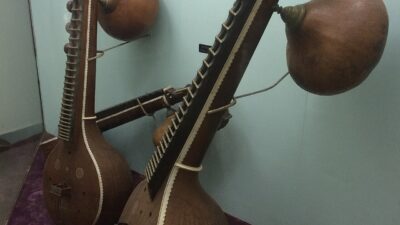
सरस्वती वीणा लगभग 1.4–1.5 मीटर लंबा एक भव्य तंत्री वाद्य है, जो परंपरागत रूप से एक ही कटहल (हलसु/पनस) की लकड़ी के खंड से तराशा जाता है। इसमें एक बड़ा गोल अनुनादक कुंड (कुडम), एक लंबी खोखली दांडी (गर्दन) जिस पर 24 स्थिर पर्दे (frets) मोम में जड़े होते हैं, दांडी के सिरे पर नीचे मुड़ा हुआ यालि (ड्रैगन/मकर) का अलंकरण, और उसके नीचे एक द्वितीयक तूँबा (सुरक्कई) होता है जो आधार व अनुनाद देता है।
Description English
The Saraswati veena is a majestic string instrument roughly 1.4–1.5 m long, traditionally carved from a single block of jackwood (halasu / panasa). It has a large rounded resonating gourd (kudam), a long hollow neck (dandi) carrying 24 fixed frets set in wax, a downward-curving yali (dragon/makara) carving at the head of the neck, and a secondary gourd (surakkai) beneath it that provides support and additional resonance.
Body
Large rounded resonator (kudam) with a long fretted neck and a downward yali (dragon-head) scroll
बड़ा गोल अनुनादक कुडम, लंबी पर्देदार दांडी और सिरे पर नीचे झुका यालि (मकर-मुख) अलंकरण
Jackwood (Artocarpus / halasu-panasa); the finest instruments are 'ekanda' — resonator, neck and yali carved from ONE block
कटहल की लकड़ी (हलसु/पनस); श्रेष्ठतम वीणाएँ 'एकंड' कहलाती हैं — कुडम, दांडी और यालि एक ही लकड़ी के खंड से तराशे जाते हैं
140-150
Main jackwood bowl (kudam) topped with a wooden sound-board; a second, smaller gourd (surakkai/tumba) at the neck-end adds resonance and rests on the player's knee
Strings
Four melody/playing strings running over the 24 frets, plucked by the right hand
Three side 'thala' (talam) strings — drone-cum-rhythm strings strung along the side of the neck over a curved secondary bridge, plucked by the right little finger to keep drone and tala
IMPORTANT DISTINCTION: the Saraswati veena has NO sympathetic (tarab) strings — unlike the sitar or sarangi. Its rich, sustaining, buzzing tone comes entirely from the flat wide bridge (meru) and the resonating jackwood body, not from resonating strings.
Plectrum
मिज़राब / नखी
Wire plectrums (mizrab / nakhi)
Curved wire plectrums worn on the right index and middle fingers (some artists pluck with bare fingertips)
The right index and middle fingers pluck the four main strings; the little finger strikes the three side thala strings for drone and rhythm. There is NO bow — the veena is entirely a plucked instrument (contrast the bowed sarangi).
Bridge
मेरु / कुदिरई (घोड़ी)
Meru / Kudirai (bridge)
A broad, flat metal bridge whose gently curved top surface makes each plucked string graze the bridge as it vibrates — producing the veena's signature buzzing, long-sustaining, humming tone (comparable to the 'javari' of the sitar and tanpura)
Brass or bell-metal, mounted on the wooden sound-board
Tuning Pegs
बिरडाई / खूँटी
Tuning pegs (birda)
Large wooden pegs at the head, near the yali, that tension the four main strings; smaller pegs on the side hold the three thala strings
Frets
सरस्वती वीणा में 24 स्थिर धातु-पर्दे (frets) होते हैं जो काले मोम-राल के बिस्तर में जड़े रहते हैं और ढाई सप्तक का पूर्ण वर्णक्रम (chromatic) देते हैं। सितार के चल पर्दों के विपरीत ये पर्दे स्थिर होते हैं; कर्नाटक संगीत की विशिष्ट गमक तार को पर्दे पर बग़ल में खींचकर उत्पन्न की जाती है।
The Saraswati veena has 24 FIXED metal frets embedded in a bed of hardened black wax-resin, giving a full chromatic scale over two and a half octaves. Unlike the sitar's movable frets these are fixed; the characteristic Carnatic gamaka (oscillation/glide) is produced by pulling the string sideways across a single fret to bend the pitch — the entire raga can be played from one fret position.
ध्वनि-चरित्र
SoundTonal Character Hindi
सरस्वती वीणा की ध्वनि गहरी, गोल, मखमली और लंबी-गूंजती होती है — एक ध्यानमग्न, शांत और गरिमामयी स्वर। मेरु घोड़ी के कारण प्रत्येक स्वर में एक कोमल झंकार (buzz) और लंबा सस्टेन रहता है, जिस पर तार को खींचकर की गई गमक तैरती है।
Tonal Character English
The Saraswati veena's tone is deep, round, velvety and long-sustaining — a meditative, serene and stately voice. Because of the meru bridge every note carries a soft buzzing halo and long sustain, over which the string-bending gamaka floats.
Timbre
Warm, sustained, gently buzzing (javari-like) resonance; darker and rounder than the sitar
Range
About two and a half octaves of fully chromatic pitches across the 24 fixed frets (Carnatic 3-sthayi range with string-pull)
Dynamic Range
Moderate to full — intimate and contemplative rather than piercing; naturally suited to slow, gamaka-rich elaboration
Techniques
सुनने का मार्गदर्शन
The Listening Guideसरस्वती वीणा का रस लेना हो तो किसी शांत क्षण में बैठिए और पहले आलापना सुनिए — बिना ताल के धीरे-धीरे खुलता राग। देखिए कैसे वादक एक ही पर्दे से तार खींचकर कई स्वरों तक पहुँचता है; यही गमक वीणा की आत्मा है। फिर तानम् की लयात्मक झंकार सुनिए, जहाँ ताल-तार मुख्य तारों के साथ गूँजते हैं। जयंती कुमरेश या ई. गायत्री की एकल प्रस्तुति से आरंभ कीजिए।
अंग्रेज़ी में पढ़ें · Read in English
To appreciate the Saraswati veena, sit in a quiet moment and first listen to an alapana — the raga unfolding slowly, without metre. Notice how the player reaches several notes by pulling the string across a single fret — this gamaka is the soul of the veena. Then hear the rhythmic pulse of tanam, where the thala strings ring against the melody strings. Begin with a solo by Jayanthi Kumaresh or E. Gayathri.
परिचय
Identity- Year Of Origin
- 1620
अन्य विवरण
More DetailsTimbre
Warm, sustained, gently buzzing (javari-like) resonance; darker and rounder than the sitar
रोचक तथ्य
Margin Notesसामान्य 'वीणा' से भिन्न विहित रूप — 'वीणा' प्राचीन ग्रंथों में समस्त तंत्री-वाद्यों का सामूहिक नाम था — रुद्र वीणा, विचित्र वीणा, चित्रा वीणा (गोट्टुवाद्यम), मोहन वीणा आदि इसी परिवार के सदस्य हैं। इनमें सरस्वती वीणा कर्नाटक संगीत की विहित (canonical) पर्देदार वीणा है, जिसे सामान्य 'वीणा' प्रविष्टि से अलग करके पहचाना जाना चाहिए।
In the ancient treatises 'veena' was a collective term for all string instruments — the rudra veena, vichitra veena, chitra veena (gottuvadyam) and mohan veena all belong to this family. Among them the Saraswati veena is the canonical fretted veena of Carnatic music, and deserves to be identified separately from the generic 'veena' entry.
यालि — मंगल का द्वारपाल — दांडी के सिरे पर नीचे झुका हुआ अलंकरण 'यालि' (या मकर) कहलाता है — एक पौराणिक सिंह-हाथी-जलजीव संयुक्त प्राणी जो दक्षिण भारतीय मंदिर-स्थापत्य में शुभ रक्षक माना जाता है। यह वीणा को केवल वाद्य नहीं, एक कलात्मक-धार्मिक कृति बना देता है।
The downward-curving carving at the head of the neck is the 'yali' (or makara) — a mythical lion-elephant-aquatic composite creature regarded as an auspicious guardian in South Indian temple architecture. It makes the veena not just an instrument but an artistic-religious object.
एक पर्दे से पूरा राग — कर्नाटक वीणा-वादन की सबसे विशिष्ट तकनीक यह है कि एक ही पर्दे पर तार को बग़ल में खींचकर पाँच स्वरों तक पहुँचा जा सकता है। इसीलिए गमक-प्रधान कर्नाटक राग वीणा पर स्वाभाविक रूप से खिलते हैं — हाथ को बार-बार पर्दे बदलने की आवश्यकता नहीं पड़ती।
The most distinctive technique of Carnatic veena playing is that from a single fret the string can be pulled sideways to reach as many as five notes. This is why gamaka-rich Carnatic ragas bloom naturally on the veena — the hand need not constantly shift frets.
दो घराने: तंजावुर और मैसूर — सरस्वती वीणा-वादन की दो प्रमुख शैलियाँ हैं — तंजावुर शैली (गमक की गहराई और गायकी-अंग पर बल) और मैसूर शैली (स्पष्ट, मधुर और तेज़ वादन)। दोनों शैलियों के अपने-अपने वीणा-निर्माण और ध्वनि-सौंदर्य हैं।
There are two principal schools of Saraswati veena playing — the Thanjavur style (emphasising depth of gamaka and a vocal 'gayaki' approach) and the Mysore style (clear, sweet and swifter playing). Each school has its own instrument-making and tonal aesthetic.
सवाल-जवाब
Questions & Answersसरस्वती वीणा क्या है?
सरस्वती वीणा दक्षिण भारत के कर्नाटक शास्त्रीय संगीत का प्रमुख पर्देदार तंत्री-वाद्य है। यह परंपरागत रूप से एक ही कटहल-लकड़ी से तराशा जाता है, इसमें 24 स्थिर पर्दे होते हैं, और इसका नाम विद्या व संगीत की देवी सरस्वती के नाम पर पड़ा है।
सरस्वती वीणा में कितने तार और पर्दे होते हैं?
सरस्वती वीणा में 4 मुख्य वादन तार और 3 पार्श्व 'ताल' (drone-cum-rhythm) तार, अर्थात कुल 7 तार होते हैं, तथा 24 स्थिर धातु-पर्दे होते हैं जो ढाई सप्तक का पूर्ण वर्णक्रम देते हैं। इसमें कोई तरब (अनुनाद) तार नहीं होता।
सरस्वती वीणा और सितार में क्या अंतर है?
सरस्वती वीणा कर्नाटक (दक्षिण) संगीत का वाद्य है जिसमें स्थिर पर्दे होते हैं और कोई तरब तार नहीं होता; सितार हिंदुस्तानी (उत्तर) संगीत का वाद्य है जिसमें चल पर्दे और अनेक तरब तार होते हैं। दोनों एक ही प्राचीन वीणा परंपरा की उत्तरी और दक्षिणी शाखाएँ हैं।
सरस्वती वीणा का देवी सरस्वती से क्या संबंध है?
विद्या, कला और संगीत की देवी सरस्वती को सदा वीणा-धारिणी रूप में चित्रित किया जाता है, इसीलिए उन्हें 'वीणापाणि' कहा जाता है और इसी वाद्य का नाम सरस्वती वीणा पड़ा। यह वीणा ज्ञान और कला की पवित्रता का प्रतीक है।
सरस्वती वीणा को इसका आधुनिक रूप कब मिला?
यद्यपि 'वीणा' प्राचीन ग्रंथों में उल्लिखित है, सरस्वती वीणा का वर्तमान रूप 17वीं शताब्दी में तंजावुर के शासक रघुनाथ नायक के दरबार में स्थिर हुआ; इसीलिए इसे 'रघुनाथ वीणा' भी कहते हैं। 24 स्थिर पर्दों की व्यवस्था का श्रेय उनके मंत्री गोविंद दीक्षित को जाता है।
नमूना-पट्टी
The Specimen Table| नाम | सरस्वती वीणा · Saraswati Veena |
|---|---|
| अन्य नाम | सरस्वती वीणा · रघुनाथ वीणा (Raghunatha Veena) · तंजावुर वीणा (Tanjore Veena) · मैसूर वीणा (Mysore Veena) · दक्षिणी वीणा (South Indian Veena) · Saraswati Veena (also: Sarasvatī Vīṇā) |
| उद्गम | 1620 |
| प्रकार | वाद्य · Instruments |
साझा कीजिए · Share this Plate