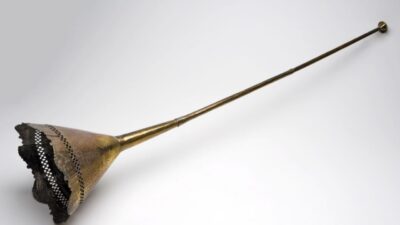
शास्त्र विंग · वाद्य-पट्टिका · Instrument Plate
नफ़ीर
Nafir
अन्य नामनफ़ीरी (ऐतिहासिक तुरही रूप — आधुनिक शहनाईनुमा नफ़ीरी से भिन्न) · नफ़र / नफ़ार (मग़रिबी उच्चारण) · Nafīr (also: Nafeer, Nafar, Nefir)
परिचय
Overviewनफ़ीर पीतल की एक सीधी, पतली प्राकृतिक तुरही है — न छेद, न वाल्व, केवल होंठ और साँस से बजने वाली, जो एक-दो तीखे स्वरों में राजसत्ता, विजय और समय की घोषणा करती है। फ़ारसी-अरबी युद्ध-बैंडों से चलकर यह दिल्ली सल्तनत और मुग़ल दरबार की 'नौबत' (नक़्क़ारा-ख़ाना) का सुर-वाद्य बनी, और आईन-ए-अकबरी में करना व सुरना के साथ दर्ज हुई। आज मोरक्को के रमज़ान 'नफ़ार' और बची-खुची नौबत परंपराओं में इसकी गूँज शेष है।
अंग्रेज़ी में पढ़ें · Read in English
The nafir is a straight, slender natural brass trumpet — no holes, no valves, sounded by lips and breath alone — that proclaims royalty, victory and the hours in one or two piercing notes. Travelling from Perso-Arabic war-bands, it became the pitched wind of the 'naubat' (naqqara-khana) at the Delhi Sultanate and Mughal courts, recorded in the Ain-i-Akbari alongside the karna and surna. Today its echo survives in Morocco's Ramadan 'nafar' and in vestigial naubat traditions.
वर्गीकरण
ClassificationNatya Shastra Category
सुषिर (Sushira - wind instruments)
नाट्यशास्त्र की चतुर्विध वाद्य-योजना में नफ़ीर 'सुषिर' (फूँक से बजने वाले) वर्ग में आता है — यह एक प्राकृतिक (वाल्व-रहित) धातु तुरही है जिसमें फूँक की गति और होंठों के दबाव से हार्मोनिक श्रेणी की एक या दो स्वर-ध्वनियाँ निकलती हैं।
In the Natya Shastra's fourfold instrument scheme, the nafir belongs to the 'Sushira' (blown/aerophone) category — a natural (valveless) metal trumpet in which lip pressure and breath speed produce one or two notes of the harmonic series.
Western Category
Natural (valveless) metal trumpet / aerophone
Western Family
Straight natural trumpet family (kin to the medieval European buisine, the Persian karna, and the Indian karnal/ransingha)
Sub Classification
बनावट
PhysicalDescription Hindi
नफ़ीर एक लंबी, सीधी, पतली धातु तुरही है — पीतल या ताँबे से गढ़ी हुई, जिसका बेलनाकार नाल (tube) अंत में एक तिकोनी घंटी (conical bell) में खुलता है। इसमें न कोई छेद होते हैं, न कोई वाल्व — यह एक 'प्राकृतिक तुरही' है जो केवल होंठों के कंपन और फूँक के दबाव से बजती है। मग़रिब (मोरक्को) के नमूने लगभग 110–150 सेंमी लंबे मिलते हैं और एक से तीन बेलनाकार खंडों को जोड़कर बनाए जाते हैं।
Description English
The nafir is a long, straight, slender metal trumpet — forged from brass or copper — whose cylindrical tube opens into a conical (funnel-shaped) bell. It has no finger-holes and no valves: it is a 'natural trumpet' sounded purely by the buzz of the lips and the pressure of the breath. Moroccan examples measure roughly 110–150 cm and are built from one to three cylindrical sections joined end to end.
Body
Long straight tube widening into a conical bell
लंबी सीधी नली जो अंत में तिकोनी घंटी में चौड़ी होती है
Brass or copper (historically also silver or iron in royal courts)
पीतल या ताँबा (राजदरबारों में कभी चाँदी या लोहा भी)
110-150
The full cylindrical air column itself resonates; the flared bell projects and brightens the sound outward
Tube
Predominantly cylindrical, flaring only near the bell
अधिकांशतः बेलनाकार, केवल घंटी के पास चौड़ाती हुई
1-3 telescoping/soldered cylindrical sections (approx. 1.6 cm outer diameter in Moroccan examples)
1 से 3 बेलनाकार खंड जोड़कर (मोरक्कन नमूनों में बाहरी व्यास लगभग 1.6 सेंमी)
सीधी नली नफ़ीर की पहचान है — यही इसे मुड़ी हुई या S-आकार वाली फ़ारसी 'करना' से अलग करती है।
The straight tube is the nafir's signature — it is what distinguishes it from the curved or S-shaped Persian 'karna'.
Bell
घंटी / मुख
Bell
Conical, funnel-shaped flare
Same metal as the tube (brass/copper)
Amplifies and brightens the tone, projecting the shrill signal over long distances
Mouthpiece
मुखनाल / फूँक-मुख
Mouthpiece
एक सादा कप या नाल-मुख जिस पर वादक होंठ रखकर कंपन (buzz) करता है; स्वर होंठों के दबाव व फूँक की गति से बदलते हैं।
A simple cup or tube-end against which the player buzzes the lips; pitch changes with lip tension and breath speed.
Valves And Holes
नफ़ीर में न वाल्व होते हैं, न छेद — यही 'प्राकृतिक तुरही' का अर्थ है। इसलिए यह पूर्ण राग नहीं बजा सकती; यह मूलतः एक या दो सशक्त स्वरों का संकेत-वाद्य है।
The nafir has neither valves nor holes — that is the meaning of a 'natural trumpet'. It therefore cannot play a full raga; it is essentially a signaling instrument of one or two powerful notes.
Frets
फ्रेट/छेद न होने के कारण नफ़ीर की स्वर-सीमा हार्मोनिक श्रेणी (मूल स्वर एवं उसके ओवरब्लो किए हुए स्वरांश) तक सीमित रहती है।
Having no frets or holes, the nafir's pitch range is limited to the harmonic series (its fundamental and overblown partials).
ध्वनि-चरित्र
SoundTonal Character Hindi
नफ़ीर की ध्वनि तीखी, भेदक और दूर तक गूँजने वाली है — युद्ध-मैदान, क़िले के प्रवेश-द्वार या दरबार की नौबत में इसे इसी कारण चुना गया। इसका स्वर उल्लास, गरिमा और चेतावनी—तीनों को एक साथ ढो सकता है।
Tonal Character English
The nafir's tone is shrill, penetrating and far-carrying — which is exactly why it was chosen for the battlefield, the fortress gateway, and the court naubat. Its sound can carry jubilation, majesty and alarm all at once.
Timbre
Bright, brassy, edgy and clarion; commanding rather than lyrical
Range
Very limited — essentially the fundamental and one or two overblown harmonics (one to two usable notes)
Dynamic Range
Loud to very loud by design; built to project over drums and crowds without amplification
Techniques
सुनने का मार्गदर्शन
The Listening Guideनफ़ीर को राग नहीं, घोषणा की तरह सुनिए। इसकी एक-दो सशक्त स्वरों की पुकार हवा को चीरती हुई दूर तक जाती है — नक़्क़ारे की थाप पर इसी सधी हुई गूँज को पहचानिए, यही नौबत की आत्मा है। मोरक्को के रमज़ान 'नफ़ार' में इसकी आदिम पीतली धार सबसे साफ़ खुलती है।
अंग्रेज़ी में पढ़ें · Read in English
To appreciate the nafir, listen to it not as a raga but as a 'proclamation'. Notice how one or two powerful notes cut through the air and carry into the distance. Pick out its steady call above the beat of the naqqara — that is the soul of the naubat. Listen to a recording of the Moroccan Ramadan 'nafar', where its raw brass edge is at its clearest.
परिचय
Identity- Year Of Origin
- 1300
अन्य विवरण
More DetailsTimbre
Bright, brassy, edgy and clarion; commanding rather than lyrical
रोचक तथ्य
Margin Notesनौबत बजाने का अधिकार = सत्ता — मध्यकालीन भारत में नौबत (नक़्क़ारा-ख़ाना) बजाने का अधिकार केवल बादशाह अपने चुने हुए अमीरों को प्रदान करता था। नफ़ीर की पुकार इसी सत्ता-प्रतीक का स्वर थी — इसे बजाना अपने आप में एक राजनीतिक घोषणा थी।
In medieval India the right to sound the naubat (naqqara-khana) was granted by the emperor only to chosen nobles. The nafir's call was a voice of this emblem of power — to sound it was in itself a political proclamation.
नौबत-ख़ाना: एक द्वार जो वाद्य के लिए बना — लाल क़िला (दिल्ली) एवं फ़तेहपुर सीकरी जैसे स्थलों पर 'नौबत-ख़ाना' या 'नक़्क़ार-ख़ाना' नामक विशेष द्वार-मंडप बनाया गया, जहाँ से नफ़ीर, करना और नक़्क़ारे दिन के नियत पहरों पर बजते थे।
At sites like the Red Fort (Delhi) and Fatehpur Sikri, a special gatehouse called the 'Naubat Khana' or 'Naqqar Khana' was built, from which the nafir, karna and naqqaras sounded at the fixed watches of the day.
सीधी नफ़ीर बनाम मुड़ी करना — नौबत में दो प्रकार की तुरहियाँ साथ बजती थीं — सीधी 'नफ़ीर' और लंबी, मुड़ी या S-आकार वाली 'करना'। दोनों प्राकृतिक तुरहियाँ थीं पर उनकी बनावट व ध्वनि-रंग भिन्न थे; नफ़ीर की धार अधिक तीखी और भेदक मानी जाती थी।
Two kinds of trumpet sounded together in the naubat — the straight 'nafir' and the long, curved or S-shaped 'karna'. Both were natural trumpets but differed in build and tone-colour; the nafir's edge was considered sharper and more piercing.
नाम की यात्रा: नफ़ीर से नफ़ार तक — इसी अरबी-फ़ारसी वाद्य-नाम की गूँज उत्तर अफ़्रीका में 'नफ़ार', भारत में 'नफ़ीर/नफ़ीरी' और मलय द्वीपसमूह की 'नोबत' परंपरा तक सुनाई देती है — एक ही तुरही की संस्कृतियों भर की यात्रा।
The echo of this Arabo-Persian instrument-name is heard as 'nafar' in North Africa, 'nafir/nafiri' in India, and in the 'nobat' tradition of the Malay Archipelago — one trumpet's journey across cultures.
सवाल-जवाब
Questions & Answersनफ़ीर क्या है?
नफ़ीर एक लंबी, सीधी, पतली धातु (पीतल/ताँबा) की प्राकृतिक तुरही है जो फ़ारसी-अरबी मूल की है। इसमें न छेद होते हैं, न वाल्व — यह केवल होंठों और फूँक से एक-दो तीखे स्वर बजाती है। यह मुग़ल एवं रियासती 'नौबत' (नक़्क़ारा-ख़ाना) वाद्यवृंद का संकेत-वाद्य थी।
नफ़ीर और नफ़ीरी में क्या अंतर है?
ऐतिहासिक 'नफ़ीर' एक लंबी सीधी धातु तुरही है जो होंठों से बजती है। आधुनिक 'नफ़ीरी' एक छोटी शहनाईनुमा दोहरी-रीड (सुषिर) वाद्य है जो फूँक से रीड कँपाकर बजती है। नाम में सगे हैं, वाद्य में भिन्न।
नफ़ीर का उपयोग किसमें होता था?
नफ़ीर मूलतः एक संकेत एवं घोषणा-वाद्य थी — युद्ध-मैदान के संकेत, शाही आगमन और विजय की घोषणा, तथा क़िले के नौबत-ख़ाना से दिन के नियत पहरों की सूचना। यह करना, सुरना और नक़्क़ारे के साथ नौबत में बजती थी।
क्या नफ़ीर राग बजा सकती है?
नहीं। नफ़ीर एक वाल्व-रहित प्राकृतिक तुरही है जो केवल हार्मोनिक श्रेणी के एक-दो स्वर बजा सकती है, अतः यह पूर्ण राग प्रस्तुत नहीं करती। इसका कार्य फ़ानफ़ार, संकेत और घोषणा है।
क्या नफ़ीर आज भी बजाई जाती है?
एक स्वतंत्र वाद्य के रूप में यह दुर्लभ है, पर लुप्त नहीं। मोरक्को में यह 'नफ़ार' के रूप में रमज़ान की सहरी-इफ़्तार घोषणा में आज भी जीवित है, और कुछ रियासती-धार्मिक जुलूसों तथा विश्व-संगीत कलाकारों के प्रयोग में सुनाई देती है।
नमूना-पट्टी
The Specimen Table| नाम | नफ़ीर · Nafir |
|---|---|
| अन्य नाम | नफ़ीरी (ऐतिहासिक तुरही रूप — आधुनिक शहनाईनुमा नफ़ीरी से भिन्न) · नफ़र / नफ़ार (मग़रिबी उच्चारण) · Nafīr (also: Nafeer, Nafar, Nefir) |
| उद्गम | 1300 |
| प्रकार | वाद्य · Instruments |
साझा कीजिए · Share this Plate