शास्त्र विंग · वाद्य-पट्टिका · Instrument Plate
नागफनी
Nagphani
अन्य नामनागफनी · नागफणी · नागफनि · Naagfani
परिचय
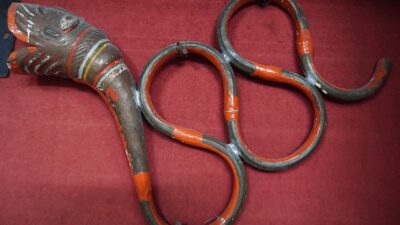
Overviewनागफनी ताँबे-काँसे में ढला वह दुर्लभ वाद्य है जिसे फन उठाए नाग के रूप में गढ़ा जाता है — मुँह से झाँकती चटख रँगी जीभ, फैला फन घंटी, और पूँछ का सिरा मुखनली। न तार, न स्वर-छिद्र; वादक के होंठों की फूँक ही इसमें एक लंबा, भेदता नाद भरती है। कुमाऊँ की पहाड़ियों से लेकर राजस्थान-गुजरात के मंदिर-मेलों और साधु-अखाड़ों तक, इसकी पुकार सदियों से देव-आह्वान और जन-समागम की ध्वनि रही है।
अंग्रेज़ी में पढ़ें · Read in English
The nagphani is a rare copper-and-bronze instrument shaped as a hooded serpent — a brightly painted tongue peering from its mouth, the flared hood forming the bell, and the tail-end serving as the mouthpiece. It has no strings and no finger-holes; the breath of the player's lips alone fills it with a long, piercing naad. From the hills of Kumaon to the temple fairs of Rajasthan and Gujarat and the sadhu-akharas, its call has for centuries been the sound of divine invocation and public gathering.
वर्गीकरण
ClassificationNatya Shastra Category
सुषिर (Sushira - wind / hollow instruments)
नागफनी नाट्यशास्त्र के 'सुषिर' वर्ग में आती है — वे वाद्य जिनमें ध्वनि हवा (फूँक) के प्रवाह से उत्पन्न होती है। इसमें कोई तार या ताल-झिल्ली नहीं होती; वादक के होंठों का कम्पन ही धातु की खोखली नली में गूँजकर स्वर बनाता है।
The nagphani belongs to the 'Sushira' (wind / hollow) class of the Natya Shastra — instruments whose sound is produced by a flow of air (breath). It has no strings or drum-skin; the buzzing of the player's lips resonating inside the hollow metal tube alone produces the tone.
Western Category
Natural lip-reed aerophone (valveless labrosone / 'natural horn')
Western Family
Horn / trumpet family (like the shofar, alphorn or serpent — a coiled metal horn sounded by lip vibration, with no valves or finger-holes)
Sub Classification
बनावट
PhysicalDescription Hindi
नागफनी एक ताँबे-काँसे की खोखली नली है जिसे किसी फन उठाए नाग के आकार में मोड़ा जाता है। पूँछ का सिरा मुखनली (मुखपत्र) होता है जहाँ वादक होंठ सटाकर फूँकता है, और नाग का फैला हुआ फन घंटी (बेल) बनता है जिससे ध्वनि बाहर निकलती है। मुँह के आगे एक चटख रंगों से रँगी धातु की दोफाड़ जीभ निकली रहती है — यही इसे साँप का रूप देती है। यह भारत के अन्य फूँक-वाद्यों (जैसे रणसिंगा या करना) से आकार में छोटी होती है।
Description English
The nagphani is a hollow copper-and-bronze tube bent into the shape of a hooded serpent. The tail end forms the mouthpiece, where the player presses the lips and buzzes, while the flared serpent's hood forms the bell from which the sound emerges. A forked metal tongue, painted in bright colours, juts out from the mouth — this is what gives it its snake form. It is smaller in size than India's other wind instruments (such as the ransingha or karna).
Body
Coiled/curved serpent form with a raised, flared hood as the bell
फन उठाए नाग जैसा मुड़ा हुआ रूप, जिसका फैला फन घंटी बनता है
Sheet copper and bronze (some examples in brass), hammered and joined
ताँबे और काँसे की चादर (कुछ में पीतल), पीटकर और जोड़कर बनाई गई
30-60 (smaller than the long straight horns)
The tapering hollow metal bore itself acts as the resonator, opening into the serpent-hood bell
Strings
The nagphani has no strings — it is a wind instrument; tone is produced by lip vibration into the metal bore
None — the nagphani is an aerophone with no sympathetic strings
The instrument's own long, held note acts as a drone-like ritual call rather than a melodic line
Bow
लागू नहीं
N/A
No bow — the nagphani is blown, not bowed
0
Sound is produced by buzzing the lips (like a bugle or shankha), not by a bow
Tuning Pegs
लागू नहीं
N/A
No tuning pegs — pitch is fixed by the length and bore of the metal tube and altered only by lip embouchure
Bridge
लागू नहीं
N/A
No bridge — this is a wind instrument, not a chordophone
N/A
Frets
नागफनी में न फ्रेट होते हैं, न स्वर-छिद्र। वादक केवल होंठों के दबाव (एम्बशर) और साँस की गति से स्वर को थोड़ा-बहुत बदल सकता है; मुख्यतः यह एक ही गूँजता स्वर देती है।
The nagphani has neither frets nor finger-holes. The player can vary the pitch only slightly through lip pressure (embouchure) and breath; essentially it sounds one resonant tone.
ध्वनि-चरित्र
SoundTonal Character Hindi
नागफनी की ध्वनि गहरी, कर्कश और दूर तक भेदती हुई होती है — एक लंबी, गूँजती पुकार जो पहाड़ी घाटियों और मंदिर-प्रांगणों में देर तक तैरती है। यह मधुर राग नहीं, बल्कि एक आध्यात्मिक 'नाद' है जो वातावरण को पवित्र और सजग कर देता है।
Tonal Character English
The nagphani's sound is deep, raucous and far-carrying — a long, droning call that hangs over hill valleys and temple courtyards. It is not sweet melody but a spiritual 'naad', a sound that sanctifies and awakens the surroundings.
Timbre
Brassy, buzzing, penetrating; a raw metallic blare rather than a refined melodic tone
Range
Very limited — the fundamental note and a small number of natural overtones (like a bugle)
Dynamic Range
Loud and commanding by nature; designed to carry across open valleys, processions and battlefields without amplification
Techniques
सुनने का मार्गदर्शन
The Listening Guideनागफनी सुनते समय धुन नहीं, वातावरण पकड़िए। यह मधुर राग का वाद्य नहीं, बल्कि 'नाद' का है। इसकी लंबी, कर्कश पुकार को ढोल-नगाड़े और शंख के साथ जुलूस की समवेत ध्वनि में सुनिए — तभी इसका असली अर्थ खुलता है: यह वाद्य कान को नहीं, आयोजन की आत्मा को संबोधित करता है।
अंग्रेज़ी में पढ़ें · Read in English
When listening to the nagphani, do not look for sweet melody — this is an instrument of 'naad', not of 'raga'. Feel its long, raucous, far-travelling call and picture a mist-filled hill valley or an incense-laden temple courtyard, where this sound tears through the air to summon the deity. It is most meaningful heard not alone but within the collective sound of a procession, alongside dhol-nagara and the conch.
परिचय
Identity- Year Of Origin
- 1800
अन्य विवरण
More DetailsTimbre
Brassy, buzzing, penetrating; a raw metallic blare rather than a refined melodic tone
रोचक तथ्य
Margin Notesनाम में छिपा साँप का फन — 'नाग' अर्थात् सर्प और 'फणी/फनी' अर्थात् फन — नागफनी यानी 'फन उठाए नाग'। वाद्य का पूरा शरीर इसी रूपक को साकार करता है: मुड़ी नली शरीर, फैला फन घंटी, और मुँह से निकली रँगी जीभ।
'Nag' means serpent and 'phani/phana' means hood — nagphani is 'the hooded serpent'. The instrument's whole body embodies this metaphor: the coiled tube is the body, the flared hood the bell, and the painted tongue juts from the mouth.
साधु और तंत्र का वाद्य — नागफनी मुख्यतः साधु-योगियों और तांत्रिक कर्मकांडियों का वाद्य रही है। साँप का शिव और शक्ति से गहरा संबंध इसे केवल संगीत का नहीं, बल्कि अनुष्ठान का उपकरण बनाता है।
The nagphani has been chiefly the instrument of sadhu-yogis and tantric ritualists. The serpent's deep link with Shiva and Shakti makes it not merely a musical device but an instrument of ritual.
सीमा-पार की परंपरा — नागफनी की परंपरा भारत तक सीमित नहीं। नेपाल में योगी इसे चांगु नारायण मंदिर की नित्य पूजा में, तथा स्वर्गद्वारी और गोसाईंकुंड के मेलों में बजाते हैं — हिमालय की साझा सांस्कृतिक धारा का प्रमाण।
The nagphani tradition is not confined to India. In Nepal, yogis sound it in the daily worship at the Changu Narayan temple and at the fairs of Swargadwari and Gosaikunda — evidence of the Himalaya's shared cultural stream.
बिना तार, बिना छिद्र का संगीत — अधिकांश भारतीय वाद्यों में तार, चाबियाँ या स्वर-छिद्र होते हैं जिनसे अलग-अलग स्वर निकाले जाते हैं। नागफनी में इनमें से कुछ नहीं — इसकी पूरी अभिव्यक्ति साँस और होंठों के दबाव पर टिकी है, इसलिए यह एक 'प्राकृतिक नरसिंगा' (natural horn) है।
Most Indian instruments have strings, keys or finger-holes to produce different notes. The nagphani has none of these — its entire expression rests on breath and lip pressure, making it a true 'natural horn'.
सवाल-जवाब
Questions & Answersनागफनी क्या है?
नागफनी एक दुर्लभ भारतीय फूँक-वाद्य है जिसे ताँबे और काँसे से फन उठाए नाग के आकार में बनाया जाता है। इसमें कोई तार या स्वर-छिद्र नहीं होते; वादक के होंठों के कम्पन से एक लंबा, भेदता नाद उत्पन्न होता है। यह मुख्यतः साधु-योगियों, तांत्रिक कर्मकांड और मंदिर-मेलों में बजाई जाती है।
नागफनी नाम का अर्थ क्या है?
'नाग' का अर्थ है सर्प और 'फणी/फनी' का अर्थ है साँप का फन। इस प्रकार नागफनी का अर्थ है 'फन उठाए नाग' — जो इसके सर्प-आकार को दर्शाता है।
नागफनी कहाँ की परंपरा है?
नागफनी मुख्यतः कुमाऊँ (उत्तराखंड), राजस्थान और गुजरात की मंदिर एवं साधु परंपराओं से जुड़ी है। यह नेपाल की मंदिर-योगी परंपराओं (चांगु नारायण, स्वर्गद्वारी, गोसाईंकुंड) में भी बजाई जाती है।
क्या नागफनी से राग बजाए जाते हैं?
नहीं। नागफनी एक प्राकृतिक नाद-वाद्य है, राग-वाद्य नहीं। इसमें स्वर-छिद्र या तार न होने के कारण यह मुख्यतः एक गूँजता स्वर और उसके कुछ अनुनाद-स्वर देती है, जिसका उपयोग देव-आह्वान, जुलूस और आरती के लिए होता है, न कि राग-विस्तार के लिए।
नागफनी की असली तस्वीर कहाँ देखी जा सकती है?
19वीं सदी की नागफनियाँ उदयपुर के भारतीय लोक कला मंडल संग्रहालय और न्यूयॉर्क के मेट्रोपॉलिटन म्यूज़ियम ऑफ़ आर्ट में संरक्षित हैं। इनकी तस्वीरें विकिमीडिया कॉमन्स पर भी उपलब्ध हैं।
नमूना-पट्टी
The Specimen Table| नाम | नागफनी · Nagphani |
|---|---|
| अन्य नाम | नागफनी · नागफणी · नागफनि · Naagfani · Naagphani · Nagfani |
| उद्गम | 1800 |
| प्रकार | वाद्य · Instruments |
साझा कीजिए · Share this Plate