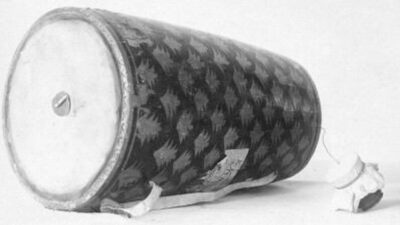
शास्त्र विंग · वाद्य-पट्टिका · Instrument Plate
खमक
Khamak
अन्य नामआनंदलहरी (Anandalahari) · गुबगुबी (Gubgubi) · गुबगुबा (Gubguba) · जमुकु (Jamuku)
परिचय
Overviewखमक भारत का सबसे विरोधाभासी वाद्य है — देखने में ढोल, पर वर्गीकरण में तार। बगल में दबे कटोरे से निकला तार हत्थे के तनाव पर झूमता है और 'गुब-गुब' करती एक बोलती-सी आवाज़ जन्म लेती है। शास्त्रीय नाम 'आनंदलहरी' (आनंद की लहरें) इसकी लोक-पहचान 'गुबगुबी' से मेल खाता है। एकतारा के साथ यह जोड़ी बाउल फकीर की आत्मा का साज़ है।
अंग्रेज़ी में पढ़ें · Read in English
The khamak is India's most paradoxical instrument — a drum to the eye, a string by classification. The string rising from a bowl tucked under the arm sways to the tension of a handle, and a talking 'gub-gub' voice is born. Its classical name 'anandalahari' (waves of joy) meets its folk identity as 'gubgubi'. Paired with the ektara, it is the instrument of the Baul fakir's soul.
वर्गीकरण
ClassificationNatya Shastra Category
तत (Tata - stringed instruments)
देखने में यह अवनद्ध (चर्म-मढ़ा ढोल) जैसा लगता है, किंतु इसकी मुख्य ध्वनि तार को झँकारने से उत्पन्न होती है — इसलिए नाट्यशास्त्र के अनुसार खमक 'तत' (तार) वर्ग का वाद्य है। इसे 'नुची हुई ढोल' (plucked drum) यानी परिवर्तनशील-तनाव वाला तत-वाद्य कहा जाता है।
Although it looks like an avanaddha (skin-covered drum), its principal sound is produced by plucking a string — so by Natya Shastra classification the khamak belongs to the Tata (stringed) category. It is a 'plucked drum', that is, a variable-tension chordophone.
Western Category
Variable-tension plucked chordophone (plucked drum)
Western Family
Plucked-drum family shared with the ektara, dotara and gopichand; unlike a talking drum, pitch is bent by tensioning a string rather than a membrane
Sub Classification
बनावट
PhysicalDescription Hindi
खमक एक अनोखा 'नुची हुई ढोल' है — एक छोटा कटोरे जैसा अनुनाद-पात्र जिसका मुँह चमड़े से मढ़ा होता है, और उसमें से एक तार निकलकर वाद्य के भीतर से होते हुए एक छोटे हत्थे (लकड़ी या पीतल के टुकड़े) से बँधा होता है। वादक इसे बगल में दबाकर, हत्थे को खींचकर तार का तनाव बदलता है और दूसरे हाथ से तार को झँकारता है।
Description English
The khamak is a singular 'plucked drum' — a small bowl-shaped resonator whose mouth is covered with a leather membrane, through which a string passes down inside the body to be fixed to a small handle (a piece of wood or brass). The player tucks the bowl under the arm, varies the string's tension by pulling on the handle, and plucks the string with the other hand.
Body
Small bowl / pot-shaped resonator (drum-like)
छोटा कटोरा या घड़े जैसा अनुनाद-पात्र (ढोल-सदृश)
Turned wood (common), or earthenware/clay, metal (copper/brass), or dried gourd
खरादी लकड़ी (सामान्यतः), या मिट्टी, धातु (ताँबा/पीतल), अथवा सूखा तुम्बा (लौकी)
20-28
Single open-bottomed bowl closed at the top by a stretched leather/parchment head that both radiates sound and anchors the string
Strings
The playing string(s) pierce the leather head, run down through the hollow body, and tie off at the movable handle; plucking them while flexing the tension gives the khamak its sliding, talking pitch
The khamak has NO sympathetic (tarab) strings — its shimmer comes entirely from the membrane and the bent playing string, not from resonating drone strings
No separate drone strings; the ektara or a tanpura often supplies the drone while the khamak provides rhythm-melody
Bow
मिज़राब / जवा (कील या प्लेक्ट्रम)
Plectrum / pin (java)
Small pin, plectrum, or the bare finger used to strike/pluck the string
N/A
The khamak is NOT bowed — the string is struck or plucked with a pin/plectrum in one hand while the other hand pulls the handle to slide the pitch
Tuning Pegs
हत्था (चल-मुठिया)
Handle (movable grip)
Instead of pegs, tuning happens in real time: the small wood/brass handle to which the string is tied is pulled harder or softer to raise or lower the pitch on every stroke
Bridge
चर्म-झिल्ली (मुँह)
Membrane head
The leather/parchment head itself acts as the vibrating surface and string anchor, transmitting the plucked string's energy into the bowl resonator
Goat or other animal skin / parchment
Frets
खमक में न फ्रेट होते हैं, न बाँस की डंडी (जैसी एकतारा में होती है) — पूरी स्वर-यात्रा केवल हत्थे के तनाव से नियंत्रित होती है, जो इसे असीम मींड (ग्लिसांडो) की क्षमता देती है।
The khamak has neither frets nor a bamboo splint (as the ektara does) — the entire pitch journey is controlled purely by handle tension, giving it an unlimited, gliding meend (glissando).
ध्वनि-चरित्र
SoundTonal Character Hindi
खमक की आवाज़ 'गुब-गुब' करती हुई, बोलती-सी, अत्यंत लचीली होती है — एक ही झटके में यह किसी शब्द की तरह ऊपर-नीचे फिसलती है। इसीलिए इसका शास्त्रीय नाम 'आनंदलहरी' यानी 'आनंद की लहरें' है। यह ताल और स्वर दोनों एक साथ देती है।
Tonal Character English
The khamak's voice is a talking, 'gub-gub' sound of extraordinary elasticity — in a single stroke it slides up and down like a spoken word. This is why its classical name is 'anandalahari', meaning 'waves of joy'. It supplies rhythm and melody at once.
Timbre
Percussive-melodic, buzzy and vocal; a plucked twang wrapped in drum resonance
Range
Roughly an octave or more of continuous glide, set entirely by hand pressure rather than fixed pitches
Dynamic Range
Soft, intimate accompaniment to bright, exclamatory accents used to punctuate a Baul verse
Techniques
सुनने का मार्गदर्शन
The Listening Guideखमक सुनते समय एक बात पर ध्यान टिकाइए — इसकी आवाज़ कभी एक जगह ठहरती नहीं। हर आघात के साथ हत्था खिंचता-ढीला होता है और स्वर शब्दों की तरह फिसलता है। बाउलगान में गायक की पंक्ति के तुरंत बाद खमक का 'जवाब' सुनिए, और नीचे बजते एकतारा की स्थिर टेक को पहचानिए। यही संवाद बाउल संगीत की आत्मा है।
अंग्रेज़ी में पढ़ें · Read in English
As you listen to the khamak, notice that the sound never settles on a single note — it slides continuously, as if speaking. In Baulgaan, catch the dialogue between the singer's line and the khamak's 'reply'. Hear the khamak's restless rhythm over the steady drone of the ektara — this pairing is the signature of Baul music.
परिचय
Identity- Year Of Origin
- 1500
अन्य विवरण
More DetailsTimbre
Percussive-melodic, buzzy and vocal; a plucked twang wrapped in drum resonance
रोचक तथ्य
Margin Notesएक ही ध्वनि में ढोल और तार — खमक उन गिने-चुने वाद्यों में है जहाँ झिल्ली (ढोल) और तार दोनों एक साथ ध्वनि रचते हैं — तार को झँकारने पर चमड़ा उसकी गूँज को अनुनादित करता है। इसीलिए इसे वर्गीकरण की पहेली माना जाता है।
The khamak is one of the very few instruments where membrane (drum) and string create sound together — plucking the string, the skin resonates its tone. This is why it is considered a classification puzzle.
मंगल काव्यों में दर्ज — आनंदलहरी का उल्लेख बिप्रदास पिपिलाई के 'मनसाविजय', मुकुंदराम चक्रवर्ती के 'चंडीमंगल' और माणिक गांगुली के 'धर्ममंगल' में मिलता है — जो इसे बंगाल के सबसे प्राचीन प्रलेखित लोक-वाद्यों में गिनवाता है।
The anandalahari is mentioned in Bipradas Pipilai's 'Manasavijay', Mukundaram Chakrabarti's 'Chandimangal', and Manik Ganguly's 'Dharmamangal' — placing it among the oldest documented folk instruments of Bengal.
संग्रहालय में सुरक्षित एक 1885 का नमूना — न्यूयॉर्क के मेट्रोपॉलिटन म्यूज़ियम ऑफ़ आर्ट के क्रॉस्बी ब्राउन संग्रह में बंगाल का लगभग 1885 का एक आनंदलहरी सुरक्षित है — लगभग 25 सेमी ऊँचा, लकड़ी, चर्म और तार से बना।
The Crosby Brown Collection at New York's Metropolitan Museum of Art preserves an anandalahari from Bengal, circa 1885 — about 25 cm tall, made of wood, parchment and string.
नाम ही ध्वनि है — 'गुबगुबी', 'गुबगुबा' और 'गबगुबागुब' — ये सब नाम वाद्य की अपनी आवाज़ की नकल हैं। यह भारतीय लोक-परंपरा में ध्वन्यात्मक (onomatopoeic) नामकरण का सुंदर उदाहरण है।
'Gubgubi', 'gubguba' and 'gabgubagub' — all these names imitate the instrument's own voice. It is a lovely example of onomatopoeic naming in Indian folk tradition.
सवाल-जवाब
Questions & Answersखमक क्या है?
खमक (शास्त्रीय नाम आनंदलहरी, लोक-नाम गुबगुबी) बंगाल एवं पूर्वी भारत का एक परिवर्तनशील-तनाव वाला 'नुची हुई ढोल' है। यह देखने में ढोल जैसा है, पर इसकी ध्वनि तार को झँकारने से बनती है, इसलिए इसे तार-वाद्य वर्ग में रखा जाता है। यह बाउल फकीरों का प्रमुख संगत-वाद्य है।
खमक कैसे बजाया जाता है?
वादक कटोरे जैसे शरीर को बगल में दबाता है और चमड़े की झिल्ली से निकले तार को एक छोटे हत्थे से जोड़ता है। एक हाथ से हत्थे को खींचकर तार का तनाव घटाया-बढ़ाया जाता है और दूसरे हाथ से कील या उँगली से तार को झँकारा जाता है, जिससे 'गुब-गुब' करती फिसलती ध्वनि निकलती है।
खमक और एकतारा में क्या अंतर है?
दोनों 'नुची हुई ढोल' परिवार के हैं, पर एकतारा में तार को बाँस की डंडी से तानकर रखा जाता है और वह मुख्यतः स्थिर टेक (ड्रोन) देता है; खमक में तार सीधे चल-हत्थे से बँधा होता है और हाथ के तनाव से लगातार फिसलती, बोलती लय देता है। खमक गोपीचंद से भी अलग है।
खमक को आनंदलहरी और गुबगुबी क्यों कहते हैं?
'आनंदलहरी' इसका शास्त्रीय नाम है जिसका अर्थ है 'आनंद की लहरें'। 'गुबगुबी' और 'गबगुबागुब' जैसे लोक-नाम इसकी अपनी 'गुब-गुब' ध्वनि की नकल से बने हैं — यानी ध्वन्यात्मक नामकरण।
खमक किस परंपरा का वाद्य है?
खमक मुख्यतः बंगाल के बाउल फकीरों के अध्यात्म एवं भक्ति-गीतों (बाउलगान) का वाद्य है, जो ओडिशा और पूर्वोत्तर भारत की लोक-परंपराओं में भी प्रयुक्त होता है। इसका उल्लेख मध्यकालीन मंगल काव्यों में मिलता है, और बाउल संगीत 2005 में यूनेस्को की अमूर्त सांस्कृतिक धरोहर घोषित हुआ।
नमूना-पट्टी
The Specimen Table| नाम | खमक · Khamak |
|---|---|
| अन्य नाम | आनंदलहरी (Anandalahari) · गुबगुबी (Gubgubi) · गुबगुबा (Gubguba) · जमुकु (Jamuku) · खोमोक / Khomok (Bengali) · गबगुबागुब (Gabgubagub) |
| उद्गम | 1500 |
| प्रकार | वाद्य · Instruments |
इस वाद्य के गीत
Songs of this Instruments

साझा कीजिए · Share this Plate