शास्त्र विंग · वाद्य-पट्टिका · Instrument Plate
खाम
Kham
अन्य नामखाम (त्रिपुरी / Tripuri) · ख्राम / खराम (तिवा — Khram) · खाम (बोडो, डिमासा, नेपाली समुदाय) · Kham (also: Khram, Khamb)
परिचय
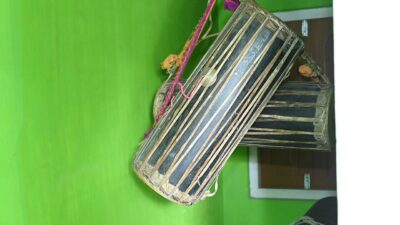
Overviewखाम पूर्वोत्तर भारत का लोक-ढोल है — एक ही लकड़ी के तने को खोखला कर, दोनों मुख बकरी की खाल से मढ़कर बनाया द्विमुखी वाद्य, जिसे गले में लटकाकर हथेलियों से बजाया जाता है। त्रिपुरा के गरिया, होजागिरी और लेबांग बूमानी नृत्य इसी की धड़कन पर होते हैं, और असम में यही 'ख्राम' नाम से तिवा उत्सवों को गति देता है — दरबार का नहीं, माटी और जंगल का वाद्य।
अंग्रेज़ी में पढ़ें · Read in English
The kham is the folk drum of Northeast India — a double-headed instrument hollowed from a single tree-trunk and skinned at both mouths with goat hide, slung from the neck and struck with the palms. Tripura's Garia, Hozagiri and Lebang Boomani dances move to its beat, and in Assam the same drum, called 'Khram', drives Tiwa festivals — a drum not of the court but of soil and forest.
वर्गीकरण
ClassificationNatya Shastra Category
अवनद्ध (Avanaddha — membranophones / covered drums)
नाट्यशास्त्र की चतुर्विध वाद्य-वर्गीकरण में खाम 'अवनद्ध' वर्ग में आता है — अर्थात् चमड़े से मढ़ा हुआ ताल-वाद्य, जिसकी ध्वनि खिंची हुई झिल्ली (चर्म) पर आघात से उत्पन्न होती है। यह दोनों मुखों पर मढ़ा एक द्विमुखी (double-headed) ढोलनुमा वाद्य है।
In the Natya Shastra's fourfold classification, the kham belongs to the 'Avanaddha' category — covered percussion whose sound arises from striking a stretched hide membrane. It is a double-headed, barrel/cylindrical drum skinned at both mouths.
Western Category
Membranophone — double-headed barrel drum
Western Family
Barrel/cylindrical hand-drum family (comparable in role to the dhol and madal of the folk world, but tribal in construction and repertoire)
Sub Classification
बनावट
PhysicalDescription Hindi
खाम एक ठोस लकड़ी के तने को खोखला करके बनाया गया लगभग बेलनाकार/पीपानुमा ढोल है, जिसके दोनों मुख बकरी (और कहीं-कहीं भैंस) की खाल से मढ़े होते हैं। इसे गले में लटकाकर, कमर से बाँधकर या गोद/ज़मीन पर रखकर हथेलियों से बजाया जाता है। इसकी दोनों झिल्लियाँ प्रायः बराबर आकार की होती हैं, जिससे यह द्विमुखी ढोल का रूप लेता है।
Description English
The kham is a roughly cylindrical/barrel-shaped drum scooped out of a single solid tree-trunk, with both faces covered by goat (and in places buffalo) skin. It is slung from the neck, tied to the waist, or rested on the lap or ground and struck with the palms. Its two membranes are usually of near-equal size, giving it the profile of a double-headed drum.
Body
Roughly cylindrical to barrel-shaped, bulging at the middle
लगभग बेलनाकार से पीपे/ढोल-जैसा, बीच में उभरा हुआ
Single hollowed log — Tripuri makers favour Gamai (teak) or other trunks; the Tiwa 'Khram' is carved from Kamari wood (Gmelina arborea)
एक ही खोखली लकड़ी का तना — त्रिपुरी कारीगर गमाई (सागवान) या अन्य तने पसंद करते हैं; तिवा 'ख्राम' कमारी लकड़ी (Gmelina arborea) से तराशा जाता है
Varies widely by tribe — compact neck-slung Tripuri khams to the long Tiwa Khram of about 4 feet (~120 cm)
Open hollowed-log body sealed at both ends by stretched hide, the wooden barrel acting as the resonating chamber
Strings
The kham is a membranophone — a drum — and has no strings; sound comes from its two hide heads
None — a drum has no sympathetic strings
Not applicable to a drum
Bow
लागू नहीं
Not applicable
The kham is struck by the bare hands, not bowed
0
Played with the palms and fingers on both heads; not bowed
Tuning Pegs
डोरी / तस्मा
Lacing rope / thongs
Instead of pegs, hide thongs or ropes lace the two heads together along the barrel; tightening or loosening these adjusts membrane tension and pitch
Bridge
लागू नहीं
Not applicable
A drum has no bridge; the hide membrane itself is the sounding surface
Goat / buffalo hide membrane
Frets
खाम में फ्रेट नहीं होते — यह एक ताल-वाद्य है, स्वर-वाद्य नहीं। लय और अलंकरण खाल पर हथेली, अँगुलियों और थाप की जगह (केंद्र बनाम किनारा) बदलकर उत्पन्न होते हैं।
The kham has no frets — it is a rhythm instrument, not a melodic one. Timbre and accent come from where and how the palm and fingers strike the head (centre versus rim).
ध्वनि-चरित्र
SoundTonal Character Hindi
खाम की आवाज़ गहरी, गूँजती और धड़कती है — इसे अक्सर 'धरती की धड़कन' कहा जाता है। दो मुखों के कारण यह एक साथ गहरी बास-थाप और तीखी किनारे की चोट दोनों दे सकता है, जिससे त्रिपुरी और तिवा नृत्यों की जीवंत, उछलती लय बनती है।
Tonal Character English
The kham's voice is deep, resonant and pulsing — often described as the 'heartbeat of the earth'. Its two heads let it sound both a deep bass thump and a sharp rim-crack, driving the lively, bounding rhythms of Tripuri and Tiwa dance.
Timbre
Warm, woody, earthy resonance with a strong low-frequency thump and a bright rim slap
Range
Percussive (unpitched to loosely-pitched); low bass from the centre of the head to sharp high cracks at the rim
Dynamic Range
Wide — from soft accompanying patter under song to full open-air volume that carries a dance procession without amplification
Techniques
सुनने का मार्गदर्शन
The Listening Guideखाम को समझना हो तो गरिया या होजागिरी नृत्य का प्रदर्शन देखिए — यह सुनने से ज़्यादा देखने का वाद्य है। गहरी केंद्र-थाप नर्तकों के पैर की चाल तय करती है और किनारे की तीखी चोट लय को सजाती है। होजागिरी में स्त्रियाँ सिर पर घड़ा-दीप संतुलित रखकर खाम की धड़कन पर थिरकती हैं — वाद्य और देह एक हो जाते हैं।
अंग्रेज़ी में पढ़ें · Read in English
To understand the kham, watch a Garia or Hozagiri performance — don't just listen, watch, because it is a dance drum. Notice how the deep centre-thump sets the dancers' footwork while the sharp rim-strike ornaments the rhythm. In the Hozagiri, watch how women dance balancing a pitcher and lamp on the head to the kham's pulse — instrument and body become one.
अन्य विवरण
More DetailsTimbre
Warm, woody, earthy resonance with a strong low-frequency thump and a bright rim slap
रोचक तथ्य
Margin Notesएक नाम, अनेक जनजातियाँ — खाम केवल त्रिपुरी वाद्य नहीं है — रियांग, तिवा, बोडो, डिमासा और कुछ नेपाली समुदाय भी इसे लगभग इसी नाम से पुकारते हैं। नामों की यह निकटता पूर्वोत्तर भारत की तिब्बती-बर्मी जनजातियों के बीच की गहरी सांस्कृतिक कड़ी की ओर इशारा करती है।
The kham is not a Tripuri instrument alone — the Reang, Tiwa, Bodo, Dimasa and some Nepali communities call it by nearly the same name. This closeness of names points to a deep cultural link among the Tibeto-Burman tribes of Northeast India.
'धरती की धड़कन' — खाम की गहरी, गूँजती थाप को अक्सर 'धरती की धड़कन' कहा जाता है। कृषि-आधारित जनजातीय जीवन में यह बुवाई और फ़सल के मौसमी चक्र की लय बनकर पूरे समुदाय को एक साथ थिरका देती है।
The kham's deep, resonant thump is often called the 'heartbeat of the earth'. In agrarian tribal life it becomes the rhythm of the sowing-and-harvest cycle, moving the whole community together.
गले में लटकता वाद्य — खाम को गले में लटकाकर और कमर से बाँधकर बजाया जाता है, जिससे वादक नृत्य करते-करते भी बजा सकता है। यही 'चलता-फिरता' स्वरूप इसे जुलूस और खुली जगह के सामूहिक नृत्यों का आदर्श वाद्य बनाता है।
The kham is slung from the neck and tied at the waist so the player can drum while dancing. This 'mobile' form makes it ideal for processions and open-air group dances.
तिवा 'ख्राम' — चार फुट का उत्सव-ढोल — असम में तिवा समुदाय का 'ख्राम' कमारी लकड़ी से बना लगभग चार फुट लंबा बेलनाकार ढोल है, जिसके मुख भैंस और बकरी की खाल से मढ़े होते हैं। इसे लांगखोन, वानशुवा, पंथाई लिवा, खेल चावा और जोनबील मेला जैसे उत्सवों में मुख्यतः पुरुष बजाते हैं।
In Assam the Tiwa community's 'Khram' is a roughly four-foot cylindrical drum of Kamari wood, its heads covered in buffalo and goat skin. It is played mainly by men at festivals such as Langkhon, Wanshuwa, Panthai Liwa, Khel Chawa and the Jonbeel Mela.
सवाल-जवाब
Questions & Answersखाम क्या है?
खाम पूर्वोत्तर भारत का एक द्विमुखी लोक ढोल है, जिसे एक ही लकड़ी के तने को खोखला कर, दोनों मुख बकरी (और कहीं-कहीं भैंस) की खाल से मढ़कर बनाया जाता है। इसे गले में लटकाकर, कमर से बाँधकर हथेलियों से बजाया जाता है और यह त्रिपुरी, रियांग, तिवा, बोडो व डिमासा जनजातियों के नृत्यों की धड़कन है।
खाम किन जनजातियों का वाद्य है?
खाम त्रिपुरा के त्रिपुरी (बोरोक) और रियांग समुदायों तथा असम के तिवा समुदाय (जहाँ इसे 'ख्राम' कहते हैं) का वाद्य है। यही नाम बोडो, डिमासा और कुछ नेपाली समुदायों में भी मिलता है — जो एक साझी तिब्बती-बर्मी सांस्कृतिक कड़ी दर्शाता है।
खाम किन नृत्यों में बजता है?
खाम त्रिपुरा के गरिया नृत्य (बुवाई/फ़सल पूजा), रियांग समुदाय के होजागिरी नृत्य (सिर पर घड़ा-दीप संतुलित कर किया जाने वाला नृत्य) और लेबांग बूमानी (कीट-पकड़ फ़सल नृत्य) की मूल लय है। असम में यह लांगखोन, वानशुवा और जोनबील मेला जैसे उत्सवों में बजता है।
खाम किस लकड़ी से बनता है?
खाम एक ही लकड़ी के तने को खोखला करके बनाया जाता है — त्रिपुरा में प्रायः गमाई (सागवान) से, और असम के तिवा 'ख्राम' के लिए कमारी लकड़ी (Gmelina arborea) से। दोनों मुख बकरी और/या भैंस की खाल से मढ़े जाते हैं।
क्या खाम हिंदी फ़िल्म संगीत में सुनाई देता है?
खाम मुख्यधारा बॉलीवुड में शायद ही सुना जाता है — यह पूर्वोत्तर की जनजातीय लोक-परंपरा का वाद्य है। हालाँकि त्रिपुरा/असम की संस्कृति दर्शाने वाले वृत्तचित्रों, क्षेत्रीय फ़िल्मों और सांस्कृतिक प्रस्तुतियों में इसकी धड़कन ध्वनि-पहचान बनती है।
नमूना-पट्टी
The Specimen Table| नाम | खाम · Kham |
|---|---|
| अन्य नाम | खाम (त्रिपुरी / Tripuri) · ख्राम / खराम (तिवा — Khram) · खाम (बोडो, डिमासा, नेपाली समुदाय) · Kham (also: Khram, Khamb) |
| प्रकार | वाद्य · Instruments |
इस वाद्य के गीत
Songs of this Instruments

साझा कीजिए · Share this Plate