शास्त्र विंग · वाद्य-पट्टिका · Instrument Plate
फ्रेंच हॉर्न
French Horn
अन्य नामफ्रेंच हॉर्न · हॉर्न (ऑर्केस्ट्रा में केवल 'Horn') · वाल्डहॉर्न (Waldhorn - जर्मन 'वन-हॉर्न') · French Horn (also simply 'Horn'; German: Waldhorn)
परिचय
Overviewफ्रेंच हॉर्न पीतल-वर्ग का सबसे मृदु और गायकी के सबसे निकट स्वर है — शिकार की दूर-दराज़ पुकार से जन्मा, वाल्वों के आविष्कार से पूर्ण हुआ, और ऑर्केस्ट्रा में भावना का केंद्र बना। लगभग साढ़े बारह फुट लंबी कुंडलित नली और गहरी कीप-आकार मुखनली इसे मखमली गूँज देती है; दाहिना हाथ घंटी में रखकर वादक स्वर को साधता है। हिंदी सिनेमा में यह गीतों की भव्य प्रस्तावनाओं और पृष्ठभूमि-संगीत की गहराई में छिपकर वीरता, विरह और भव्यता की चादर बुनता है।
अंग्रेज़ी में पढ़ें · Read in English
The French horn is the mellowest of the brass and the closest to the singing voice — born from the far-off call of the hunt, completed by the invention of valves, and grown into the emotional centre of the orchestra. Nearly twelve and a half feet of coiled tubing and a deep funnel mouthpiece give it a velvety resonance; the player tunes each note with a right hand cupped inside the bell. In Hindi cinema it hides within the grand preludes of songs and the depth of background scores, weaving a pad of heroism, longing, and grandeur.
वर्गीकरण
ClassificationNatya Shastra Category
सुषिर (Sushira - फूँक से बजने वाले खोखले वाद्य)
नाट्यशास्त्र की चार वाद्य-श्रेणियों में फ्रेंच हॉर्न 'सुषिर' (खोखले, फूँक से बजने वाले) वर्ग में आता है — यह एक पाश्चात्य पीतल-वाद्य है जिसे भारतीय वर्गीकरण में उपमा के आधार पर सुषिर माना जाता है, क्योंकि ध्वनि होंठों के कंपन और वायु-स्तंभ से उत्पन्न होती है, न कि किसी तार या चमड़े से।
Among the four instrument categories of the Natya Shastra, the French horn falls under 'Sushira' (hollow, wind-blown instruments). It is a Western brass instrument mapped by analogy into the Sushira class, since its sound arises from the vibration of the player's lips against an air column, not from strings or membranes.
Western Category
Brass wind instrument (lip-reed aerophone)
Western Family
Horn family of the brass section (cousins: trumpet, trombone, tuba; descended from the natural hunting horn)
Sub Classification
बनावट
PhysicalDescription Hindi
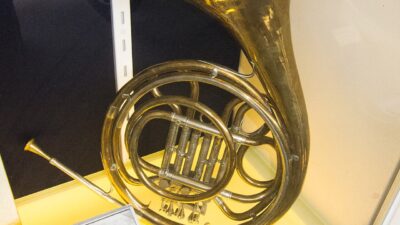
फ्रेंच हॉर्न एक कुंडली में लिपटा हुआ पीतल का वाद्य यंत्र है जिसकी लंबी शंकुधारी नली एक चौड़ी, फैली हुई घंटी में खुलती है। बजाने वाला बाएँ हाथ से रोटरी वाल्व दबाता है और दाहिना हाथ घंटी के भीतर रखता है, जिससे स्वर और लय दोनों नियंत्रित होते हैं। इसकी नली को सीधा फैलाया जाए तो लगभग 3.7 मीटर (एफ-हॉर्न) लंबी होती है, फिर भी इसे एक हाथ में समाने योग्य आकार में लपेट दिया जाता है।
Description English
The French horn is a coiled brass instrument whose long, conical tubing opens into a wide, flared bell. The player presses rotary valves with the left hand and rests the right hand inside the bell, controlling both pitch and tone colour. Uncoiled, the tubing of the F horn is about 3.7 metres (12 feet) long, yet it is wound into a compact form that fits in one embrace.
Body
Circular coiled tubing terminating in a large flared bell
गोलाकार कुंडलित नली जो एक बड़ी फैली हुई घंटी में समाप्त होती है
Brass (yellow brass, gold brass, or nickel-silver alloys); often lacquered or silver-plated
पीतल (पीला पीतल, स्वर्ण-पीतल, या निकल-चाँदी मिश्रधातु); प्रायः लाख-लेपित या चाँदी-मढ़ा
घंटी का व्यास लगभग 30-35 सेमी; लिपटी हुई नली की कुल परिधि हाथ भर की
The flared bell projects and warms the tone; the player's right hand inside the bell fine-tunes pitch and timbre
Tubing
नली
Tubing
≈ 3.7 m (F horn); ≈ 2.8 m (B-flat side of a double horn)
Predominantly conical bore (widening gradually), which gives the horn its mellow, rounded tone — unlike the mainly cylindrical bore of the trumpet and trombone
मुख्यतः शंकुधारी (धीरे-धीरे चौड़ी होती) नली, जो हॉर्न को उसका मृदु, गोल स्वर देती है — तुरही और ट्रॉम्बोन की मुख्यतः बेलनाकार नली के विपरीत
Bell
घंटी
Bell
चौड़ी, फैली हुई घंटी जो नली के अंत में होती है। बजाने वाले का दाहिना हाथ घंटी के भीतर रहता है — हाथ की स्थिति बदलकर स्वर को थोड़ा नीचे/ऊपर किया जाता है और 'बंद' (stopped) व 'खुली' ध्वनि में अंतर लाया जाता है।
The wide, flared bell at the end of the tubing. The player's right hand rests inside it — shifting the hand adjusts pitch slightly and switches between 'open' and 'stopped' (hand-muted) tone colours.
Valves
रोटरी वाल्व
Rotary valves
3 (single horn); 4 on a double horn — the fourth (thumb) valve switches between the F and B-flat sides
फ्रेंच हॉर्न में घूमने वाले (रोटरी) वाल्व होते हैं, जो तुरही के दबाने वाले (पिस्टन) वाल्वों से भिन्न हैं। ये अतिरिक्त नली-खंड जोड़कर वायु-स्तंभ की लंबाई बदलते हैं और भिन्न स्वर देते हैं।
The French horn uses rotary valves, which differ from the piston valves of the trumpet. Rotating them adds extra lengths of tubing, changing the air column and producing different pitches.
Mouthpiece
मुखनली
Mouthpiece
गहरी, कीप-आकार (funnel/conical) मुखनली — तुरही की उथली कप-आकार मुखनली से भिन्न। यही गहराई हॉर्न की मखमली, गायकी-सी कोमलता का कारण है। ध्वनि होंठों के 'बज़' (कंपन) से बनती है।
A deep, funnel-shaped (conical) mouthpiece — unlike the shallow cup mouthpiece of the trumpet. This depth is a key reason for the horn's velvety, almost vocal softness. Sound is produced by the 'buzz' of the player's vibrating lips.
Pitch And Transposition
स्वर व लिप्यंतरण
Pitch & transposition
आधुनिक मानक 'डबल हॉर्न' एफ और बी-फ्लैट दोनों में बजता है। पारंपरिक रूप से इसे एफ में लिखा जाता है (एक ट्रांसपोज़िंग वाद्य)।
The modern standard 'double horn' plays in both F and B-flat. It is conventionally notated in F (a transposing instrument).
ध्वनि-चरित्र
SoundTonal Character Hindi
फ्रेंच हॉर्न की ध्वनि गर्म, गोल और मखमली होती है — पीतल-वर्ग में सबसे कोमल और गायकी के सबसे निकट। यह वीरतापूर्ण और भव्य (जैसे शिकार की पुकार) से लेकर स्वप्निल, दूरगामी और उदास तक जा सकती है। यही कारण है कि पृष्ठभूमि-संगीत में हॉर्न भावनाओं की 'चादर' (harmonic pad) बुनने के लिए आदर्श है।
Tonal Character English
The French horn's tone is warm, round, and velvety — the mellowest of the brass and the closest to the singing voice. It can be heroic and majestic (like a distant hunting call) or dreamy, far-off, and melancholic. This is why, in background scoring, the horn is ideal for weaving lush harmonic 'pads' of emotion.
Timbre
Rich, dark, and blending — sits between brass and woodwind, fusing seamlessly with strings and woodwinds to create a soft orchestral glow
Range
Roughly B1 (below the bass clef) to F5 — about three and a half octaves; the mid and lower registers are especially warm
Dynamic Range
Very wide — from a barely-audible far-off murmur to a full, ringing fanfare that can crown a whole orchestra
Techniques
सुनने का मार्गदर्शन
The Listening Guideफ्रेंच हॉर्न को कान से पकड़ना हो तो पुराने हिंदी गीतों की भव्य प्रस्तावनाओं और अंतरों के बीच के लंबे अंतरालों पर ध्यान दीजिए — तार-वाद्यों के नीचे बहती गर्म, गोल, दूर से आती-सी पुकार प्रायः वही होती है। पहले किसी पाश्चात्य टुकड़े में हॉर्न-एकल सुनकर रंग पहचान लीजिए, फिर उसी कान से भारतीय पृष्ठभूमि-संगीत सुनिए।
अंग्रेज़ी में पढ़ें · Read in English
To recognise the French horn, listen to the grand preludes of old Hindi songs and the interludes between verses — the warm, round, far-off call flowing beneath the strings is often the horn. First hear a horn solo in a Western orchestral piece to fix the colour in your ear, then listen to Hindi background scores with that same ear.
परिचय
Identity- Year Of Origin
- 1815
अन्य विवरण
More DetailsTimbre
Rich, dark, and blending — sits between brass and woodwind, fusing seamlessly with strings and woodwinds to create a soft orchestral glow
रोचक तथ्य
Margin Notesशिकार से ऑर्केस्ट्रा तक — फ्रेंच हॉर्न का पूर्वज घोड़े पर बैठे शिकारी का गोलाकार 'कोर द शास' था, जिसे कंधे पर लटकाकर बजाया जाता था। इसकी 'दूर से आती पुकार' का चरित्र आज भी ऑर्केस्ट्रल हॉर्न में जीवित है — इसीलिए संगीतकार इसे भव्य उदय और दूरगामी विरह के लिए चुनते हैं।
The French horn's ancestor was the mounted huntsman's circular 'cor de chasse', slung over the shoulder. Its character of a 'call from afar' still lives in the orchestral horn — which is why composers choose it for grand entrances and far-off longing.
वाल्वों का आविष्कार — लगभग 1815 में जर्मनी में हाइनरिख़ श्टोएल्ज़ेल और फ्रीड्रिख़ ब्लूमेल ने पीतल-वाद्यों के लिए वाल्व बनाए। इससे हॉर्न, जो पहले केवल हार्मोनिक श्रृंखला बजा सकता था, किसी भी स्वरग्राम में सुगमता से बजने लगा — यही आधुनिक फ्रेंच हॉर्न का जन्म था।
Around 1815 in Germany, Heinrich Stölzel and Friedrich Blühmel created valves for brass instruments. The horn, once limited to the harmonic series, could now play fluently in any key — the birth of the modern French horn.
डबल हॉर्न का जन्म — 19वीं सदी के अंत में जर्मन निर्माता फ्रिट्ज़ क्रुस्पे ने एफ और बी-फ्लैट दो हॉर्न एक में मिला दिए। अँगूठे से चलने वाला चौथा वाल्व दोनों पक्षों के बीच स्विच करता है — इससे ऊँचे स्वर अधिक निश्चित और सुरक्षित हो गए। यही 'डबल हॉर्न' आज का विश्व-मानक है।
In the late 19th century the German maker Fritz Kruspe combined two horns — in F and B-flat — into one. A fourth thumb valve switches between the two sides, making high notes surer and safer. This 'double horn' is today's global standard.
फ़िल्म-ऑर्केस्ट्रा की गुमनाम आवाज़ — हिंदी सिनेमा के स्वर्णकाल में फ्रेंच हॉर्न प्रायः गीतकार, गायक या संगीतकार के नाम में नहीं आता — पर उसकी गर्म चादर प्रस्तावनाओं और पृष्ठभूमि-संगीत में भावना का आधार बुनती है। सेबेस्टियन डिसूज़ा और एंथनी गोंसाल्विस जैसे व्यवस्थापकों ने इस पाश्चात्य रंग को भारतीय धुनों में पिरोया।
In Hindi cinema's golden age the French horn seldom appears in the names of lyricist, singer, or composer — yet its warm pad weaves the emotional foundation of preludes and background scores. Arrangers like Sebastian D'Souza and Anthony Gonsalves threaded this Western colour into Indian melody.
सवाल-जवाब
Questions & Answersफ्रेंच हॉर्न क्या है?
फ्रेंच हॉर्न एक कुंडली में लिपटा पीतल का वाद्य यंत्र है जिसकी शंकुधारी नली एक चौड़ी घंटी में खुलती है। इसका स्वर पीतल-वर्ग में सबसे कोमल और गायकी के सबसे निकट माना जाता है। यह पाश्चात्य ऑर्केस्ट्रा का प्रमुख वाद्य है।
फ्रेंच हॉर्न हिंदी फ़िल्म-संगीत में कैसे प्रयोग होता है?
हिंदी फ़िल्म-संगीत में फ्रेंच हॉर्न मुख्यतः गीतों की भव्य प्रस्तावनाओं और पृष्ठभूमि-संगीत में प्रयोग होता है, जहाँ इसका गर्म, गोल स्वर भावनाओं की 'हार्मोनिक चादर' बुनता है — वीरता, विरह और भव्यता के लिए।
फ्रेंच हॉर्न को 'French' क्यों कहते हैं?
इसका नाम 17वीं सदी के फ्रांसीसी गोलाकार शिकार-हॉर्न ('कोर द शास') से आया है। विडंबना यह है कि आधुनिक वाल्व-हॉर्न और डबल हॉर्न का विकास जर्मनी में हुआ, और जर्मन इसे 'वाल्डहॉर्न' (वन-हॉर्न) कहते हैं।
फ्रेंच हॉर्न में कितने वाल्व होते हैं?
एकल (single) हॉर्न में तीन रोटरी वाल्व होते हैं। आधुनिक मानक 'डबल हॉर्न' में चार होते हैं — अँगूठे से चलने वाला चौथा वाल्व एफ और बी-फ्लैट पक्षों के बीच स्विच करता है।
क्या फ्रेंच हॉर्न भारतीय शास्त्रीय संगीत का वाद्य है?
नहीं। फ्रेंच हॉर्न एक पाश्चात्य पीतल-वाद्य है और हिंदुस्तानी शास्त्रीय संगीत की राग-आधारित मीड के लिए नहीं बना। भारत में इसका मुख्य स्थान फ़िल्म-ऑर्केस्ट्रा और फ्यूज़न-प्रयोगों में है।
नमूना-पट्टी
The Specimen Table| नाम | फ्रेंच हॉर्न · French Horn |
|---|---|
| अन्य नाम | फ्रेंच हॉर्न · हॉर्न (ऑर्केस्ट्रा में केवल 'Horn') · वाल्डहॉर्न (Waldhorn - जर्मन 'वन-हॉर्न') · French Horn (also simply 'Horn'; German: Waldhorn) |
| उद्गम | 1815 |
| प्रकार | वाद्य · Instruments |
साझा कीजिए · Share this Plate