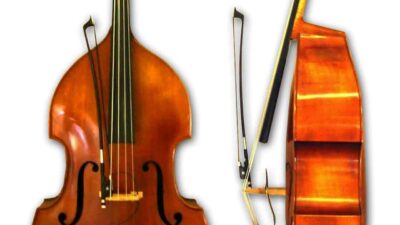
शास्त्र विंग · वाद्य-पट्टिका · Instrument Plate
डबल बास
Double Bass
अन्य नामकॉन्ट्राबास · बास वायोल · स्ट्रिंग बास · अपराइट बास
परिचय
Overviewडबल बास (कॉन्ट्राबास) आधुनिक वाद्यवृंद का सबसे बड़ा और सबसे गहरा तार-वाद्य है — वायोल परिवार से जन्मा, चतुर्थांश में मिलाया जाने वाला, फ्रेट-रहित। हिंदी सिनेमा में इसका आगमन 1940-70 के गोअन-नेतृत्व वाले स्टूडियो-ऑर्केस्ट्रा के साथ हुआ, जहाँ इसने अनगिनत गीतों की धड़कती 'वॉकिंग बास' नींव रखी। सेबेस्टियन डिसूज़ा और एंथनी गोंसाल्विस जैसे अरेंजरों के भव्य तार-खंडों का सबसे गहरा स्तंभ यही था।
अंग्रेज़ी में पढ़ें · Read in English
The double bass (contrabass) is the largest and deepest string instrument of the modern orchestra — born of the viol family, tuned in fourths, fretless. Its entry into Hindi cinema came with the Goan-led studio orchestras of 1940-70, where it laid the pulsing 'walking bass' foundation of countless songs. It was the deepest pillar of the lush string sections written by arrangers like Sebastian D'Souza and Anthony Gonsalves.
वर्गीकरण
ClassificationNatya Shastra Category
तत (Tata - stringed instruments)
डबल बास मूलतः एक पश्चिमी वाद्य है और नाट्यशास्त्र की परंपरा का अंग नहीं है, किंतु ध्वनि-उत्पत्ति की दृष्टि से यह 'तत' (तार-वाद्य) वर्ग में आता है — इसका स्वर धनुष के घर्षण या अंगुली से तार को झंकृत (pizzicato) करने से उत्पन्न होता है। हिंदी सिनेमा के वाद्यवृंद में यह तार-खंड (string section) की सबसे गहरी, आधार-स्वर देने वाली आवाज़ रही है।
The double bass is fundamentally a Western instrument and not part of the Natya Shastra tradition, but by its mode of sound production it belongs to the 'Tata' (stringed) category — tone is produced by friction of a bow or by plucking the string (pizzicato). In the Hindi-film orchestra it was the deepest, foundation-note voice of the string section.
Western Category
Bowed / plucked string instrument (chordophone)
Western Family
Violin–viol family — the largest and lowest-pitched member of the modern orchestral string section, of hybrid violin and viol ancestry
Sub Classification
बनावट
PhysicalDescription Hindi
डबल बास आधुनिक वाद्यवृंद का सबसे बड़ा और सबसे नीचे स्वर वाला तार-वाद्य है। खड़ा होने पर यह प्रायः वादक से भी ऊँचा (लगभग 180 सेमी) होता है। इसका खोखला लकड़ी का शरीर, ढालू कंधे, लंबी गर्दन और फ्रेट-रहित अंगुली-पट्टी इसे गहरी, गूँजती हुई आवाज़ देते हैं। इसे या तो गज (धनुष) से बजाया जाता है या अंगुलियों से तार खींचकर (pizzicato) — हिंदी फ़िल्म-संगीत में यही खींची हुई, चलती-फिरती बास-लय सबसे अधिक सुनाई देती है।
Description English
The double bass is the largest and lowest-pitched string instrument of the modern orchestra. Standing, it is usually taller than the player (about 180 cm). Its hollow wooden body, sloping shoulders, long neck and fretless fingerboard give it a deep, resonant voice. It is played either with a bow (arco) or by plucking the strings with the fingers (pizzicato) — and it is this plucked, walking bass line that is most often heard in Hindi film music.
Body
Large teardrop/violin body but with sloping (viol-style) shoulders
बड़ा अश्रु/वायलिन जैसा शरीर किंतु ढालू (वायोल-शैली) कंधों के साथ
Carved spruce soundboard (top), maple or laminated wood back and ribs, maple neck, ebony fingerboard
तराशा हुआ स्प्रूस का ऊपरी पटल (साउंडबोर्ड), मेपल या परत-लकड़ी की पीठ व बग़लें, मेपल की गर्दन, आबनूस (एबोनी) की अंगुली-पट्टी
180-200 (standing height with endpin); ~110 cm string/scale length (3/4 size is standard)
Large enclosed wooden box with two f-holes; the biggest resonating chamber in the string family, giving it its subterranean bass
Strings
Playing strings tuned in perfect fourths — the only orchestral string instrument not tuned in fifths
The double bass has NO sympathetic strings — unlike the sarangi or sitar, all its resonance comes from the large body cavity and the four (or five) playing strings alone
No dedicated drone strings; the open low E and A strings themselves often serve as a de-facto pedal/foundation in film arrangements
Bow
गज (धनुष)
Bow
Pernambuco or brazilwood stick with horsehair; a thicker, shorter, heavier bow than the cello's
70-75
Two rival bow-holds: the French bow (overhand, like a cello) and the German/Butler bow (underhand). Held near-horizontal against the vertical strings; the player stands or sits on a high stool
Tuning Pegs
मशीन-हेड / ट्यूनिंग खूँटियाँ
Machine heads (geared tuners)
Unlike the friction pegs of the violin family, the double bass uses geared metal machine-heads because string tension is far too high to hold by friction alone
Bridge
पुल (ब्रिज)
Bridge
Tall arched wooden bridge that transmits string vibration to the soundboard; often carved with adjuster wheels to raise or lower string height
Maple
Frets
डबल बास फ्रेट-रहित है — वादक अंगुलियों से सीधे तार दबाकर स्वर बनाता है, जिससे ग्लिसांडो (सरकना), विब्रातो और भारतीय 'मींड' जैसी सूक्ष्म स्वर-यात्रा संभव होती है।
The double bass is fretless — the player stops the string directly with the fingers, allowing glissando (sliding), vibrato and the fine pitch-inflection akin to Indian 'meend'.
ध्वनि-चरित्र
SoundTonal Character Hindi
डबल बास की आवाज़ गहरी, गंभीर और नींव जैसी होती है — मानो संगीत के पूरे भवन को नीचे से थामे हुए हो। धनुष से बजाने पर यह मखमली और गूँजती है, और अंगुली से खींचने पर (pizzicato) एक गोल, धड़कती हुई 'थप' पैदा करती है जो हृदय की धड़कन-सी लगती है।
Tonal Character English
The double bass's voice is deep, grave and foundational — as if holding up the entire edifice of the music from below. Bowed, it is velvety and resonant; plucked (pizzicato) it produces a round, pulsing 'thud' that feels like a heartbeat.
Timbre
Dark, woody, subterranean; rich in low harmonics, warm and enveloping rather than piercing
Range
Sounds an octave lower than written — from low E1 (~41 Hz), or B0 (~31 Hz) on a 5-string, up past the octave, with skilled players reaching high harmonics well into the treble
Dynamic Range
Wide — from an almost inaudible pianissimo pizzicato to a floor-shaking arco fortissimo; in film sections it usually plays a supporting, moderate dynamic
Techniques
सुनने का मार्गदर्शन
The Listening Guideडबल बास सुनना हो तो 1950-60 के दशक के किसी हिंदी फ़िल्म-गीत को अच्छे स्पीकर पर बजाइए और सबसे नीचे की धड़कती, चलती-फिरती लय पर कान लगाइए — वही डबल बास है, गीत की मौन धड़कन। फिर बॉत्तेसीनी का बास-कंसर्टो सुनिए और देखिए यही 'भारी' वाद्य मंच के केंद्र में कैसे कोमलता से गाता है।
अंग्रेज़ी में पढ़ें · Read in English
To hear the double bass, play an old (1950s-60s) Hindi film song on good speakers or headphones and fix your attention on the lowest, pulsing 'walking' line — that is the double bass. Then listen to a Bottesini or Koussevitzky bass concerto, where this 'accompaniment' instrument sings centre-stage, and you will grasp how much tenderness hides inside this giant.
परिचय
Identity- Year Of Origin
- 1600
अन्य विवरण
More DetailsTimbre
Dark, woody, subterranean; rich in low harmonics, warm and enveloping rather than piercing
रोचक तथ्य
Margin Notesबॉलीवुड की 'गोअन नींव' — हिंदी फ़िल्म-संगीत के स्वर्ण-युग का पश्चिमी वाद्यवृंद बड़े हद तक गोवा के ईसाई संगीतकारों पर टिका था। सेबेस्टियन डिसूज़ा (शंकर-जयकिशन व ओ.पी. नैयर के अरेंजर) और एंथनी गोंसाल्विस जैसे गोअन कलाकारों ने विशाल तार-खंड रचे जिनकी सबसे गहरी नींव डबल बास देता था — पर ये वादक पर्दे पर कभी नहीं आए।
The Western orchestra of Hindi film music's golden age rested heavily on Goa's Christian musicians. Goan artists like Sebastian D'Souza (arranger for Shankar-Jaikishan and O.P. Nayyar) and Anthony Gonsalves wrote the lush string sections whose deepest foundation was the double bass — yet these players never appeared on screen.
पंचम नहीं, चतुर्थांश — वायलिन, वायोला और सेलो — तीनों पंचम (fifths) में मिलाए जाते हैं, पर डबल बास चतुर्थांश (fourths: E-A-D-G) में। यह इसकी संकर वंशावली का सबसे स्पष्ट प्रमाण है: शरीर वायोल जैसा, पर धनुष और बजाने का ढंग वायलिन-परिवार से।
Violin, viola and cello are all tuned in fifths, but the double bass is tuned in fourths (E-A-D-G). This is the clearest evidence of its hybrid ancestry: a viol-like body, but bow and playing manner from the violin family.
इलेक्ट्रिक बास ने ली जगह — 1970 के दशक तक डबल बास फ़िल्म-रिकॉर्डिंग की रीढ़ था, पर इलेक्ट्रिक बास गिटार — सस्ता, हल्का और माइक्रोफ़ोन के लिए आसान — ने इसे विस्थापित कर दिया। आर.डी. बर्मन जैसी पॉप-रॉक शैली में यह बदलाव सबसे साफ़ सुनाई देता है।
Until the 1970s the double bass was the backbone of film recording, but the electric bass guitar — cheaper, lighter and easier to mic — displaced it. The shift is heard most clearly in the pop-rock style of composers like R.D. Burman.
दो धनुष, दो घराने — डबल बास बजाने की दुनिया दो 'घरानों' में बँटी है: फ़्रेंच धनुष (ऊपर से पकड़, सेलो जैसा) और जर्मन/बटलर धनुष (नीचे से पकड़)। एक ही वाद्य, पर पकड़ के अनुसार तकनीक और परंपरा अलग-अलग।
The world of double bass playing is split into two 'schools': the French bow (overhand, cello-like) and the German/Butler bow (underhand). One instrument, but technique and tradition differ by the grip.
सवाल-जवाब
Questions & Answersडबल बास क्या है?
डबल बास (कॉन्ट्राबास) आधुनिक वाद्यवृंद का सबसे बड़ा और सबसे नीचे स्वर वाला तार-वाद्य है। इसे गज (धनुष) से या अंगुली से तार खींचकर (pizzicato) बजाया जाता है। हिंदी फ़िल्म-संगीत में यह तार-खंड का आधार-स्वर देता था।
डबल बास के कितने तार होते हैं और कैसे मिलाए जाते हैं?
अधिकतर डबल बास में चार तार होते हैं जो चतुर्थांश (fourths) में E–A–D–G पर मिलाए जाते हैं; कुछ में पाँच तार होते हैं जो निम्न B तक जाते हैं। यह वाद्यवृंद का एकमात्र तार-वाद्य है जो पंचम के बजाय चतुर्थांश में मिलाया जाता है।
हिंदी फ़िल्म-संगीत में डबल बास कैसे आया?
1940-1970 के दशक में गोवा के ईसाई संगीतकार — जो पश्चिमी व जैज़ तालीम लेकर आए — बंबई के स्टूडियो-ऑर्केस्ट्रा की रीढ़ बने। सेबेस्टियन डिसूज़ा और एंथनी गोंसाल्विस जैसे गोअन अरेंजरों के रचे तार-खंडों में डबल बास सबसे गहरी बास-नींव देता था।
डबल बास और सेलो में क्या अंतर है?
डबल बास सेलो से बड़ा और नीचा है, इसे प्रायः खड़े होकर बजाया जाता है, इसके कंधे ढालू होते हैं और तार चतुर्थांश में मिलाए जाते हैं; सेलो छोटा है, बैठकर बजाया जाता है और तार पंचम में मिलाए जाते हैं। डबल बास वायोल परिवार से जुड़ा है, सेलो वायलिन परिवार से।
फ़िल्म-संगीत में डबल बास की जगह किसने ली?
1970 के दशक से इलेक्ट्रिक बास गिटार ने फ़िल्म-रिकॉर्डिंग में डबल बास की जगह लेनी शुरू की, क्योंकि वह सस्ता, हल्का और माइक्रोफ़ोन के लिए आसान था। आर.डी. बर्मन जैसी पॉप-रॉक शैली में यह बदलाव सबसे स्पष्ट सुनाई देता है।
नमूना-पट्टी
The Specimen Table| नाम | डबल बास · Double Bass |
|---|---|
| अन्य नाम | कॉन्ट्राबास · बास वायोल · स्ट्रिंग बास · अपराइट बास · Contrabass · String Bass |
| उद्गम | 1600 |
| प्रकार | वाद्य · Instruments |
जुड़े हुए पन्ने
Connected Plates · The Graph Made Visibleअटलस में कोई पन्ना अकेला नहीं — इस वाद्य से जुड़े गीत, कलाकार, शास्त्र और कहानियाँ, सब यहाँ से खुलते हैं।
इस वाद्य के गीत
Songs of this Instruments
साझा कीजिए · Share this Plate