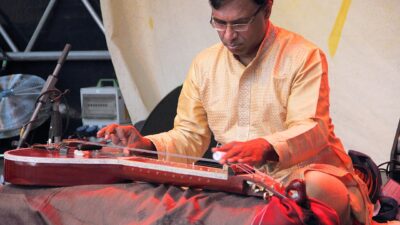
शास्त्र विंग · वाद्य-पट्टिका · Instrument Plate
चित्रवीणा
Chitravina (Gottuvadyam)
अन्य नामगोट्टुवाद्यम् · चित्र वीणा · चित्रवेणा · Chitravina (also: Chitra Veena, Chitraveena)
परिचय
Overviewचित्रवीणा, जिसे लोक-भाषा में गोट्टुवाद्यम् कहते हैं, कर्नाटक संगीत की एक बिना-पर्दे की स्लाइड-वीणा है — कटहल की लकड़ी से तराशा शरीर, ऊपर लटकी तूम्बा, और लगभग इक्कीस तार (छह मुख्य, तीन द्रोण, और लगभग एक दर्जन तरब)। पर्दों के अभाव में इसके स्वर एक चिकने बेलन 'गोट्टु' की सरकन से निकलते हैं, जिससे मींड और गमक इतनी सहज बहती है कि इसे मानव-कंठ का सबसे निकट का साथी माना जाता है। उत्तर भारत में इसका जुड़वाँ रूप है विचित्र वीणा; और इसके आधुनिक पुनर्जागरण का चेहरा हैं चित्रवीणा एन. रविकिरण।
अंग्रेज़ी में पढ़ें · Read in English
The chitravina, known in everyday speech as the gottuvadyam, is a fretless slide-veena of Carnatic music — a jackwood body, a gourd hung at the top, and roughly twenty-one strings (six main, three drone, about a dozen sympathetic). In the absence of frets its notes are drawn from the glide of a smooth cylinder, the 'gottu', so that meend and gamaka flow so naturally it is reckoned the closest companion to the human voice. In North India its twin is the vichitra veena; and the face of its modern revival is Chitravina N. Ravikiran.
वर्गीकरण
ClassificationNatya Shastra Category
तत (Tata - stringed instruments)
तत वर्ग में चित्रवीणा एक बिना पर्दे (fretless) की तार वाली वीणा है, जिसे बाईं हाथ में पकड़े एक बेलनाकार स्लाइड (गोट्टु) से बजाया जाता है और दाहिने हाथ की उंगलियों पर पहने मिज़राब (नखी) से टंकार दी जाती है। प्राचीन 'सप्ततंत्री चित्रा वीणा' का इसमें नाम-सूत्र मिलता है।
In the Tata (stringed) category, the chitravina is a fretless plucked veena. The pitch is produced by gliding a smooth cylindrical slide (gottu) held in the left hand along the strings, while the right hand plucks with wire plectra (mizrab) worn on the fingers. Its name echoes the ancient seven-stringed 'chitra vina' of Sanskrit texts.
Western Category
Fretless plucked/slide string instrument (lap slide lute)
Western Family
Slide-lute family — the melodic method is akin to the Hawaiian lap-steel guitar and to its Hindustani cousin the vichitra veena, but the body, tuning and gamaka aesthetic are wholly Indian
Sub Classification
बनावट
PhysicalDescription Hindi
चित्रवीणा दिखने में सरस्वती वीणा जैसी है — जैकवुड (कटहल की लकड़ी) से तराशा एक लंबा शरीर, चौड़ा गोल अनुनादक (resonator) और गर्दन के ऊपरी सिरे पर लगी एक तूम्बा (लौकी)। परंतु इसकी सबसे बड़ी विशेषता यह है कि इसमें कोई पर्दा (fret) नहीं होता — पूरी उँगली-पट्टी (fingerboard) चिकनी और सपाट होती है, जिस पर स्लाइड फिसलती है।
Description English
The chitravina looks much like the Saraswati veena — a long body carved from jackwood, a broad round resonator, and a gourd (tumba) fixed near the top of the neck. But its defining feature is that it has no frets: the entire fingerboard is smooth and flat, so a slide can glide freely along its length.
Body
Long boat/veena form with a large hemispherical resonator and a smooth fretless neck
लंबी वीणा-नुमा आकृति, एक बड़ा अर्धगोलाकार अनुनादक और पूरी तरह चिकनी बिना-पर्दे की गर्दन
Solid jackwood (halasu / कटहल की लकड़ी), traditionally carved from a single block
ठोस जैकवुड (कटहल की लकड़ी), परंपरागत रूप से एक ही लकड़ी के टुकड़े से तराशी गई
115-140 (overall length)
Large jackwood resonator plus a gourd (tumba) mounted under the upper neck for added sustain and depth
Strings
Primary melody strings played with the slide and plucked by the right hand
Fine tarab strings running beneath the fingerboard that resonate in sympathy and give the instrument its shimmering halo
Side drone / tala strings (thala tanti) strummed for rhythm and to hold the tonic drone
Bow
गोट्टु / कम्बी (स्लाइड)
Gottu / Slide (not a bow — a hand-held sliding block)
A short smooth cylinder of hardwood (ebony), buffalo horn, glass, or modern Teflon, about 6-7 cm long
6-7
The chitravina is NOT bowed. The cylindrical slide is held in the left hand and glided along the strings to stop the pitch, exactly as on a lap-steel guitar; the right hand plucks. This slide is what the folk name 'gottu-vadyam' (gottu = slide, vadyam = instrument) is built from.
Tuning Pegs
बिरुडाई / खूँटी
Birudai (tuning pegs)
Large lateral pegs for the main and drone strings, with small side pegs for the sympathetic strings
Bridge
कुदुरै (सेतु)
Kudurai (bridge)
A broad, gently curved flat bridge — like the veena's — over which the strings graze to produce the characteristic buzzing, sustaining jivari tone
Wood, often with a bone or metal top plate
Frets
चित्रवीणा में एक भी पर्दा नहीं होता — यही इसे साधारण वीणा से अलग करता है। स्वर पूरी तरह स्लाइड की स्थिति से निकलते हैं, जिससे निरंतर मींड और गमक — यानी कर्नाटक संगीत की आत्मा — स्वाभाविक रूप से आती है। इसीलिए इसे बजाना अत्यंत कठिन माना जाता है, क्योंकि हर स्वर हाथ की सूक्ष्म पकड़ पर निर्भर है।
The chitravina has not a single fret — this is what sets it apart from the ordinary veena. Every pitch comes purely from the position of the slide, which makes continuous meend and gamaka — the very soul of Carnatic music — flow naturally. This also makes it one of the hardest instruments to master, since every note depends on the precise touch of the hand.
ध्वनि-चरित्र
SoundTonal Character Hindi
चित्रवीणा की ध्वनि गायकी के सबसे निकट मानी जाती है — मानो कोई कंठ बिना शब्दों के गा रहा हो। स्लाइड के फिसलने से स्वर एक-दूसरे में घुल जाते हैं, कहीं कोई ठहराव नहीं; तरब तारों की गूँज हर स्वर के पीछे एक रोशनी-सी छोड़ती है। यही निरंतरता इसे गमक-प्रधान कर्नाटक रागों के लिए आदर्श बनाती है।
Tonal Character English
The chitravina's sound is held to be among the closest of all instruments to the singing voice — as though a throat were singing without words. As the slide glides, notes melt into one another with no break, and the sympathetic strings leave a glow behind every tone. This seamlessness makes it ideal for the gamaka-laden ragas of Carnatic music.
Timbre
Warm, sustaining and vocal, with a soft jivari buzz from the flat bridge and a halo of sympathetic shimmer
Range
About two-and-a-half to three octaves of clean, continuously slidable pitch
Dynamic Range
Intimate and expressive — from a barely-there glide to a ringing, fully plucked stroke
Techniques
सुनने का मार्गदर्शन
The Listening Guideचित्रवीणा को सुनते समय ध्यान दीजिए कि स्वर कभी टूटते नहीं — वे किसी गायक की तान की तरह एक-दूसरे में बहते हैं। धीमी आलापना से शुरुआत कीजिए और सुनिए कि स्लाइड कैसे दो स्वरों के बीच की हर श्रुति को छूती है; फिर तरब तारों की पृष्ठ-गूँज पर कान दीजिए। एन. रविकिरण का कोई एकल अंश इसके लिए आदर्श आरंभ है।
अंग्रेज़ी में पढ़ें · Read in English
When you listen to the chitravina, notice that notes never 'break' — they flow into one another, exactly like a singer's phrase. Begin with a slow alapana and hear how the slide touches every fine interval between two notes; then attend to the background hum of the sympathetic strings. A solo kutcheri excerpt by N. Ravikiran is an ideal place to start.
परिचय
Identity- Year Of Origin
- 1800
अन्य विवरण
More DetailsTimbre
Warm, sustaining and vocal, with a soft jivari buzz from the flat bridge and a halo of sympathetic shimmer
रोचक तथ्य
Margin Notesगोट्टु — जिससे नाम पड़ा — जिस बेलनाकार स्लाइड से यह वाद्य बजता है, उसे 'गोट्टु' कहते हैं — और यहीं से लोक-नाम 'गोट्टुवाद्यम्' बना। यह स्लाइड परंपरागत रूप से एबनी (आबनूस), भैंस के सींग या काँच की, और आधुनिक काल में टेफ़्लॉन की बनाई जाती है।
The cylindrical slide with which the instrument is played is called the 'gottu' — and from it comes the folk name 'gottuvadyam'. The slide is traditionally made of ebony, buffalo horn or glass, and in modern times of Teflon.
दक्षिण की चित्रवीणा, उत्तर की विचित्र वीणा — भारतीय स्लाइड-वीणा का विचार दो रूपों में जीवित है — दक्षिण की कर्नाटक चित्रवीणा और उत्तर की हिंदुस्तानी विचित्र वीणा। दोनों बिना पर्दे की हैं और दोनों में स्वर स्लाइड से निकलते हैं; अंतर केवल स्लाइड के रूप और राग-शैली का है।
The idea of the Indian slide-veena survives in two forms — the Carnatic chitravina of the South and the Hindustani vichitra veena of the North. Both are fretless and both draw their notes from a slide; the difference is only in the form of the slide and the style of raga.
सखा राम राव और मंच पर वापसी — 20वीं शताब्दी के आरंभ में सखा राम राव ने लगभग विस्मृत हो रहे गोट्टुवाद्यम् को कर्नाटक कच्चेरी के मंच पर पुनर्स्थापित किया और इसे एक सम्मानित एकल वाद्य बनाया — इसी परंपरा को आगे चलकर चित्रवीणा नरसिम्हन और एन. रविकिरण ने शिखर तक पहुँचाया।
In the early 20th century Sakha Rama Rao restored the near-forgotten gottuvadyam to the Carnatic concert stage and made it a respected solo instrument — a tradition later carried to its peak by Chitravina Narasimhan and N. Ravikiran.
गायकी के सबसे निकट — क्योंकि पर्दे नहीं हैं, चित्रवीणा दो स्वरों के बीच के हर सूक्ष्म श्रुति-अंतराल को निरंतर छू सकती है — यही कारण है कि इसे प्रायः 'हाथ से गाया जाने वाला वाद्य' कहा जाता है।
Because there are no frets, the chitravina can continuously touch every fine shruti-interval between two notes — which is why it is often called 'the instrument that is sung by the hand'.
सवाल-जवाब
Questions & Answersचित्रवीणा (गोट्टुवाद्यम्) क्या है?
चित्रवीणा कर्नाटक संगीत की एक बिना पर्दे (fretless) की तार वाली वीणा है, जिसे बाएँ हाथ में पकड़े एक चिकने बेलन (गोट्टु) को तारों पर फिसलाकर और दाहिने हाथ से टंकार देकर बजाया जाता है। इसे लोक-भाषा में गोट्टुवाद्यम् कहते हैं।
चित्रवीणा में कितने तार होते हैं?
चित्रवीणा में सामान्यतः लगभग इक्कीस तार होते हैं — छह मुख्य सुर-तार, तीन द्रोण (ताल) तार, और लगभग ग्यारह से तेरह तरब (सहानुभूतिशील) तार, जो अनुनाद से बजते हैं।
चित्रवीणा और विचित्र वीणा में क्या संबंध है?
दोनों बिना पर्दे की स्लाइड-वीणाएँ हैं। चित्रवीणा दक्षिण भारत (कर्नाटक) की है और लकड़ी/टेफ़्लॉन के गोट्टु से बजती है, जबकि विचित्र वीणा उत्तर भारत (हिंदुस्तानी) की है और काँच के अंडाकार बट्टे से बजती है। इसलिए चित्रवीणा को विचित्र वीणा का दक्षिणी समकक्ष कहा जाता है।
चित्रवीणा का सबसे प्रसिद्ध वादक कौन है?
आधुनिक काल में चित्रवीणा एन. रविकिरण इसके सबसे प्रसिद्ध वादक हैं — एक बाल-प्रतिभा जिन्होंने गोट्टुवाद्यम् को 'चित्रवीणा' नाम दिया। इससे पहले सखा राम राव जैसे कलाकारों ने इसे मंच पर पुनर्जीवित किया था।
चित्रवीणा बजाना कठिन क्यों है?
क्योंकि इसमें कोई पर्दा नहीं होता, हर स्वर पूरी तरह स्लाइड की सही स्थिति पर निर्भर करता है। ज़रा-सी चूक स्वर को बेसुरा कर देती है, इसलिए इसे विश्व के सबसे कठिन वाद्यों में गिना जाता है और इसे 'हाथ से गाना' सीखने जैसा माना जाता है।
नमूना-पट्टी
The Specimen Table| नाम | चित्रवीणा · Chitravina (Gottuvadyam) |
|---|---|
| अन्य नाम | गोट्टुवाद्यम् · चित्र वीणा · चित्रवेणा · Chitravina (also: Chitra Veena, Chitraveena) · Gottuvadyam (also: Gottuvadhyam, Gotuvadyam) · Mahanataka Veena |
| उद्गम | 1800 |
| प्रकार | वाद्य · Instruments |
साझा कीजिए · Share this Plate