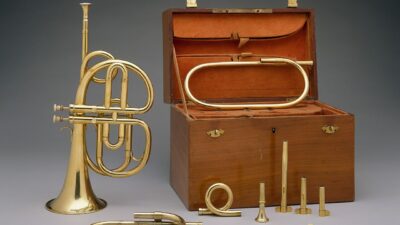
शास्त्र विंग · वाद्य-पट्टिका · Instrument Plate
कॉर्नेट
Cornet
अन्य नामकॉर्नेट · कॉरनेट · Cornet à pistons · Cornopean (historical)
परिचय
Overviewकॉर्नेट पीतल-वाद्य परिवार का गोल, गायन-प्रिय सदस्य है — तुरही का निकट चचेरा भाई, पर स्वभाव से कहीं नरम। इसकी शंक्वाकार नली और गहरी कप-मुखनली एक गर्म, मखमली स्वर देती है; तीन पिस्टन वाल्व इसे इतना फुर्तीला बनाते हैं कि यह ब्रास बैंडों का प्रिय एकल-वाद्य बना। 1820 के दशक के पेरिस में पोस्ट हॉर्न पर वाल्व चढ़ाकर इसका जन्म हुआ, और यही वह वाद्य था जिस पर लुई आर्मस्ट्रांग जैसे जैज़-प्रवर्तकों ने शुरुआत की। भारत में यह औपनिवेशिक बैंडों के साथ आया और आज बरात के 'बैंड-बाजे' से लेकर पुराने हिंदी फ़िल्म-वृंदों के पीतल-खंड तक हमारे उत्सव-संगीत की धड़कन है।
अंग्रेज़ी में पढ़ें · Read in English
The cornet is the round, song-loving member of the brass family — a close cousin of the trumpet but far gentler in temperament. Its conical bore and deep cup mouthpiece give a warm, velvety tone; three piston valves make it so agile that it became brass bands' favourite solo voice. It was born in 1820s Paris by fitting valves onto the post horn, and it was on this instrument that jazz pioneers such as Louis Armstrong began. In India it arrived with colonial bands and is today the heartbeat of festive music, from the baraat's 'band-baja' to the brass sections of old Hindi film orchestras.
वर्गीकरण
ClassificationNatya Shastra Category
सुषिर (Sushir — wind/blown aerophones; a Western import mapped to the closest classical Indian category)
कॉर्नेट भारतीय शास्त्रीय वर्गीकरण की दृष्टि से 'सुषिर' (फूँक से बजने वाले) वाद्य वर्ग में आता है, क्योंकि इसमें ध्वनि होंठों के कंपन और वायु-स्तंभ से उत्पन्न होती है। यह भारत की देशी परंपरा का वाद्य नहीं, बल्कि पश्चिमी पीतल-वाद्य (ब्रास) परिवार का सदस्य है जो औपनिवेशिक काल में भारतीय ब्रास बैंडों और आरंभिक फ़िल्म-संगीत के माध्यम से भारतीय ध्वनि-परिदृश्य में शामिल हुआ।
By Indian classical typology the cornet falls within the 'Sushir' (blown/aerophone) category, since its sound arises from the vibration of the player's lips against a cushion of air. It is not an indigenous Indian instrument but a member of the Western brass family, absorbed into the Indian soundscape during the colonial era through brass bands and early film music.
Western Category
Brass wind instrument (labrosone / lip-reed aerophone)
Western Family
Trumpet family — a close cousin of the trumpet and flugelhorn, distinguished by its predominantly conical bore
Sub Classification
बनावट
PhysicalDescription Hindi
कॉर्नेट एक कॉम्पैक्ट पीतल-वाद्य है जो देखने में तुरही (ट्रम्पेट) जैसा लगता है, किन्तु उससे छोटा, गोल और अधिक गठीला होता है। इसकी नली अधिकतर शंक्वाकार (कोनिकल) होती है — मुखनली पर संकरी और घंटी (bell) की ओर धीरे-धीरे चौड़ी होती जाती है — जिससे इसकी ध्वनि तुरही की तुलना में अधिक कोमल और मखमली बनती है। तीन पिस्टन वाल्व इसे पूर्ण वर्णक्रमीय (क्रोमैटिक) बनाते हैं।
Description English
The cornet is a compact brass instrument that resembles a trumpet but is shorter, rounder and more tightly coiled. Its tubing is predominantly conical — narrow at the mouthpiece and gradually widening towards the bell — which gives it a mellower, more velvety tone than the trumpet. Three piston valves make it fully chromatic.
Body
Compact, tightly wrapped brass tubing ending in a flared bell; more coiled than a trumpet
सघन रूप से लपेटी हुई पीतल की नली, अंत में फैली हुई घंटी; तुरही से अधिक कुंडलित
Brass (often lacquered or silver-plated); mouthpiece of brass or silver
पीतल (प्राय: लाख-लेपित या चाँदी-मुलम्मा); मुखनली पीतल या चाँदी की
Approx. 33-38 cm long (about two-thirds the outstretched length of a B♭ trumpet)
The conical bore itself acts as the resonating air column, projecting through the flared bell
Strings
The cornet has no strings — tone is produced by the vibration of the player's lips (embouchure) buzzing into a cup mouthpiece
None — the cornet is an aerophone, not a chordophone
The cornet does not sustain a drone; it is a melodic, single-line instrument
Bow
लागू नहीं (मुखनली से बजता है)
Not applicable (played with a mouthpiece, not a bow)
Mouthpiece: deep-cupped, short-shanked (deeper cup than a trumpet mouthpiece, contributing to the mellow tone)
Mouthpiece approx. 8-9 cm
The player buzzes the lips into the cup mouthpiece; air is blown continuously while the tongue articulates notes
Tuning Pegs
ट्यूनिंग स्लाइड / वाल्व स्लाइड
Tuning slide and valve slides
A main tuning slide is pushed in or drawn out to adjust overall pitch; individual valve slides fine-tune each valve combination
Bridge
लागू नहीं
Not applicable
No bridge — this is a wind instrument, not a stringed one
Not applicable
Frets
कॉर्नेट में फ्रेट या तार नहीं होते। स्वर तीन पिस्टन वाल्वों और होंठों के तनाव (हार्मोनिक श्रृंखला) के संयोजन से चुने जाते हैं; वाल्वों के बीच होंठों को साधकर 'लिप-बेंड' और 'ग्लाइड' भी संभव हैं।
The cornet has no frets or strings. Pitches are selected by combining the three piston valves with lip tension (the harmonic series); between valve settings, skilled players can lip-bend and glide notes as well.
ध्वनि-चरित्र
SoundTonal Character Hindi
कॉर्नेट की ध्वनि गर्म, गोल और मखमली होती है — तुरही की चुभती-चमकती धार की तुलना में अधिक मृदु और गायन-सी। यही कोमलता इसे धुन-प्रधान (मेलोडी) भूमिकाओं और भावुक एकल-वादन के लिए आदर्श बनाती है। साथ ही यह अत्यंत फुर्तीली है, इसलिए तेज़ अलंकार और चपल हरकतें सहजता से बजती हैं।
Tonal Character English
The cornet's tone is warm, round and velvety — softer and more song-like than the trumpet's brilliant, cutting edge. This mellowness makes it ideal for melodic leads and expressive solos. It is also highly agile, so rapid ornaments and nimble runs come easily.
Timbre
Warm, mellow, vocal; less brassy 'ping' than a trumpet due to the conical bore and deep-cup mouthpiece
Range
Roughly two and a half octaves in comfortable playing (written from F♯ below middle C upward), extendable higher by advanced players; a transposing instrument in B♭
Dynamic Range
Wide — from a soft, singing pianissimo to a full, ringing fortissimo, though gentler at the top than the trumpet
Techniques
सुनने का मार्गदर्शन
The Listening Guideकॉर्नेट को समझना हो तो पहले उसे तुरही के साथ रखकर सुनिए — कॉर्नेट की आवाज़ अधिक गोल और गुनगुनाती लगेगी, तुरही अधिक चमकीली और भेदक। किसी धीमे एकल से शुरुआत कीजिए जहाँ उसका वाइब्रेटो खुलकर गाता है, फिर पर्सी कोड की 'ज़ेल्डा' जैसी तेज़ रचना में उसकी चपलता देखिए; और सबसे अंत में अपने ही मोहल्ले की किसी बरात के बैंड-बाजे में उसे उसके असली उत्सवी घर में सुनिए।
अंग्रेज़ी में पढ़ें · Read in English
To understand the cornet, first hear it beside the trumpet — listen closely and you will find the cornet rounder, more humming and less piercing. Begin with a slow solo (such as the cornet version of 'You Raise Me Up'), where its vocal vibrato shines. Then hear a virtuoso piece like Percy Code's 'Zelda', full of nimble double-tonguing. Finally, listen to a baraat or brass band — there the cornet rings out in its true, festive home.
श्रवण-कक्ष · The Listening Room
देखें-सुनें
Trumpet vs Cornet - discussion and demonstration · 5:58
You raise me up (cornet solo) · 5:04
James Shepherd plays the Cornet Solo Zelda by Percy Code (Black Dyke Mills, 1970) · 6:26
परिचय
Identity- Year Of Origin
- 1828
अन्य विवरण
More DetailsTimbre
Warm, mellow, vocal; less brassy 'ping' than a trumpet due to the conical bore and deep-cup mouthpiece
रोचक तथ्य
Margin Notesपोस्ट हॉर्न से जन्मा वाद्य — कॉर्नेट कोई प्राचीन वाद्य नहीं — यह 1820-30 के दशक में पेरिस में तब बना जब निर्माताओं ने साधारण 'पोस्ट हॉर्न' (डाक-नरसिंगा) पर नए पिस्टन वाल्व जोड़ दिए। इसी एक नवाचार से पीतल-वाद्य पहली बार पूरी तरह वर्णक्रमीय और फुर्तीला बन सका।
The cornet is no ancient instrument — it was created in Paris in the 1820s-30s when makers added the new piston valves to the humble post horn. That single innovation made a brass instrument fully chromatic and agile for the first time.
जैज़ का पहला वाद्य — न्यू ऑर्लीन्स के आरंभिक जैज़ की धुन-आवाज़ कॉर्नेट थी। बडी बोल्डन और युवा लुई आर्मस्ट्रांग ने इसी पर बजाया; तुरही की चढ़त बाद में आई।
The melodic voice of early New Orleans jazz was the cornet. Buddy Bolden and a young Louis Armstrong played it; the trumpet's rise came later.
ब्रास बैंड का 'प्रथम स्वर' — ब्रिटिश-शैली के मानक ब्रास बैंड में प्रायः नौ B♭ कॉर्नेट और एक E♭ सोप्रानो कॉर्नेट होते हैं — यही समूह की अग्रणी धुन-पंक्ति बनाते हैं। भारत के विवाह-बैंड इसी परंपरा की देशी संतान हैं।
A standard British-style brass band typically has nine B♭ cornets and one E♭ soprano cornet — together they form the ensemble's leading melodic line. India's wedding bands are the indigenous offspring of this very tradition.
तुरही की छाया में — बीसवीं सदी के मध्य तक कॉर्नेट को उसकी अधिक चमकीली बहन तुरही ने आर्केस्ट्रा और जैज़ दोनों से लगभग विस्थापित कर दिया; अनेक फ़िल्म-स्वरलिपियों में 'कॉर्नेट' भाग चुपचाप तुरही में बदल दिया गया। किन्तु ब्रास और विवाह-बैंडों में यह आज भी राज करती है।
By the mid-20th century the cornet was largely displaced from both orchestra and jazz by its brighter sister, the trumpet; in many film scores the 'cornet' part was quietly reassigned to the trumpet. Yet in brass and wedding bands it still reigns.
सवाल-जवाब
Questions & Answersकॉर्नेट क्या है?
कॉर्नेट एक पश्चिमी पीतल-वाद्य है — तुरही का निकट चचेरा भाई — जो तीन पिस्टन वाल्वों से बजता है। इसकी नली अधिकतर शंक्वाकार होने से इसका स्वर तुरही की तुलना में अधिक कोमल और गायन-सा होता है। यह ब्रास बैंडों और भारतीय विवाह-बाजे की मुख्य धुन-आवाज़ है।
कॉर्नेट और तुरही में क्या अंतर है?
दोनों B♭ में होते हैं और लगभग एक ही रेंज बजाते हैं, पर कॉर्नेट छोटा, अधिक कुंडलित और शंक्वाकार-नली वाला होता है, जिससे उसका स्वर गर्म और कोमल लगता है; तुरही की नली बेलनाकार होने से उसका स्वर अधिक चमकीला व भेदक होता है।
कॉर्नेट का भारतीय संगीत से क्या संबंध है?
कॉर्नेट भारत का देशी वाद्य नहीं है; यह औपनिवेशिक सैन्य और चर्च बैंडों के साथ भारत आया। यहाँ यह विवाह और बरात के 'बैंड-बाजा' की मुख्य धुन बना और स्वर्णयुगीन हिंदी फ़िल्म-वृंदों के पीतल-खंड का हिस्सा रहा।
कॉर्नेट का आविष्कार कब हुआ?
कॉर्नेट 1820-30 के दशक में पेरिस, फ़्रांस में बना, जब पुराने 'पोस्ट हॉर्न' पर पेरिने पिस्टन वाल्व जोड़े गए। इससे यह पहला पूरी तरह वर्णक्रमीय, फुर्तीला पीतल-वाद्य बना।
क्या कॉर्नेट जैज़ में इस्तेमाल हुआ?
हाँ — आरंभिक न्यू ऑर्लीन्स जैज़ की मुख्य धुन-आवाज़ कॉर्नेट थी। बडी बोल्डन और युवा लुई आर्मस्ट्रांग ने इसी पर बजाया; बाद में तुरही ने इसका स्थान ले लिया।
नमूना-पट्टी
The Specimen Table| नाम | कॉर्नेट · Cornet |
|---|---|
| अन्य नाम | कॉर्नेट · कॉरनेट · Cornet à pistons · Cornopean (historical) · Cornet (also: Kornett) |
| उद्गम | 1828 |
| प्रकार | वाद्य · Instruments |
साझा कीजिए · Share this Plate