शास्त्र विंग · वाद्य-पट्टिका · Instrument Plate
चंगु
Changu
अन्य नामचांगु · चंगु नट / चंगु नाच (Changu Nata / Changu Nacha — the dance named after it) · Changu (also: Chāngu, Chango)
परिचय
Overviewचंगु ओडिशा के जनजातीय अंचल का एक बड़ा, एकल-मुख फ्रेम ड्रम है — लकड़ी के चौड़े घेरे पर तनी बकरी की खाल, जिसे केवल हथेली और उँगलियों से बजाया जाता है। जुआंग और भुइयाँ समुदायों में इसी वाद्य पर 'चंगु नाच' होता है, जहाँ पुरुष बजाते-गाते हैं और स्त्रियाँ थिरकती हैं। करम, माघे परब और सरहुल जैसे उत्सवों की यह धड़कती हुई आत्मा है।
अंग्रेज़ी में पढ़ें · Read in English
The changu is a large, single-membrane frame drum of Odisha's tribal belt — goat skin stretched over a broad wooden hoop, played only with palm and fingers. It is the drum of the 'Changu Nacha' among the Juang and Bhuiyan, where men drum and sing while women dance. It is the beating heart of festivals like Karma, Maghe Parab and Sarhul.
वर्गीकरण
ClassificationNatya Shastra Category
अवनद्ध (Avanaddha - membranophone / covered percussion)
नाट्यशास्त्र की चतुर्विध वाद्य-व्यवस्था (तत, सुषिर, अवनद्ध, घन) में चंगु 'अवनद्ध' वर्ग का वाद्य है — अर्थात् वह वाद्य जिसका मुख चमड़े से मढ़ा (ढका) जाता है। यह एक ही ओर से मढ़ा हुआ चर्म-वाद्य है, अतः इसे एकल-मुख (single-membrane) फ्रेम ड्रम कहा जाता है।
In the fourfold classification of the Natya Shastra (Tata, Sushira, Avanaddha, Ghana), the changu belongs to the 'Avanaddha' category — instruments whose mouth is covered (stretched) with hide. It is skinned on only one face, making it a single-membrane frame drum.
Western Category
Membranophone (single-headed frame drum)
Western Family
Frame drum family — a shallow circular wooden hoop with one skin head, kin to the daf, bodhrán and jingle-less tambourine
Sub Classification
बनावट
PhysicalDescription Hindi
चंगु एक बड़ा, गोल फ्रेम ड्रम है जिसमें लकड़ी का एक चौड़ा वलय (घेरा) होता है और उसके केवल एक मुख पर पशु-चर्म मढ़ा रहता है। इसकी बनावट सरल, मज़बूत और खुले मैदान में बजने योग्य है — कोई तार, कोई परदा (फ्रेट) नहीं, बस लकड़ी और खाल की आदिम प्रतिध्वनि। जुआंग समुदाय में इसे परंपरागत रूप से 'दमन' नामक लकड़ी और बकरी की खाल से बनाया जाता है।
Description English
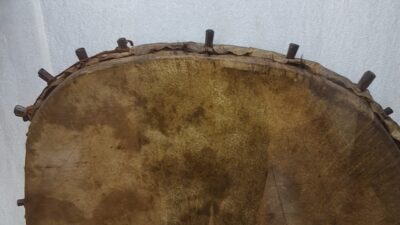
The changu is a large, round frame drum: a broad wooden hoop skinned with animal hide on one face only. Its build is simple, sturdy and made to sound in the open air — no strings, no frets, just the primal resonance of wood and skin. In the Juang community it is traditionally built from a wood called 'Daman' and covered with goat skin.
Body
Circular open hoop (frame)
गोल खुला वलय (फ्रेम)
Wooden ring/hoop — traditionally 'Daman' wood among the Juang of the Gonasika hills
लकड़ी का वलय — जुआंग परंपरा में प्रायः गोनासिका पर्वत का 'दमन' काष्ठ
approx. 40-60 (a large hand drum; exact dimensions vary by maker and tribe)
shallow rim (a few inches) — characteristic of a frame drum rather than a barrel drum
Open-backed frame — the single skin head vibrates over a shallow open hoop, giving an earthy, un-tuned resonance rather than a sealed acoustic chamber
Membrane
1 (single head)
केवल एक ओर मढ़ा हुआ चर्म-मुख। पशु-खाल (जुआंग में बकरी की खाल; अन्य समुदायों में बकरी अथवा गोवंश का चर्म) वलय पर तानकर बाँधी जाती है।
A single skin face. Animal hide (goat skin among the Juang; goat or cattle hide among other communities) is stretched taut and fastened over the wooden hoop.
Goat skin (traditional); cow/buffalo hide in some regions
बकरी की खाल (परंपरागत); कुछ क्षेत्रों में गाय/भैंस का चर्म
Hide lapped over the hoop edge and secured by lacing/binding around the rim; not machine-tuned
Tuning
ताप-तनाव (आग की गरमी से)
Heat-tensioning
चंगु में कोई पेंच या यांत्रिक ट्यूनिंग नहीं होती। बजाने से पूर्व वादक चर्म-मुख को आग या धूप की गरमी के पास ले जाकर कसते हैं ताकि खाल तनकर गहरी, खनकती ध्वनि दे। नमी में स्वर मंद पड़ जाता है।
The changu has no screws or mechanical tuning. Before playing, performers warm the skin head near a fire or in the sun to tighten it for a deep, ringing tone; in damp weather the pitch goes slack and dull.
Playing Grip
पकड़ एवं वादन
Grip and striking
वादक चंगु को एक हाथ से पकड़कर (अथवा गले/कंधे में झुलाकर) दूसरे हाथ की उँगलियों और हथेली से बजाता है; प्रायः दोनों हाथों की अँगुलियों-हथेलियों से थाप दी जाती है। कोई डंडा (स्टिक) नहीं — पूर्णतः करतल वादन।
The player holds the changu in one hand (or slings it against the body) and strikes the head with the fingers and palm of the other; often both hands' fingers and palms are used. There is no beater stick — it is played entirely by hand.
Beater
चंगु हस्त-वाद्य है — इसे केवल उँगलियों और हथेली से बजाया जाता है, किसी डंडे से नहीं।
The changu is a hand drum — struck only with fingers and palm, never with a stick.
Frets
यह चर्म-वाद्य है, अतः इसमें परदे या तार नहीं होते; स्वर के स्थान पर लय, नाद और थाप की गूँज प्रधान है।
Being a membrane drum, it has no frets or strings; instead of pitch it foregrounds rhythm, boom and the ring of the struck skin.
ध्वनि-चरित्र
SoundTonal Character Hindi
चंगु की ध्वनि गहरी, भरी और गूँजती हुई है — केंद्र पर पड़ी थाप एक बड़ी, बूम-सी बास देती है, जबकि किनारे की चोट तीखी 'ताक' पैदा करती है। यह मिट्टी से जुड़ी, आदिम और उत्तेजक लय है जो सामूहिक नृत्य को गति देती है और खुले मैदान में दूर तक सुनाई देती है।
Tonal Character English
The changu's voice is deep, full and resonant — a strike in the centre yields a big booming bass, while a blow at the rim produces a sharp 'tak'. It is an earthy, primal, driving rhythm that powers communal dance and carries far across open ground.
Timbre
Warm low boom with a bright ringing edge; un-tuned, percussive, open resonance
Range
Indefinite pitch — a low fundamental boom with contrasting rim tones (not a melodic instrument)
Dynamic Range
Loud and outdoor-strong; capable of soft palm-taps for texture but built to project over a dancing, singing crowd
Techniques
सुनने का मार्गदर्शन
The Listening Guideचंगु को समझना हो तो इसे अकेले नहीं, नृत्य के साथ सुनिए। केंद्र की गहरी थाप और किनारे की तीखी 'ताक' के संवाद को पकड़िए। देखिए कैसे पुरुषों की थाप-गीत स्त्रियों के कदमों को बुलाते हैं — यही आगे-पीछे की चाल चंगु नाच का मर्म है। करम या सरहुल के किसी सामुदायिक प्रदर्शन में ही इसकी असली ऊर्जा खुलती है।
अंग्रेज़ी में पढ़ें · Read in English
To understand the changu, hear it not alone but with the dance. Catch the dialogue between the deep bass of the centre-strike and the sharp 'tak' of the rim. Notice how the men's drumming and song call to the women's steps — this to-and-fro is the very soul of the Changu dance. Watch a video of a community performance at Karma or Sarhul; only then does the instrument's collective energy open up.
श्रवण-कक्ष · The Listening Room
देखें-सुनें
Changu Dance of the Juang tribe (English) · 3:11
Juang Changu Dance · 2:26
Changu tribal Orissa folk dance in Keonjhar — Juanga adivasi · 7:03
अन्य विवरण
More Details- Name English
- Heat-tensioning
- Description English
- The changu has no screws or mechanical tuning. Before playing, performers warm the skin head near a fire or in the sun to tighten it for a deep, ringing tone; in damp weather the pitch goes slack and dull.
- Name
- ताप-तनाव (आग की गरमी से)
- Description
- चंगु में कोई पेंच या यांत्रिक ट्यूनिंग नहीं होती। बजाने से पूर्व वादक चर्म-मुख को आग या धूप की गरमी के पास ले जाकर कसते हैं ताकि खाल तनकर गहरी, खनकती ध्वनि दे। नमी में स्वर मंद पड़ जाता है।
Tuning
Timbre
Warm low boom with a bright ringing edge; un-tuned, percussive, open resonance
रोचक तथ्य
Margin Notesनाम जो नृत्य बन गया — 'चंगु नाच' या 'चंगु नट' नामक लोकनृत्य पूर्णतः इसी वाद्य के इर्द-गिर्द बुना गया है। यह इतना अभिन्न है कि चंगु के बिना यह नृत्य संभव ही नहीं — वाद्य और नृत्य एक-दूसरे के पर्याय बन गए हैं।
The folk dance called 'Changu Nacha' or 'Changu Nata' is woven entirely around this instrument. It is so integral that the dance is impossible without the changu — instrument and dance have become synonymous.
एक चौड़ा भूगोल — यद्यपि चंगु जुआंग एवं पौड़ी भुइयाँ से सर्वाधिक जुड़ा है, यह ओडिशा के सुंदरगढ़, केओंझर, मयूरभंज और फूलबनी (कंधमाल) क्षेत्रों की भुइयाँ, बाथुड़ी, खड़िया, मेची, गोंड एवं कोंध जनजातियों में भी बजता है।
Though most associated with the Juang and Paudi Bhuyan, the changu is also played among the Bhuiyan, Bathudi, Kharia, Mechi, Gond and Kondh tribes across Odisha's Sundargarh, Keonjhar, Mayurbhanj and Phulbani (Kandhamal) regions.
संग्रहालय में सहेजा हुआ — केओंझर के जुआंग समुदाय का एक चंगु नमूना भुवनेश्वर स्थित ओडिशा राज्य जनजातीय संग्रहालय में प्रदर्शित है — जो इस लोक-वाद्य को अभिलेखित एवं संरक्षित करने के शासकीय प्रयास का प्रमाण है।
A specimen changu of the Juang community from Keonjhar is displayed in the Odisha State Tribal Museum at Bhubaneswar — testament to institutional efforts to document and preserve this folk instrument.
फ्रेम ड्रम का कुटुम्ब — बनावट में चंगु एक फ्रेम ड्रम है — यानी उथले लकड़ी के घेरे पर एक ही चर्म-मुख। इस दृष्टि से यह सूफ़ी संगीत के 'डफ़' और आयरिश 'बोध्रान' का दूर का चचेरा है, यद्यपि इसका संगीतीय संसार पूर्णतः भिन्न आदिवासी लोक-परंपरा का है।
In construction the changu is a frame drum — a single skin head over a shallow wooden hoop. In that sense it is a distant cousin of the Sufi 'daf' and the Irish 'bodhrán', even though its musical world belongs wholly to a different tribal folk tradition.
सवाल-जवाब
Questions & Answersचंगु क्या है?
चंगु ओडिशा के जनजातीय अंचल का एक बड़ा, एकल-मुख फ्रेम ड्रम है — लकड़ी के चौड़े घेरे पर तनी पशु-खाल (प्रायः बकरी की), जिसे उँगलियों और हथेली से बजाया जाता है। यह जुआंग, भुइयाँ एवं अन्य आदिवासी समुदायों के 'चंगु नाच' का प्रमुख वाद्य है।
चंगु कैसे बजाया जाता है?
चंगु को एक हाथ से पकड़कर दूसरे हाथ (और प्रायः दोनों हाथों) की उँगलियों-हथेली से बजाया जाता है; इसमें कोई डंडा नहीं होता। केंद्र की थाप गहरी बास देती है और किनारे की चोट तीखी 'ताक'। बजाने से पहले खाल को गरमी से कसा जाता है।
चंगु नाच कौन करता है?
चंगु नाच में पुरुष चंगु बजाते और गीत गाते हैं जबकि स्त्रियाँ नृत्य करती हैं। यह भुइयाँ, जुआंग, बाथुड़ी, खड़िया, गोंड एवं कोंध समुदायों में सुंदरगढ़, केओंझर, मयूरभंज और कंधमाल क्षेत्रों में प्रचलित है।
चंगु किन उत्सवों में बजाया जाता है?
चंगु मुख्यतः कृषि-ऋतु और आदिवासी उत्सवों — करम पूजा, माघे परब एवं सरहुल — में बजाया जाता है, जब पूरा समुदाय मिलकर नाचता-गाता है।
क्या चंगु शास्त्रीय या फ़िल्मी संगीत में प्रयोग होता है?
नहीं। चंगु एक लोक/जनजातीय ताल-वाद्य है, जिसका हिंदुस्तानी/कर्नाटक राग-पद्धति या मुख्यधारा बॉलीवुड संगीत से संबंध नहीं। इसकी दुनिया ओडिशा की जनजातीय नृत्य-परंपरा तक सीमित है।
नमूना-पट्टी
The Specimen Table| नाम | चंगु · Changu |
|---|---|
| अन्य नाम | चांगु · चंगु नट / चंगु नाच (Changu Nata / Changu Nacha — the dance named after it) · Changu (also: Chāngu, Chango) |
| प्रकार | वाद्य · Instruments |
साझा कीजिए · Share this Plate