शास्त्र विंग · वाद्य-पट्टिका · Instrument Plate
चंडे
Chande
अन्य नामचेंडे (Chende) · चंडे (Chande) · बडगुतिट्टु चंडे (Badagutittu Chande) · तेंकुतिट्टु चंडे (Tenkutittu Chande)
परिचय
Overviewचंडे तटीय कर्नाटक की रंगमंच-परंपरा यक्षगान का गर्जन करता हुआ ताल-वाद्य है — कटहल की लकड़ी से खोदे बेलनाकार 'गूडु' पर मढ़ा गोवंश-चर्म, बारह रस्सी-कड़ियों में कसा, दो 'चंडे कोलु' डंडियों से बजने वाला बिजली-सा नाद। भागवत, मद्दले, ताल एवं श्रुति के साथ यह 'हिम्मेला' रचता है, जिसकी लय पर 'मुम्मेला' के वेशधारी कलाकार युद्ध एवं भक्ति की गाथाएँ जीते हैं। लगभग डेढ़ सदी पहले यक्षगान में जुड़ा यह वाद्य आज बडगुतिट्टु एवं तेंकुतिट्टु — दो शैलियों में जीवित है।
अंग्रेज़ी में पढ़ें · Read in English
The chande is the roaring rhythm instrument of Yakshagana, the theatre tradition of coastal Karnataka — cow-skin over a cylindrical 'goodu' carved from jackfruit wood, held by twelve rope loops and struck by a pair of 'chande kolu' sticks into a lightning-like sound. With the bhagavata, maddale, taala and shruti it forms the 'himmela', to whose rhythm the costumed 'mummela' performers live out tales of war and devotion. Added to Yakshagana roughly a century and a half ago, it survives today in two schools — Badagutittu and Tenkutittu.
वर्गीकरण
ClassificationNatya Shastra Category
अवनद्ध (Avanaddha - covered/membrane percussion instruments)
नाट्यशास्त्र की चतुर्विध वाद्य-प्रणाली में चंडे 'अवनद्ध' वर्ग का वाद्य है — अर्थात चमड़े से मढ़ा हुआ ताल-वाद्य, जिसकी ध्वनि खिंचे हुए चर्मपटल पर आघात से उत्पन्न होती है। यह मृदंग, ढोल एवं नगाड़े के समान परिवार का है।
In the fourfold instrument system of the Natya Shastra, the chande belongs to the 'Avanaddha' (covered/membranophone) category — a skin-headed rhythm instrument whose sound is produced by striking a stretched membrane. It belongs to the same family as the mridangam, dhol, and nagara.
Western Category
Membranophone (drum)
Western Family
Cylindrical stick-drum family (open-air processional/theatre drums, related to the Kerala chenda)
Sub Classification
बनावट
PhysicalDescription Hindi
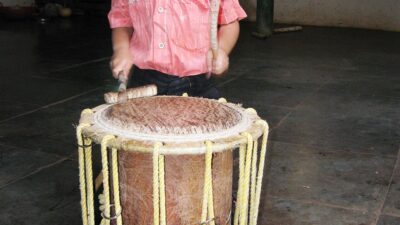
चंडे एक ऊँची, बेलनाकार आकृति का दो-मुखी ताल-वाद्य है जिसे यक्षगान के कलाकार गले में पट्टे से लटकाकर, खड़े होकर बजाते हैं। इसका खोखला काष्ठ-शरीर (कन्नड़ में 'गूडु') परंपरागत रूप से कटहल (हलसु) की लकड़ी से — तथा कुछ बडगुतिट्टु वाद्यों में नारियल की लकड़ी से — बनाया जाता है, और दोनों सिरों पर संस्कारित गोवंश-चर्म का पटल मढ़ा होता है। यह वाद्य अपनी अत्यंत तीव्र, भेदक और दूर तक पहुँचने वाली ध्वनि के लिए जाना जाता है, जो रात भर चलने वाले खुले-मंच प्रदर्शन में मीलों तक सुनाई देती है।
Description English
The chande is a tall, cylindrical, double-headed rhythm instrument that Yakshagana performers play standing, with the drum slung vertically from a strap around the neck. Its hollow wooden body (called 'goodu' in Kannada) is traditionally carved from jackfruit (halasu) wood — and in some Badagutittu instruments from coconut wood — with processed cow-skin membranes stretched over both ends. The instrument is celebrated for its extremely loud, piercing, far-carrying tone that cuts across all-night open-air performances.
Body
Tall hollow cylinder (barrel), open-air theatre drum
ऊँचा खोखला बेलन (ढोलनुमा), खुले मंच का रंगमंच-वाद्य
Jackfruit wood (Kannada: Kakke / Baine / Jambe); some Badagutittu drums use coconut wood
कटहल की लकड़ी (कन्नड़: कक्के / बाइने / जंबे); कुछ बडगुतिट्टु वाद्यों में नारियल की लकड़ी
45-60 (varies by school and maker)
Single open cylindrical wooden shell ('goodu') with a membrane at each end; the shell projects the struck head's sound outward
Strings
Chande is a membranophone (drum) — it has no strings; sound comes from struck cow-skin heads, not strings
None — chande has no sympathetic strings
None
Membrane
संस्कारित गोवंश-चर्म (प्रसंस्कृत गाय की खाल), दोनों मुखों पर मढ़ा हुआ
Processed cow skin, stretched over both heads
Outer rim approx. 32 cm; inner opening approx. 23 cm; effective playing surface approx. 20 cm
पटल को काष्ठ-शरीर से लगभग 12 कड़ियों (हुक/छल्लों) में पिरोई मोटी रस्सियों से बाँधा जाता है; रस्सियों में लकड़ी के फंचर (पाचर/wedge) घुमाकर तनाव बढ़ाया-घटाया जाता है जिससे स्वर साधा जाता है।
The head is bound to the wooden shell through roughly 12 loops (hooks/braces) of thick rope; wooden wedges twisted into the rope raise or lower tension, which is how the drum is tuned (badagutittu drums are commonly tuned to a D–E shruti).
Bow
चंडे कोलु (डंडियाँ)
Chande kolu (a pair of playing sticks)
Wood; a matched pair of sticks each about 28 cm long
28
Chande is a stick drum — not bowed. Two sticks strike the upper head: the dominant-hand stick has a thicker, tapering head, the other is slightly thicker with less taper. Rolling the dominant stick on a wooden wedge fixed at the head's edge produces the characteristic fluttering fillers between beats.
Tuning Pegs
पाचर / फंचर (काष्ठ)
Wooden wedges (in the rope lacing)
There are no pegs; tuning is done by twisting wooden wedges into the rope lacing to increase or decrease membrane tension
Bridge
लागू नहीं
N/A
A drum has no bridge; a small wooden wedge fixed at the rim edge acts as the surface on which the stick is rolled for flutter strokes
Wood
Frets
चंडे एक ताल-वाद्य है; इसमें फ्रेट या स्वर-पर्दे नहीं होते। स्वर एवं लय पूर्णतः डंडियों के आघात-स्थान, बल एवं गति से नियंत्रित होते हैं।
The chande is a rhythm instrument; it has no frets. Pitch and rhythm are controlled entirely by where, how hard, and how fast the sticks strike the head.
ध्वनि-चरित्र
SoundTonal Character Hindi
चंडे की ध्वनि अत्यंत तीव्र, ऊँचे स्वर वाली, धारदार और भेदक है — मानो युद्ध की ललकार। यह विद्युत की भाँति कड़कती है और खुले आकाश के नीचे रात भर चलने वाले यक्षगान की वीर, रौद्र एवं अद्भुत रस की स्थितियों में रोमांच भर देती है। मृदु शृंगार की जगह यह ऊर्जा, वेग एवं नाटकीय तीव्रता का वाद्य है।
Tonal Character English
The chande's tone is extremely loud, high-pitched, sharp, and penetrating — like a battle-cry. It cracks like lightning and, under the open sky of an all-night Yakshagana, electrifies the heroic (vira), furious (raudra), and wondrous (adbhuta) moods of the drama. Rather than tender lyricism, it is an instrument of energy, speed, and dramatic intensity.
Timbre
Bright, cutting, high-tension crack with a rattling flutter on rolled strokes; designed to project outdoors without amplification
Range
Rhythm instrument — no melodic range; tuned to a fixed shruti (commonly D–E for badagutittu) that anchors the ensemble
Dynamic Range
Overwhelmingly loud at full attack; capable of soft rolling fillers and rapid crescendos that mirror the dancer's footwork
Techniques
सुनने का मार्गदर्शन
The Listening Guideचंडे को समझना हो तो किसी यक्षगान के युद्ध-दृश्य या 'ओड्डोलग' (राज-प्रवेश) से शुरुआत कीजिए — वहीं इसकी बिजली-सी गति खुलती है। सुनिए कैसे ऊँची, धारदार चंडे गहरे मद्दले के साथ प्रश्न-उत्तर करती है और नर्तक के पैरों के साथ पल-पल तेज़ होती जाती है। फिर एकल 'चेंडे वादन' सुनिए, जहाँ अकेली डंडियाँ एक पूरी कथा बुन देती हैं।
अंग्रेज़ी में पढ़ें · Read in English
To understand the chande, begin with a Yakshagana battle scene or an 'oddolaga' (royal court entry) — there its speed and edge unfold. Notice how the loud, sharp chande trades call-and-response with the deep maddale, and how it accelerates moment by moment with the dancer's footwork. Then hear a solo 'chende vadana', where the sticks alone weave a narrative.
श्रवण-कक्ष · The Listening Room
देखें-सुनें
Chende Vaadana by Suman and Team · 10:55
Chende Vaadana Yakshagana : Drum Beats Show by Aadithya K S · 6:24
Amazing Fastest Chande playing in Yakshagana · 2:38
परिचय
Identity- Year Of Origin
- 1870
अन्य विवरण
More DetailsTimbre
Bright, cutting, high-tension crack with a rattling flutter on rolled strokes; designed to project outdoors without amplification
रोचक तथ्य
Margin Notesएक ही परंपरा का वाद्य — चंडे विश्व के उन विरल वाद्यों में है जो लगभग पूर्णतः एक ही रंग-परंपरा — यक्षगान — के लिए ही बजाया जाता है। कहा जाता है कि यह 'कर्नाटक के यक्षगान में ही विशिष्ट रूप से प्रयुक्त होता है।'
The chande is among the rare instruments of the world played almost entirely for a single theatre tradition — Yakshagana. It is said to be 'used exclusively in the Yakshagana of Karnataka.'
कटहल की लकड़ी एवं बारह कड़ियाँ — चंडे का खोखला शरीर ('गूडु') परंपरागत रूप से कटहल की लकड़ी से खोदा जाता है, और चर्म-पटल लगभग बारह रस्सी-कड़ियों में बँधा होता है; लकड़ी की पाचरों को घुमाकर स्वर साधा जाता है।
The chande's hollow body ('goodu') is traditionally carved from jackfruit wood, and the skin head is bound through roughly twelve rope loops; wooden wedges are twisted to tune it.
फड़फड़ाहट का रहस्य — चंडे की विशिष्ट 'फड़फड़ाती' भराव-ध्वनि पटल के किनारे लगी एक लकड़ी की पाचर के कारण संभव होती है, जिस पर प्रमुख हाथ की डंडी को लुढ़काया जाता है — यही बीट के बीच अनेक सूक्ष्म भराव उत्पन्न करती है।
The chande's signature 'fluttering' fillers are made possible by a wooden wedge fixed at the head's rim, on which the dominant-hand stick is rolled — producing many fine fillers between the beats.
उत्तर बनाम दक्षिण — बडगुतिट्टु (उत्तरी शैली) एवं तेंकुतिट्टु (दक्षिणी शैली) यक्षगान की दो घरानों में चंडे की बनावट, स्वर एवं वादन-रीति भिन्न है; तेंकुतिट्टु चंडे केरल की सीमा से लगे क्षेत्रों में 'चेंडा' के निकट है।
In the Badagutittu (Northern) and Tenkutittu (Southern) schools of Yakshagana, the chande differs in build, tuning and playing style; the Tenkutittu chande, in the districts bordering Kerala, is close to the 'chenda'.
सवाल-जवाब
Questions & Answersचंडे क्या है?
चंडे तटीय कर्नाटक की रंगमंच परंपरा यक्षगान में बजाया जाने वाला एक ऊँचा, बेलनाकार, दो-मुखी ताल-वाद्य है। इसे गले में पट्टे से लटकाकर, खड़े होकर, दो लकड़ी की डंडियों ('चंडे कोलु') से बजाया जाता है, और इसकी ध्वनि अत्यंत तीव्र एवं दूर तक पहुँचने वाली होती है।
चंडे किस लकड़ी से बनता है?
चंडे का खोखला शरीर ('गूडु') परंपरागत रूप से कटहल की लकड़ी (कुछ बडगुतिट्टु वाद्यों में नारियल की लकड़ी) से बनता है, और दोनों मुखों पर संस्कारित गोवंश-चर्म मढ़ा होता है। चर्म को लगभग बारह रस्सी-कड़ियों से बाँधा जाता है और लकड़ी की पाचरों से स्वर साधा जाता है।
चंडे की कौन-कौन सी शैलियाँ हैं?
चंडे की दो प्रमुख शैलियाँ हैं — बडगुतिट्टु (उत्तरी शैली) एवं तेंकुतिट्टु (दक्षिणी शैली)। तेंकुतिट्टु चंडे, जो केरल की सीमा से लगे क्षेत्रों में प्रचलित है, केरल के 'चेंडा' से घनिष्ठ रूप से जुड़ी है।
क्या चंडे हिंदी फिल्म-संगीत में प्रयुक्त होता है?
मुख्यधारा बॉलीवुड में चंडे का प्रयोग विरल है — यह उत्तर भारतीय फिल्म-वाद्य नहीं है। इसका मुख्य क्षेत्र यक्षगान रंगमंच है; यदा-कदा यह दक्षिण भारतीय (कन्नड़/तुलु) फिल्मों एवं फ्यूज़न-प्रयोगों में नाटकीय प्रभाव हेतु सुनाई देता है।
चंडे यक्षगान में कब जुड़ा?
यक्षगान में चंडे का नियमित प्रयोग लगभग 150 वर्ष पुराना ही है — इससे पहले प्रमुख ताल-वाद्य केवल मद्दले था। चंडे के जुड़ने से यक्षगान को उसकी विशिष्ट रौद्र-वीर, युद्ध-जैसी ऊर्जा प्राप्त हुई।
नमूना-पट्टी
The Specimen Table| नाम | चंडे · Chande |
|---|---|
| अन्य नाम | चेंडे (Chende) · चंडे (Chande) · बडगुतिट्टु चंडे (Badagutittu Chande) · तेंकुतिट्टु चंडे (Tenkutittu Chande) |
| उद्गम | 1870 |
| प्रकार | वाद्य · Instruments |
साझा कीजिए · Share this Plate