शास्त्र विंग · वाद्य-पट्टिका · Instrument Plate
बुगचू
Bugchu
अन्य नामबुघचू · बुगदू (Bugdu / Bughdu) · बुघदू · Bugchu (also: Bughchu, ਬੁਘਚੂ)
परिचय
Overviewबुगचू पंजाब का एक नन्हा, डमरू जैसा लोक-वाद्य है जिसकी खाल के बीच से एक डोर पिरोई होती है। बाँह की कुहनी में दबाकर, उस डोर को छेड़ते-खींचते हुए बजाने पर यह ठीक अपने नाम जैसी 'बुग-चू' टर्राती, उछलती पुकार छोड़ता है। यह कोई राग या धुन नहीं बजाता — यह भँगड़ा और मालवई गिद्दा की वह जीवंत, 'बोलती' धड़कन है जो ढोल की गड़गड़ाहट में लोच और मस्ती भर देती है।
अंग्रेज़ी में पढ़ें · Read in English
The bugchu is a tiny, damru-like folk instrument of Punjab, with a cord threaded through the centre of its skin head. Cradled in the crook of the arm and played by plucking and stretching that cord, it lets out a croaky, springy 'bug-choo' call exactly like its name. It plays no raga or melody — it is that living, 'talking' pulse of bhangra and Malwai Giddha which lends elasticity and joy to the rumble of the dhol.
वर्गीकरण
ClassificationNatya Shastra Category
अवनद्ध (Avanaddha - membranophone / covered percussion instruments)
अवनद्ध वर्ग में बुगचू एक चर्म-मढ़ा (झिल्ली वाला) वाद्य है, किंतु यह साधारण ढोल से भिन्न है — इसकी झिल्ली को हाथ से नहीं, बल्कि उसमें पिरोई एक डोर को खींचकर और छेड़कर बजाया जाता है। डोर के तनाव को घटा-बढ़ाकर स्वर 'बोलता' सा लगता है।
Within the Avanaddha (skin-covered percussion) category, the bugchu is a membranophone, but unlike an ordinary drum it is not struck on its head — instead a cord threaded through the skin is plucked while its tension is varied, making the pitch 'talk'. It belongs to the family of variable-tension plucked/friction drums.
Western Category
Variable-tension plucked / friction drum (membranophone)
Western Family
Plucked-string drum family — closely related to the Bengali khamak / gubgubbi / anandalahari and the ektara-family gopichand, and hourglass-shaped like the damru
Sub Classification
बनावट
PhysicalDescription Hindi
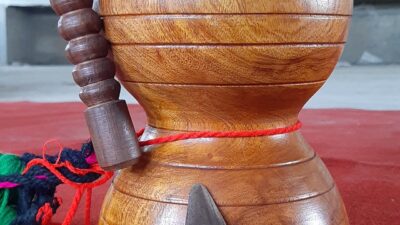
बुगचू एक छोटा, घंटी-घड़ी (hourglass) के आकार का पंजाबी लोक वाद्य है — देखने में डमरू जैसा। इसका ढाँचा लकड़ी या सूखे कद्दू (लौकी/तुम्बा) से बनता है, जिसके एक या दोनों मुँह पर बकरी की खाल मढ़ी जाती है। खाल के बीचोंबीच से एक मोटी डोर पिरोई जाती है और उसके सिरे पर लकड़ी की एक गाँठ या गुल्ली बँधी होती है। वाद्य छोटा और हल्का होता है ताकि इसे बाँह की कुहनी में दबाकर बजाया जा सके।
Description English
The bugchu is a small, hourglass-shaped Punjabi folk instrument that looks much like a damru. Its frame is turned from wood or fashioned from a dried gourd (bottle-gourd / tumba), with goat-skin stretched over one or both mouths. A thick cord is threaded through the centre of the skin and knotted to a small wooden knob or peg at the other end. It is deliberately small and light so it can be tucked into the crook of the arm while played.
Body
Hourglass / waisted (like a damru), two flared mouths joined by a narrow middle
घंटीघड़ी/डमरू जैसा — बीच से पतला, दोनों सिरों पर चौड़ा
Turned wood (sheesham/mango) or a hollowed dried gourd (tumba / kaddu)
खरादी लकड़ी (शीशम/आम) अथवा खोखला किया सूखा कद्दू (तुम्बा/लौकी)
12-20
Small hollow waisted shell open at the skin head; the stretched skin acts as the sounding membrane amplified by the shell
Strings
A single thick internal cord (डोर) passing through the centre of the skin, plucked to sound the instrument
The bugchu has no sympathetic strings; its characteristic buzzing 'bug-choo' pulse comes purely from the plucked cord coupling to the skin
The single cord also functions as a rhythmic drone-pulse — a steady, croaky throb rather than a sustained pitch
Bow
छेड़ / गुल्ली
Striker / fingers (no bow)
Played by plucking the cord with the fingers of the free hand, or with a small wooden striker; there is no bow
N/A
The instrument is cradled in the crook of one arm; the cord is held in the palm of that same arm's hand, and the free hand plucks/flicks the cord while the cradling arm squeezes to bend the tension
Tuning Pegs
गाँठ / गुल्ली
Knot / knob
There are no rotating pegs — the cord is simply knotted to a wooden knob; 'tuning' is done live, by hand tension, not by a fixed peg
Bridge
चर्म-मुख
Skin head
The stretched skin itself is the sounding surface; the cord's vibration is transmitted directly into the membrane and shell
Goat skin over a wooden/gourd shell
Frets
बुगचू में न फ्रेट होते हैं न कोई सुर-स्थान — पूरा 'स्वर' खिलाड़ी की बाँह के दबाव और डोर के खिंचाव से जीवंत रूप से बनता है, जिससे 'बोलती' सी ध्वनि निकलती है।
The bugchu has neither frets nor fixed note positions — the entire 'pitch' is shaped live by the player's arm pressure and cord tension, producing a 'talking', swooping sound.
ध्वनि-चरित्र
SoundTonal Character Hindi
बुगचू की आवाज़ खुरदुरी, टर्राती और उछाल भरी होती है — मानो कोई नाम ही पुकार रहा हो: 'बुग...चू...बुग...चू'। यह मधुर स्वर वाला वाद्य नहीं, बल्कि एक जीवंत, लयदार धड़कन है जो भँगड़े के कदमों को धक्का देती है। तनाव बदलते ही ध्वनि ऊपर-नीचे मुड़ती है, जिससे वह 'बात करती' सी लगती है।
Tonal Character English
The bugchu's voice is gritty, croaky and springy — as if it were calling out its own name: 'bug...choo...bug...choo'. It is not a melodic instrument but a living rhythmic throb that pushes the footwork of bhangra. As the tension changes the sound swoops up and down, so that it seems to 'talk'.
Timbre
Croaky, buzzing, elastic — a boing-like plucked-drum snap with a vocal, bending quality
Range
Not a pitched instrument in the classical sense; the tension bend spans roughly an octave of glissando-like 'talking' pitches
Dynamic Range
Moderate but cutting — its percussive snap slices through a loud dhol-driven ensemble without amplification
Techniques
सुनने का मार्गदर्शन
The Listening Guideबुगचू को ढोल-तूम्बी की संगत में सुनिए, अकेले नहीं। पहले उस लगातार उछलती धड़कन को पकड़िए जो नाचने वालों के कदम धकेलती है; फिर हर 'बुग-चू' के हल्के ऊपर-नीचे मुड़ते स्वर पर कान लगाइए — यही इसका 'बोलना' है। किसी लोक-वाद्य पाठ से शुरुआत बेहतर, जहाँ खिलाड़ी धीरे-धीरे बाँह की पकड़ और डोर की छेड़ दिखाता है।
अंग्रेज़ी में पढ़ें · Read in English
Listen to the bugchu not alone but with the dhol and tumbi — only then does its true flavour open up. First pick out the relentless, springy pulse that pushes the footwork. Then notice how the pitch of each 'bug-choo' bends gently up and down, as if the instrument were speaking. Start with a live bhangra-troupe performance or a folk-instrument lesson where the player slowly demonstrates the technique.
अन्य विवरण
More DetailsTimbre
Croaky, buzzing, elastic — a boing-like plucked-drum snap with a vocal, bending quality
रोचक तथ्य
Margin Notesनाम में ही छिपी आवाज़ — बुगचू लोक-वाद्यों के उस समूह में आता है जिनका नाम उनकी अपनी ध्वनि से बना है। बजते समय यह 'बुग-चू' पुकारता है, और यही पुकार इसका नाम बन गई। इसे बुघचू, बुगदू या बुघदू भी कहा जाता है।
The bugchu belongs to that class of folk instruments whose name comes from their own sound. As it plays it calls out 'bug-choo', and that very call became its name. It is also known as bughchu, bugdu or bughdu.
कद्दू का वाद्य — यद्यपि कई बुगचू खरादी लकड़ी के होते हैं, पारंपरिक रूप से इन्हें सूखे कद्दू (लौकी/तुम्बा) को खोखला करके भी बनाया जाता रहा है — वही तुम्बा जो तूम्बी और अलगोज़े जैसे पंजाबी लोक-वाद्यों का भी आधार है।
Although many bugchus are of turned wood, they have traditionally also been made by hollowing a dried gourd (bottle-gourd / tumba) — the same tumba that underlies other Punjabi folk instruments such as the tumbi and algoza.
भँगड़ा-मंडली का चौथा साज़ — पारंपरिक भँगड़ा-मंडली में बुगचू ढोल (धमाका), तूम्बी (धुन), अलगोज़ा (युग्म-बाँसुरी) और चिमटे (झनकार) के साथ मिलकर एक संपूर्ण लोक-ध्वनि रचता है — जहाँ हर वाद्य की एक अलग भूमिका है और बुगचू 'बोलती' लय देता है।
In the traditional bhangra ensemble the bugchu joins the dhol (the boom), the tumbi (the tune), the algoza (twin flutes) and the chimta (the jingle) to build a complete folk sound — each instrument with a distinct role, the bugchu supplying the 'talking' rhythm.
भारत के 'बोलते' वाद्यों का परिवार — बुगचू का बजाने का सिद्धांत बंगाल के खमक/गुबगुबी और आनंदलहरी से मिलता-जुलता है — इन सबमें एक डोर को छेड़ते हुए तनाव बदलकर स्वर 'मोड़ा' जाता है, जिससे वाद्य मानो बात करता प्रतीत होता है। यह भारत की समृद्ध चर-तनाव (variable-tension) ताल-परंपरा की झलक है।
The bugchu's playing principle closely resembles Bengal's khamak/gubgubbi and the anandalahari — in all of them a cord is plucked while the tension is changed to 'bend' the pitch, so the instrument seems to talk. It is a glimpse of India's rich variable-tension percussion tradition.
सवाल-जवाब
Questions & Answersबुगचू क्या है?
बुगचू पंजाब का एक पारंपरिक डमरू-जैसा लोक वाद्य यंत्र है। यह लकड़ी या सूखे कद्दू से बनता है, जिसकी खाल के बीच से एक डोर पिरोई होती है। बाँह में दबाकर उस डोर को छेड़ने और खींचने से 'बुग-चू' जैसी टर्राती, उछलती लय निकलती है, जो भँगड़ा और मालवई गिद्दा में बजती है।
बुगचू कैसे बजाया जाता है?
वाद्य को एक बाँह की कुहनी में दबाया जाता है और उसी हाथ की हथेली में भीतरी डोर पकड़ी जाती है। दूसरे हाथ की उँगलियों या छोटी गुल्ली से डोर को छेड़ा जाता है, और बाँह के दबाव से डोर का तनाव घटा-बढ़ाकर स्वर 'मोड़ा' जाता है। इसी से बुगचू 'बोलता' सा लगता है।
बुगचू किस श्रेणी का वाद्य है?
यह अवनद्ध (चर्म-मढ़ा/झिल्ली वाला) वर्ग का वाद्य है, किंतु इसकी झिल्ली को हाथ से नहीं पीटा जाता — इसमें पिरोई डोर को छेड़कर और तनाव बदलकर बजाया जाता है। इसे 'चर-तनाव प्लक/फ्रिक्शन ड्रम' कहा जाता है।
बुगचू और डमरू में क्या अंतर है?
दोनों देखने में घंटीघड़ी/डमरू जैसे होते हैं, पर बजने का तरीका अलग है। डमरू को हिलाया जाता है ताकि उससे बँधी गेंदें दोनों मुँह की खाल से टकराएँ; बुगचू में एक भीतरी डोर होती है जिसे छेड़कर और खींचकर 'बोलती' लय बनाई जाती है।
बुगचू किस संगीत में बजता है?
बुगचू मुख्यतः पंजाबी लोक-संगीत और नृत्य — भँगड़ा तथा मालवई गिद्दा — में बजता है, प्रायः ढोल, तूम्बी, अलगोज़ा और चिमटे के साथ। बॉलीवुड और आधुनिक पंजाबी पॉप में यह भँगड़ा-रंग के गीतों में लोक-प्रामाणिकता के लिए आता है।
नमूना-पट्टी
The Specimen Table| नाम | बुगचू · Bugchu |
|---|---|
| अन्य नाम | बुघचू · बुगदू (Bugdu / Bughdu) · बुघदू · Bugchu (also: Bughchu, ਬੁਘਚੂ) |
| प्रकार | वाद्य · Instruments |
साझा कीजिए · Share this Plate