शास्त्र विंग · वाद्य-पट्टिका · Instrument Plate
बैसून
Bassoon
अन्य नामबैसून · फ़ैगोट (Fagott / Fagotto) · बासों (Basson) · Bassoon (also: Double-reed bass woodwind)
परिचय
Overviewबैसून पश्चिमी वाद्यवृंद के काष्ठ-वाद्य-वर्ग का सबसे गहरा, दोहरी-रीड वाला वाद्य है — ढाई मीटर लंबी नली, जो 'यू' में मुड़कर एक मानवीय, गंभीर और कभी विनोदी स्वर देती है। यूरोप के बारोक दरबारों में डल्शियन से विकसित होकर, यह 20वीं सदी में बॉम्बे के फ़िल्म-स्टूडियो पहुँचा, जहाँ स्वर्ण युग के विशाल ऑर्केस्ट्रा में गोवा के सत्र-संगीतकारों ने इसे बजाकर रीड-वर्ग की गहराई भरी।
अंग्रेज़ी में पढ़ें · Read in English
The bassoon is the deepest, double-reed instrument of the Western orchestra's woodwind section — a two-and-a-half-metre tube folded into a 'U' that yields a voice at once human, grave and sometimes comic. Developed in Europe's Baroque courts from the dulcian, it reached the Bombay film studios in the 20th century, where Goan session musicians played it in the vast golden-age orchestras to fill the depth of the reed section.
वर्गीकरण
ClassificationNatya Shastra Category
सुषिर (Sushira - wind instruments)
नाट्यशास्त्र की चार वाद्य श्रेणियों (तत, अवनद्ध, घन, सुषिर) में बैसून एक सुषिर अर्थात् फूँक-आधारित वाद्य है। यह भारतीय मूल का नहीं है, अतः इसे सादृश्य के आधार पर सुषिर वर्ग में रखा जाता है — जैसे शहनाई और नादस्वरम, वैसे ही बैसून भी एक द्विजिह्वा (डबल-रीड) फूँक-वाद्य है, किंतु यह वाद्य-परिवार का सबसे गहरा, बास स्वर वाला सदस्य है।
Among the four instrument categories of the Natya Shastra (tata, avanaddha, ghana, sushira), the bassoon falls under Sushira, the wind/breath-blown class. It is not of Indian origin, so it is placed in the Sushira category by analogy — like the shehnai and nadaswaram, the bassoon is a double-reed blown instrument, but it is the deepest, bass-register member of its family.
Western Category
Double-reed woodwind (aerophone)
Western Family
Woodwind family — the bass voice of the double-reed choir, sitting below the oboe and cor anglais; its octave-lower sibling is the contrabassoon
Sub Classification
बनावट
PhysicalDescription Hindi
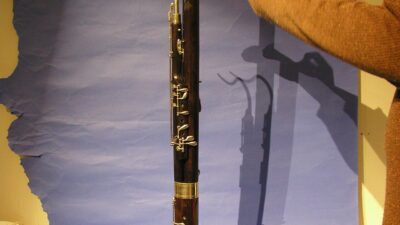
बैसून पश्चिमी वाद्यवृंद (ऑर्केस्ट्रा) का सबसे लंबा दोहरी-रीड वाला काठ-वाद्य है। इसकी नली लगभग ढाई मीटर (आठ फुट से अधिक) लंबी होती है, जिसे बजाने योग्य बनाने के लिए 'यू' आकार में मोड़ दिया जाता है। कलाकार इसे गले में लटके पट्टे (नेक-स्ट्रैप या सीट-स्ट्रैप) के सहारे तिरछा पकड़ता है और एक घुमावदार धातु की नली (बोकल) पर लगी दोहरी रीड में फूँक मारकर बजाता है।
Description English
The bassoon is the longest double-reed woodwind of the Western orchestra. Its tube is roughly 2.5 metres (over eight feet) long, folded into a 'U' shape to make it playable. The player holds it diagonally, supported by a neck-strap or seat-strap, and blows into a double reed mounted on a curved metal tube called the bocal.
Body
Long conical bore folded double, so the tube runs down and back up through a shared butt joint
लंबी शंक्वाकार नली जो नीचे जाकर पुनः ऊपर लौटती है — बीच में साझा 'बूट/बट' जोड़ होता है
Seasoned maple wood (traditionally sycamore maple); student instruments often polypropylene or ebonite
पकाई हुई मेपल (सिकैमोर मेपल) की लकड़ी; अभ्यास-वाद्यों में अक्सर पॉलीप्रोपिलीन या एबोनाइट
134 (assembled height); total unrolled tube length ~254 cm
Conical wooden bore of five joined sections (bell, bass/long joint, boot/butt joint, wing/tenor joint) plus the metal bocal
Strings
The bassoon is a wind instrument — sound is produced by a vibrating double reed, not strings
None — the bassoon has no sympathetic strings
No drones; the bassoon is a melodic and bass-line instrument
Bow
बोकल (क्रूक)
Bocal (crook)
Nickel-silver metal tube, sometimes silver- or gold-plated, onto which the double reed is fitted
20-30
Not a bow — the bocal is the curved metal tube that channels the player's breath from the reed into the wooden body; it is not drawn like a string bow
Tuning Pegs
चाबियाँ (कीज़)
Keys
The modern bassoon carries an elaborate silver-plated keywork mechanism (Heckel/German or Buffet/French systems) with rods, rollers and pads that open and close tone holes far beyond finger reach
Bridge
बूट/बट जोड़
Boot (butt) joint
The U-bend section at the bottom where the descending and ascending bores meet, lined with a metal U-tube to seal the fold
Maple wood with a metal U-tube liner
Frets
बैसून में फ्रेट नहीं होते (यह तार-वाद्य ही नहीं है) — स्वर उँगली-छिद्रों और चाबियों से बनते हैं, तथा होंठ-दबाव (एम्बशर) और साँस से सूक्ष्म स्वर-परिवर्तन संभव होते हैं।
The bassoon has no frets (it is not a stringed instrument at all) — pitches are formed by tone holes and keywork, while lip pressure (embouchure) and breath allow subtle pitch inflection and expressive shading.
ध्वनि-चरित्र
SoundTonal Character Hindi
बैसून का स्वर गहरा, गर्म और नस्य (रीड-जैसा) होता है। निचले सप्तक में यह गंभीर, शोकपूर्ण और भारी लगता है; मध्य सप्तक में मानवीय, गायन-सी अभिव्यक्ति देता है; और स्टकाटो (टूक-टूक) बजाने पर यह विनोदी, चंचल हो जाता है — इसी कारण इसे 'वाद्यवृंद का विदूषक' भी कहा जाता है।
Tonal Character English
The bassoon's tone is deep, warm and reedy. In its low register it sounds grave, mournful and heavy; in the middle register it is human and vocal; and in staccato it turns comic and playful — which is why it is nicknamed the 'clown of the orchestra'.
Timbre
Dark, woody, slightly buzzing double-reed timbre; sonorous in the bass, plaintive and singing in the tenor register
Range
B♭1 (contra B-flat, below the bass staff) up to around E5 and higher in expert hands — over three octaves
Dynamic Range
Wide — from a soft, distant murmur in the low register to a firm, cutting cry at the top (as in the Rite of Spring opening)
Techniques
सुनने का मार्गदर्शन
The Listening Guideबैसून को पहचानना हो तो पहले उसे अकेले सुनिए — मोत्ज़ार्ट के कॉन्चेर्तो में इसकी गोल, गायन-सी आवाज़ खुलकर सामने आती है। फिर स्ट्राविंस्की के 'राइट ऑफ़ स्प्रिंग' का आरंभ सुनिए, जहाँ यह अपनी चरम ऊँचाई पर काँपता है। और अंत में किसी पुराने फ़िल्मी गीत के वाद्यवृंद-अंतराल में उस गहरी, काठ-सी बास-रेखा को ढूँढिए जो वायलिन और बाँसुरी के नीचे बहती है — प्रायः वही बैसून है।
अंग्रेज़ी में पढ़ें · Read in English
To recognise the bassoon, first hear it alone — in Mozart's concerto its singing, rounded voice is unmistakable. Then listen to the opening of Stravinsky's 'Rite of Spring', where it trembles at the very top of its range. Finally, in an orchestral interlude of an old Hindi film song, search for that deep, woody bass line flowing beneath the violins and flute — often that is the bassoon.
परिचय
Identity- Year Of Origin
- 1650
अन्य विवरण
More DetailsTimbre
Dark, woody, slightly buzzing double-reed timbre; sonorous in the bass, plaintive and singing in the tenor register
रोचक तथ्य
Margin Notesनाम का रहस्य — 'लकड़ियों का गट्ठर' — इतालवी 'फ़ैगोटो' और जर्मन 'फ़ैगोट' का शाब्दिक अर्थ है 'लकड़ियों का गट्ठर', क्योंकि मुड़ी हुई दोहरी नली गट्ठर जैसी दिखती है। अंग्रेज़ी 'बैसून' फ़्रांसीसी 'बासों' से आया, जो इसके गहरे बास स्वर की ओर संकेत करता है।
The Italian 'fagotto' and German 'Fagott' literally mean 'a bundle of sticks', because the folded double bore resembles a bundle. The English 'bassoon' comes from the French 'basson', pointing to its deep bass voice.
दो घराने — जर्मन (हेकेल) बनाम फ़्रांसीसी (बूफ़े) — आधुनिक बैसून दो प्रणालियों में बनता है: जर्मन 'हेकेल सिस्टम' (1831 में स्थापित हेकेल कंपनी द्वारा मानकीकृत), जो विश्व भर में सबसे प्रचलित है, और फ़्रांसीसी 'बूफ़े सिस्टम', जिसकी आवाज़ कुछ अधिक तीखी और नस्य होती है।
The modern bassoon is made in two systems: the German 'Heckel system' (standardised by the Heckel firm founded in 1831), the most widespread worldwide, and the French 'Buffet system', whose sound is somewhat brighter and reedier.
गोवा के संगीतकार और फ़िल्मी वाद्यवृंद — बॉम्बे के फ़िल्म-स्टूडियो में बैसून, ओबो, क्लैरिनेट, ट्रम्पेट जैसे पश्चिमी वाद्य प्रायः गोवा में पश्चिमी संगीत-प्रशिक्षित सत्र-संगीतकार बजाते थे। सेबेस्टियन डिसूज़ा जैसे गोवा के अरेंजरों ने शंकर-जयकिशन और अन्य संगीतकारों के लिए इन वाद्यवृंद-भागों को स्वरबद्ध किया, जिससे हिंदी फ़िल्म-संगीत में पश्चिमी काष्ठ-वाद्य-वर्ग जुड़ा।
In Bombay's film studios, Western instruments like the bassoon, oboe, clarinet and trumpet were often played by Goa-trained session musicians. Goan arrangers such as Sebastian D'Souza scored these orchestral parts for Shankar-Jaikishan and other composers, bringing the Western woodwind section into Hindi film music.
इसका विशाल छोटा भाई — कॉन्ट्राबैसून — बैसून का एक और भी बड़ा संस्करण 'कॉन्ट्राबैसून' (डबल बैसून) है, जो एक सप्तक और नीचे बजता है और वाद्यवृंद की सबसे गहरी काष्ठ-ध्वनि उत्पन्न करता है। इसकी नली बैसून से भी दोगुनी लंबी होती है।
An even larger version of the bassoon, the 'contrabassoon' (double bassoon), sounds an octave lower and produces the deepest woodwind tone of the orchestra. Its tube is twice as long as the bassoon's again.
सवाल-जवाब
Questions & Answersबैसून क्या है?
बैसून पश्चिमी वाद्यवृंद का सबसे गहरा दोहरी-रीड वाला काष्ठ-वाद्य है। इसकी नली ढाई मीटर से अधिक लंबी होती है, जिसे 'यू' आकार में मोड़ा जाता है, और यह काष्ठ-वाद्य-वर्ग का बास स्वर प्रदान करता है।
बैसून की ध्वनि कैसी होती है?
बैसून का स्वर गहरा, गर्म और नस्य होता है। निचले सप्तक में यह गंभीर और शोकपूर्ण, मध्य में गायन-सा, और स्टकाटो में विनोदी लगता है — इसीलिए इसे 'वाद्यवृंद का विदूषक' भी कहते हैं।
क्या बैसून हिंदी फ़िल्म संगीत में प्रयुक्त हुआ है?
हाँ। 1950-1970 के स्वर्ण युग में शंकर-जयकिशन, सलिल चौधरी और सी. रामचंद्र जैसे संगीतकारों के विशाल वाद्यवृंदों में गोवा के सत्र-संगीतकार बैसून बजाते थे। यह पश्चिमी काष्ठ-वाद्य-वर्ग की बास-गहराई भरता था।
बैसून और शहनाई में क्या संबंध है?
दोनों दोहरी-रीड (डबल-रीड) वाद्य हैं, अर्थात् ध्वनि दो जुड़ी रीडों के कंपन से बनती है। किंतु शहनाई भारतीय, ऊँचे-शुभ स्वर वाली है, जबकि बैसून पश्चिमी, गहरे बास स्वर वाला वाद्यवृंद-वाद्य है।
बैसून का नाम कहाँ से आया?
अंग्रेज़ी 'बैसून' फ़्रांसीसी 'बासों' से आया, जो इसके गहरे बास स्वर की ओर संकेत करता है। इतालवी और जर्मन में यह 'फ़ैगोटो'/'फ़ैगोट' कहलाता है, जिसका अर्थ है 'लकड़ियों का गट्ठर' — इसकी मुड़ी हुई नलियों के कारण।
नमूना-पट्टी
The Specimen Table| नाम | बैसून · Bassoon |
|---|---|
| अन्य नाम | बैसून · फ़ैगोट (Fagott / Fagotto) · बासों (Basson) · Bassoon (also: Double-reed bass woodwind) |
| उद्गम | 1650 |
| प्रकार | वाद्य · Instruments |
साझा कीजिए · Share this Plate