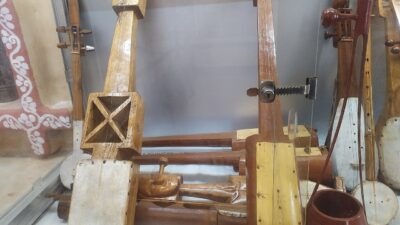
शास्त्र विंग · वाद्य-पट्टिका · Instrument Plate
बानम
Banam
अन्य नामबाना · बाणम · ढोड्रो बानम (Dhodro Banam) · हुका बानम (Huka Banam)
परिचय
Overviewबानम संताल जनजाति की आत्मा है — एक ही लकड़ी से तराशा एकतारी धनुष-वाद्य, जिसके पेट पर पशु-चमड़ी मढ़ी होती है और जिसकी गर्दन पर मनुष्य, पशु और आत्माओं की आकृतियाँ जीवंत रहती हैं। न दरबार का, न स्टूडियो का — यह गाँव के आँगन, पर्व और पूर्वज-संवाद का वाद्य है, जिसकी रोती-गाती आवाज़ में संताल स्मृति बसती है।
अंग्रेज़ी में पढ़ें · Read in English
The banam is the soul-instrument of the Santals — a single-string bowed fiddle carved from one block of wood, its belly stretched with animal hide and its neck alive with figures of humans, animals and spirits. Belonging to neither court nor studio, it is the instrument of the village courtyard, the festival and the dialogue with ancestors, its weeping-singing voice holding Santal memory.
वर्गीकरण
ClassificationNatya Shastra Category
तत (Tata - stringed instruments)
नाट्यशास्त्र के वर्गीकरण में बानम तत वर्ग का एक धनुष-वाद्य (fiddle) है, जो घोड़े के बाल के गज से तार पर घर्षण द्वारा ध्वनि उत्पन्न करता है। यह शास्त्रीय दरबारी परंपरा का नहीं, बल्कि संताल जनजाति की लोक-परंपरा का वाद्य है, अतः इसे 'तत' की लोक-शाखा में रखा जा सकता है।
Within the Natya Shastra scheme the banam falls in the Tata (stringed) category as a bowed fiddle, producing sound by friction of a horsehair bow across its string(s). It belongs not to the classical court lineage but to the folk branch of the Tata family, carried by the Santal tribe.
Western Category
Bowed string instrument (folk fiddle)
Western Family
Sarinda / spike-fiddle family — a partially hollowed, skin-bellied bowed lute related to the sarinda, ravanhatha and pena/bena of eastern India
Sub Classification
बनावट
PhysicalDescription Hindi
बानम संताल जनजाति का हस्तनिर्मित धनुष-वाद्य है, जिसे प्रायः एक ही लकड़ी के ठोस टुकड़े से तराशा जाता है। इसका निचला (पेट वाला) भाग खुला रहता है और उस पर पशु की खाल (अक्सर गोह/मॉनिटर छिपकली या बकरी की चमड़ी) मढ़ी जाती है, जिस पर पुल टिकता है। सबसे सामान्य रूप एक-तारी है, पर दो, तीन और चार तारों वाले बानम भी मिलते हैं। इसकी सबसे बड़ी पहचान इसके गले और सिर पर तराशी गई मानव-आकृतियाँ, पशु-मुखौटे और आत्मिक चित्र हैं।
Description English
The banam is the hand-carved bowed fiddle of the Santals, usually hewn from a single solid block of wood. Its lower belly is left partly open and covered with animal hide (commonly Bengal monitor-lizard skin or goat skin), over which the bridge rests. The single-string form is most common, though two-, three- and four-string banams exist. Its defining feature is the carving on the neck and head — human figures, animal masks and spirit forms unique to each maker.
Body
Elongated, waisted body carved as a single piece — an open lower sound-bowl (belly) topped by a solid carved neck and finial
एक ही टुकड़े में तराशा लंबा, कमरदार शरीर — नीचे खुला ध्वनि-कटोरा (पेट) और ऊपर ठोस तराशी हुई गर्दन व शीर्ष
A single block of dark, hard wood — traditionally the guloj/gulaych tree wood
गहरे रंग की कठोर लकड़ी का एक ही टुकड़ा — परंपरागत रूप से गुलोज/गुलैच वृक्ष की लकड़ी
40-70 (varies widely by maker and variety)
Open lower bowl sealed by a stretched animal-hide membrane (not an f-hole wooden box); the skin belly radiates the sound
Strings
Primary bowed melody string(s), traditionally of twisted gut or horsehair, resting on a bridge set on the hide belly
The banam has no sympathetic strings, unlike the sarangi. Its resonance comes entirely from the skin belly and the carved sound-bowl.
Most banams carry no separate drone; on multi-string variants a lower string may sound a continuous open drone under the melody
Bow
गज / धनु
Gaj (bow)
A curved stick strung with horsehair
40-55
Drawn across the string(s) while the instrument is held vertically, resting against the chest or knee, with the carved figure facing the listener
Tuning Pegs
खूँटी (कभी बाँस की)
Khunti (peg) — often absent
Many banams lack conventional tuning pegs; tuning is done by shifting the bridge or by tying/re-tying the string along the neck. Where pegs exist they are simple wooden or bamboo pegs.
Bridge
घोड़ी / पुल
Ghodi (bridge)
A small wooden bridge seated directly on the taut hide belly, transmitting string vibration into the skin membrane
Wood (sometimes bamboo)
Frets
बानम में फ्रेट नहीं होते — वादक तार को उँगलियों से सीधे दबाकर स्वर बदलता है, जिससे मानव-कंठ जैसी सरकती, गाती हुई ध्वनि (मींड-सी) निकलती है।
The banam is fretless — the player stops the string directly with the fingers, giving the sliding, singing, voice-like glides characteristic of the instrument.
ध्वनि-चरित्र
SoundTonal Character Hindi
बानम की ध्वनि खुरदरी, नम और गहरे लोक-रंग से भरी होती है — मानव-कंठ की तरह रोती-गाती, पर सारंगी की चमक से रहित एक मिट्टी-सी, आदिम मिठास लिए। चमड़ी के पेट से आती यह आवाज़ कच्ची और भावभीनी होती है।
Tonal Character English
The banam's voice is earthy, reedy and steeped in folk colour — weeping and singing like the human throat, yet without the sarangi's silvery shimmer; a raw, primal sweetness carried by the skin belly.
Timbre
Warm, slightly buzzing, vocal timbre with the grain of a skin-bellied fiddle; intimate rather than concert-loud
Range
Modest single-octave-ish melodic compass matched to the human singing voice and the pentatonic dance tunes it accompanies
Dynamic Range
Soft to moderate — an intimate courtyard and ritual instrument, not built for large-hall projection
Techniques
सुनने का मार्गदर्शन
The Listening Guideबानम को मंच का नहीं, आँगन का वाद्य मानकर सुनिए। किसी संताल सोहराय या दासाँय गीत में सुनिए कि कैसे बानम की एकतारी रेखा गायक के कंठ की परछाईं बनकर चलती है। धुन की कच्ची, मिट्टी-सी बनावट और चमड़ी के पेट से आती नमी को महसूस कीजिए — यही इसकी असली सुंदरता है।
अंग्रेज़ी में पढ़ें · Read in English
To understand the banam, hear it as an instrument of the courtyard, not the stage. In a Santal Sohrai or Dasae song, listen to how its single-string line moves as the shadow of the singer's throat. Feel the earthy, unpolished grain of the tune and the moist warmth of the skin belly — that rawness, not refinement, is its true beauty.
अन्य विवरण
More DetailsTimbre
Warm, slightly buzzing, vocal timbre with the grain of a skin-bellied fiddle; intimate rather than concert-loud
रोचक तथ्य
Margin Notesनक्काशी से वर्गीकरण — संताली वाद्य-निर्माता बानम को संरचना (तारों की संख्या, आकार) से नहीं, बल्कि उस पर उकेरी गई आकृतियों से नाम देते और अलग करते हैं। इसीलिए एक ही तरह की बनावट वाले वाद्य को अलग-अलग नक्काशी के कारण अलग-अलग बानम कहा जा सकता है।
Santali makers name and distinguish banams by the figures carved upon them, not by structure (string count, shape). Two instruments of near-identical build may thus be called different banams purely because of their different carving.
चमड़ी का पेट — बानम का निचला हिस्सा खुला रखकर उस पर पशु की खाल — प्रायः गोह (मॉनिटर छिपकली) या बकरी की चमड़ी — मढ़ी जाती है। पुल इसी झिल्ली पर टिकता है, और यही चमड़ी वाद्य की कच्ची, नम, गाती हुई आवाज़ का स्रोत है।
The banam's lower body is left open and covered with animal hide — usually Bengal monitor-lizard or goat skin. The bridge rests on this membrane, and it is this skin that gives the instrument its raw, moist, singing tone.
सबसे सुंदर, सबसे सादा — एक रोचक विरोधाभास: सबसे बारीक और अलंकृत नक्काशी वाले बानम कभी-कभी विशुद्ध संगीत की दृष्टि से सबसे साधारण होते हैं — क्योंकि उनमें कारीगरी मूर्तिकला पर केंद्रित रहती है, ध्वनि-गुण पर नहीं।
A curious paradox: the most finely and elaborately carved banams are sometimes the crudest as pure musical instruments — because their craft is lavished on sculpture rather than on sound.
एक ही परिवार, कई नाम — 'बानम' पूर्वी भारत के धनुष-वाद्यों के एक पूरे परिवार का छाता-नाम है, और इसके सजातीय नाम — बाना, बेना, पेना — क्षेत्र-भर में मिलते हैं। संतालों में ढोड्रो, हुका, फेंटोर/टेंडोर और रेता जैसे कई प्रकार प्रचलित हैं।
'Banam' is an umbrella name for a whole family of eastern-Indian fiddles, with cognate names — bana, bena, pena — found across the region. Among the Santals several types thrive: Dhodro, Huka, Phentor/Tendor and Reta.
सवाल-जवाब
Questions & Answersबानम क्या है?
बानम पूर्वी भारत के संताल आदिवासी समुदाय का एक धनुष-वाद्य (फ़िडल) है, जिसे एक ही लकड़ी के टुकड़े से तराशा जाता है और जिसका निचला भाग पशु-चमड़ी से मढ़ा होता है। यह प्रायः एकतारी होता है और इसकी गर्दन पर मानव व पशु-आकृतियाँ उकेरी जाती हैं।
बानम के कितने तार होते हैं?
सबसे सामान्य बानम एकतारी होता है, पर दो, तीन और चार तारों वाले बानम भी पाए जाते हैं। सारंगी से भिन्न, इसमें कोई तरब (अनुनाद) तार नहीं होता।
बानम के प्रमुख प्रकार कौन से हैं?
प्रमुख प्रकार ढोड्रो बानम, हुका बानम, फेंटोर/टेंडोर बानम और रेता बानम हैं। रोचक बात यह है कि संताल इन्हें संरचना से नहीं, बल्कि उन पर की गई नक्काशी से वर्गीकृत करते हैं।
बानम का उपयोग कहाँ होता है?
बानम संताल गीतों और सामूहिक नृत्यों — सोहराय, दासाँय, दॉन, लागड़े और करम — का संगत-वाद्य है। यह मृत्यु-संस्कारों और अनुष्ठानों में भी बजता है, जहाँ इसे जीवितों को पूर्वजों से जोड़ने वाला आध्यात्मिक सेतु माना जाता है।
क्या बानम का हिंदुस्तानी शास्त्रीय संगीत में उपयोग होता है?
नहीं। बानम राग-आधारित हिंदुस्तानी शास्त्रीय या बॉलीवुड संगीत का वाद्य नहीं है। यह संताल आदिवासी लोक-वाद्य है, जो पंचस्वरी लोक-धुनें बजाता है और आज एक लुप्तप्राय कला-परंपरा है।
नमूना-पट्टी
The Specimen Table| नाम | बानम · Banam |
|---|---|
| अन्य नाम | बाना · बाणम · ढोड्रो बानम (Dhodro Banam) · हुका बानम (Huka Banam) · फेंटोर / टेंडोर बानम (Phentor / Tendor Banam) · रेता / रेगेड़ा बानम (Reta / Regeda Banam) |
| प्रकार | वाद्य · Instruments |
साझा कीजिए · Share this Plate