शास्त्र विंग · वाद्य-पट्टिका · Instrument Plate
शुटुली
Xutuli
अन्य नामहुतुली (Hutuli) · सुतुली (Sutuli) · मिट्टी की सुतुली / माटिर सुतुली (clay xutuli) · সুতুলি (Assamese script)
परिचय
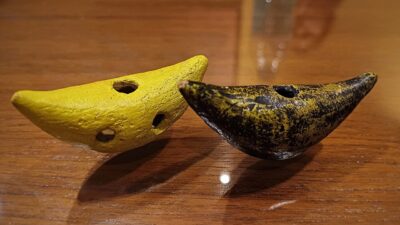
Overviewशुटुली असम की मिट्टी से बनी एक नन्ही अर्धचंद्राकार सीटी है — बीच में एक फूँक-छिद्र, शरीर पर तीन स्वर-छिद्र, और भीतर खोखला मिट्टी का पेट जो पूरी हवा को एक साथ गुँजाता है। कोयल (कुली) की बोली उतारती इसकी टेर बोहाग बिहू के वसंत का प्राण है; जेंग बिहू और बिहूवती नृत्यों में यह अनिवार्य मानी जाती है, और लोक-विश्वास कहता है कि इसकी सीटी वर्षा को बुला लाती है।
अंग्रेज़ी में पढ़ें · Read in English
The xutuli is a tiny crescent-shaped whistle of Assamese clay — one blow-hole at the centre, three finger-holes on the body, and a hollow clay belly that resonates the whole air within at once. Its call, mimicking the koel (kuli), is the very breath of Bohag Bihu's spring; it is held indispensable in the Jeng Bihu and Bihuwati dances, and folk belief says its whistle summons the rain.
वर्गीकरण
ClassificationNatya Shastra Category
सुषिर (Sushira - wind / hollow instruments)
शुटुली सुषिर वर्ग का एक फूँक वाद्य (aerophone) है — यह एक 'वेसल फ्लूट' या मृत्तिका-सीटी (clay ocarina) है, जिसमें कंपमान तार या डोरी नहीं होती; ध्वनि खोखले मिट्टी के कक्ष में फूँकी गई हवा के भँवर से उत्पन्न होती है।
The xutuli belongs to the Sushira (wind / hollow) category as a blown aerophone — a vessel flute or clay ocarina. It has no vibrating strings; sound is produced by air blown across an edge inside the hollow clay chamber, setting the enclosed air column resonating.
Western Category
Aerophone — globular / vessel flute (ocarina family)
Western Family
Vessel-flute family (a Helmholtz resonator, like the ocarina and the ancient Chinese xun; unlike a tube flute, the whole enclosed cavity resonates rather than a length of pipe)
Sub Classification
बनावट
PhysicalDescription Hindi
शुटुली एक छोटी, हथेली में समाने वाली मिट्टी (टेराकोटा) की सीटी है, जो प्रायः अर्धचंद्राकार (आधे चाँद जैसी) होती है और लगभग 12 सेंटीमीटर लंबी होती है; कुछ गाँवों में लगभग 10 सेंटीमीटर व्यास वाली गोल शुटुली भी मिलती है। कुछ शुटुली मिट्टी के बजाय बाँस के निचले, कटे हुए कंद-भाग से भी बनाई जाती हैं। इसमें बीच में एक फूँक-छिद्र और स्वर बदलने के लिए तीन अँगुली-छिद्र होते हैं।
Description English
The xutuli is a small, palm-sized clay (terracotta) whistle, usually shaped like a half-moon and about 12 cm long; in some villages a round variant about 10 cm in diameter is also found. Some xutulis are made not from clay but from the lower, cut-off knotty section of a bamboo stalk. It has one central blow-hole and three finger-holes for changing pitch.
Body
Half-moon (crescent); a round variant also exists
अर्धचंद्राकार (आधे चाँद जैसी); एक गोल संस्करण भी प्रचलित है
Special sticky potter's clay, fired into terracotta (or the lower cut node-section of a bamboo stalk)
विशेष चिपचिपी कुम्हार-मिट्टी, जिसे पकाकर टेराकोटा बनाया जाता है (या बाँस के निचले, कटे गाँठ-भाग से भी)
≈12 (crescent form); round form ≈10 cm diameter
A single hollow, enclosed clay cavity acting as a Helmholtz resonator — the whole trapped body of air vibrates, giving a soft, rounded, flute-like whistle
Blow Hole
फूँक-छिद्र / मुख-छिद्र
Blow-hole (mouth aperture)
1 (central)
बीच में बना एक छिद्र, जिसमें हवा फूँकने पर सीटी जैसी ध्वनि पैदा होती है। हवा एक धार से टकराकर भँवर बनाती है और भीतर की हवा को कंपित करती है।
A single central hole into which the player blows; the airstream strikes an edge and sets the enclosed air vibrating to produce the whistling tone.
Finger Holes
अँगुली-छिद्र / स्वर-छिद्र
Finger-holes (tone-holes)
3
शरीर पर बने तीन छिद्र, जिन्हें अँगुलियों से खोलकर-बंद करके वादक स्वर (पिच) बदलता है और भिन्न सुर व पक्षी-सी तानें निकालता है। छिद्रों की यह संख्या इसे प्राचीन चीनी 'शुन' (xun) की परंपरा से जोड़ती मानी जाती है।
Three holes on the body which the player opens and closes with the fingers to change pitch and coax different notes and bird-like calls. The number of holes is thought to link it to the tradition of the ancient Chinese xun.
Playing Technique
वाद्य को हथेली/अँगुलियों में पकड़कर फूँक-छिद्र को होठों के पास रखा जाता है; एक हाथ की अँगुलियाँ स्वर-छिद्रों को नियंत्रित करती हैं।
The instrument is cupped in the hand, the blow-hole held to the lips while the fingers of one hand cover and uncover the tone-holes.
स्थिर, कोमल फूँक से मूल स्वर निकलता है; छिद्रों को क्रम से खोलने-बंद करने पर पिच ऊपर-नीचे होती है। कुशल वादक कोयल (कुली) व अन्य पक्षियों की बोली की सटीक नकल उतारते हैं।
A steady, gentle breath produces the base note; progressively opening and closing the holes raises and lowers the pitch. Skilled players imitate the exact call of the koel (kuli) and other birds.
Frets
शुटुली में तार या फ्रेट नहीं होते — यह एक फूँक वाद्य है; स्वर अँगुली-छिद्रों और फूँक के दबाव से नियंत्रित होते हैं।
The xutuli has no strings or frets — it is a wind instrument; pitch is controlled entirely by the finger-holes and breath pressure.
ध्वनि-चरित्र
SoundTonal Character Hindi
शुटुली की ध्वनि कोमल, गोल और बाँसुरी-सी सीटी जैसी है — भरी हुई और मीठी, किंतु हल्की। यह मुख्यतः पक्षियों की, विशेषकर कोयल (असमिया 'कुली') की, बोली की नकल करती है और वसंत, वर्षा तथा विरह के भाव जगाती है।
Tonal Character English
The xutuli's sound is soft, rounded and flute-like — full and sweet yet gentle. It chiefly imitates bird calls, above all the koel (Assamese 'kuli'), and evokes moods of spring, rain and longing.
Timbre
Warm, breathy, hollow-woody whistle — the mellow, un-piercing timbre characteristic of a small clay vessel flute
Range
Narrow — a handful of folk pitches across roughly one octave, sufficient for pentatonic Bihu tunes and bird-call imitations rather than full melodic elaboration
Dynamic Range
Soft to moderate; intimate and un-amplified, suited to close, open-air group dancing
Techniques
सुनने का मार्गदर्शन
The Listening Guideशुटुली सुनने के लिए बिहू के किसी वीडियो से शुरुआत कीजिए और उसकी बारीक, कोयल-सी सीटी को ढोल-पेपा के शोर के बीच पहचानिए। ध्यान दीजिए कि वादक केवल एक फूँक और तीन छिद्रों से पक्षी की पूरी बोली कैसे उतार लेता है। यह वाद्य विस्तार का नहीं, वातावरण और भाव का है — इसकी सादगी ही इसका सौंदर्य है।
अंग्रेज़ी में पढ़ें · Read in English
When listening to the xutuli, first pick out its koel-like whistle — watch how the player conjures a bird's call from breath and three holes. Begin with a Bihu-song or Bihuwati-dance video, where the xutuli's thin, sweet line rises among dhol and pepa. Its beauty lies in its simplicity — this is an instrument of mood and atmosphere, not of elaboration.
परिचय
IdentityYear Of Origin
प्राचीन लोक-परंपरा (मौखिक इतिहास के अनुसार सादियाल कछारी समूहों के पूर्वजों के प्रवास से जुड़ी, संभवतः 1600 ईसा पूर्व से पहले) / ancient folk tradition; oral history links it to the migration of Sadiyal Kachari groups, possibly pre-1600 BCE
अन्य विवरण
More DetailsTimbre
Warm, breathy, hollow-woody whistle — the mellow, un-piercing timbre characteristic of a small clay vessel flute
रोचक तथ्य
Margin Notesआधे चाँद का वाद्य — पारंपरिक शुटुली प्रायः अर्धचंद्राकार होती है और लगभग 12 सेंटीमीटर लंबी; कुछ गाँवों में लगभग 10 सेंटीमीटर व्यास की गोल शुटुली भी बनती है। दोनों रूपों में बीच का फूँक-छिद्र और तीन स्वर-छिद्र समान रहते हैं।
The traditional xutuli is usually half-moon shaped and about 12 cm long; some villages also make a round version about 10 cm in diameter. In both forms the central blow-hole and three finger-holes remain the same.
मिट्टी या बाँस — अधिकतर शुटुली विशेष चिपचिपी मिट्टी से बनकर पकाई जाती हैं, पर कुछ बाँस के निचले, कटे गाँठ-भाग से भी बनाई जाती हैं — वही भाग जो मुख्य तने के गिरने या काटे जाने के बाद बचता है।
Most xutulis are made from a special sticky clay and fired, but some are made from the lower, cut-off knot-section of a bamboo stalk — the part left after the main stem falls or is cut away.
वर्षा-आह्वान की सीटी — असमिया लोक-मान्यता है कि शुटुली की ध्वनि वर्षा को बुलाती है; साथ ही इसकी टेर को 'श्रद्धेय संन्यासी, शोक में डूबी नायिका, या थके हुए वीर' के भाव से भी जोड़ा जाता है।
Assamese folk belief holds that the xutuli's sound summons rain; its call is also associated with the moods of a 'respectable hermit, a lady in sorrow, or heroes at the end of their strength.'
लड़कियों का गौरव — यद्यपि लड़के-लड़कियाँ दोनों शुटुली बजाते हैं, जेंग बिहू और बिहूवती/बर बिहूवती नृत्यों में इसे मुख्यतः लड़कियाँ बजाती हैं, और निपुण वादन प्रतियोगिताओं में बहुत सराहा जाता है।
Though both boys and girls play the xutuli, in the Jeng Bihu and Bihuwati / Bor Bihuwati dances it is mainly played by girls, and skilled playing is greatly admired in competitions.
सवाल-जवाब
Questions & Answersशुटुली क्या है?
शुटुली (सुतुली/हुतुली) असम का एक छोटा मिट्टी (टेराकोटा) से बना फूँक-वाद्य है — एक वेसल-फ्लूट या मृत्तिका-ओकारिना, जिसमें बीच का एक फूँक-छिद्र और तीन स्वर-छिद्र होते हैं। यह बिहू का लोक-वाद्य है और कोयल जैसी सीटी बजाता है।
शुटुली किस चीज़ से बनती है?
अधिकतर शुटुली विशेष चिपचिपी मिट्टी से बनकर पकाई जाती हैं (टेराकोटा); कुछ बाँस के निचले कटे गाँठ-भाग से भी बनती हैं। यह प्रायः अर्धचंद्राकार, लगभग 12 सेंटीमीटर लंबी होती है।
शुटुली कहाँ और कब बजाई जाती है?
शुटुली मुख्यतः असम के रोंगाली/बोहाग बिहू वसंत-उत्सव में बजाई जाती है। जेंग बिहू और बिहूवती/बर बिहूवती नृत्यों में यह अनिवार्य है और अक्सर लड़कियों द्वारा बजाई जाती है।
शुटुली की ध्वनि कैसी होती है?
इसकी ध्वनि कोमल, बाँसुरी-सी सीटी जैसी होती है और पक्षियों की — विशेषकर कोयल (कुली) की — बोली की नकल करती है। असमिया लोक-विश्वास में इसकी टेर वर्षा को आमंत्रित करती है।
क्या शुटुली शास्त्रीय संगीत का वाद्य है?
नहीं। शुटुली एक विशुद्ध लोक-वाद्य है और शास्त्रीय राग-प्रणाली में नहीं आती; यह बिहू-गीत की सरल, प्रायः पंचस्वरीय धुनें बजाती है, न कि विस्तृत राग।
नमूना-पट्टी
The Specimen Table| नाम | शुटुली · Xutuli |
|---|---|
| अन्य नाम | हुतुली (Hutuli) · सुतुली (Sutuli) · मिट्टी की सुतुली / माटिर सुतुली (clay xutuli) · সুতুলি (Assamese script) · Xutuli (also: Sutuli, Hutuli) |
| प्रकार | वाद्य · Instruments |
साझा कीजिए · Share this Plate