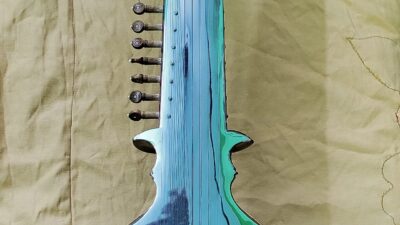
शास्त्र विंग · वाद्य-पट्टिका · Instrument Plate
सुरसिंगार
Sursingar
अन्य नामसुरश्रृंगार · सुरशृंगार · सुरसंगा (संग्रहालय अभिलेखों में) · Sursringar
परिचय
Overviewसुरसिंगार सरोद का बड़ा, गंभीर पूर्वज है — 19वीं सदी के आरंभ में सेनिया घराने ने पुराने ध्रुपद-रबाब को परिष्कृत कर, चमड़े की जगह लकड़ी का पटल और आँत की जगह धातु के तार लगाकर इसे गढ़ा। फ़्रेट-रहित इस्पात की उँगली-पट्टी इसे दो सप्तक तक की लंबी मींड देती है, जो ध्रुपद-आलाप की आत्मा है। रुद्र वीणा और सुरबहार के साथ यह ध्रुपद की सबसे धीमी, गहरी गति निभा सकने वाले गिने-चुने वाद्यों में है। उस्ताद अल्लाउद्दीन ख़ान ने इसी पर बीन-बाज साधा। आज लगभग लुप्त, यह वाद्य धीरे-धीरे मंच पर लौट रहा है।
अंग्रेज़ी में पढ़ें · Read in English
The sursingar is the larger, graver ancestor of the sarod — refined in the early 19th century by the Senia gharana from the old dhrupad-rabab, replacing skin with a wooden soundboard and gut with metal strings. Its fretless steel fingerboard yields a meend up to two octaves long, the very soul of dhrupad alap. With the rudra veena and surbahar it is one of the few instruments able to sustain dhrupad's slowest, deepest gait. Ustad Allauddin Khan trained his been-baj on it. Nearly extinct today, the instrument is slowly returning to the stage.
वर्गीकरण
ClassificationNatya Shastra Category
तत (Tata - stringed instruments)
तत वर्ग में सुरसिंगार एक मिज़राब से बजने वाला तंतु वाद्य है — यह धनुष से नहीं, बल्कि उँगली में पहने प्लेक्ट्रम (जवा) के आघात से ध्वनि उत्पन्न करता है। यह वीणा-परिवार का गहरे स्वर वाला तत वाद्य है।
In the Tata (stringed) category of the Natya Shastra, the sursingar is a plucked chordophone — it produces sound not with a bow but with a plectrum (java) worn on the fingers striking metal strings. It belongs to the deep-voiced end of the veena family of stringed instruments.
Western Category
Plucked string instrument (bass lute)
Western Family
Long-necked plucked lute family — the bass ancestor of the sarod, comparable in role to a bass lute or theorbo but uniquely Indian in tuning and technique
Sub Classification
बनावट
PhysicalDescription Hindi
सुरसिंगार सरोद का बड़ा, गंभीर स्वर वाला पूर्वज है। इसमें कद्दू (तूँबा) का गोल अनुनादक होता है जिस पर लकड़ी का ध्वनि-पटल (साउंडबोर्ड) मढ़ा जाता है, एक खोखली लकड़ी की गर्दन, और फ़्रेट-रहित धातु की मढ़ी हुई अँगुली-पट्टी (फ़िंगरबोर्ड) होती है। धातु के तार और चमकदार इस्पात की पट्टी इसे लंबी, चमकती हुई मींड देती है। यह सरोद से बड़ा और अधिक गहरे स्वर वाला वाद्य है, जो विशेष रूप से ध्रुपद-आलाप के लिए बना है।
Description English
The sursingar is the larger, deeper-voiced ancestor of the sarod. It has a rounded gourd (tumba) resonator covered by a wooden soundboard, a hollow carved wooden neck, and a fretless metal-plated fingerboard. Metal strings and a bright polished steel plate give it a long, shimmering meend. It is larger and deeper than the sarod, built specifically for the slow alap of dhrupad.
Body
Large rounded gourd resonator with a broad wooden soundboard and long hollow neck
बड़ा गोल कद्दू अनुनादक, चौड़ा लकड़ी का ध्वनि-पटल और लंबी खोखली गर्दन
Tun/toon wood body and neck, gourd (pumpkin shell) resonator, wooden soundboard; older instruments used bone and ivory inlay
तून की लकड़ी का शरीर और गर्दन, कद्दू (तूँबा) का अनुनादक, लकड़ी का ध्वनि-पटल; पुराने वाद्यों में हड्डी और हाथीदाँत की जड़ाई होती थी
100-110
Single large gourd chamber sealed by a wooden soundboard (unlike the sarod's skin-covered face), giving a rounder, more sustained tone
Strings
Primary plucked melody strings (older dhrupad instruments had no sympathetic strings)
Original dhrupad sursingars had NO sympathetic strings; the smaller modern instrument developed by Radhika Mohan Maitra and his school added sympathetic (tarab) strings to play beyond the dhrupad alap
Chikari (rhythm/drone) strings struck to punctuate the rhythm, especially in jod and jhala
Bow
जवा / मिज़राब (धनुष नहीं)
Java / Mizrab (no bow — plucked)
Plectrum traditionally of polished coconut shell or wire, held between the fingers
N/A (plectrum, not a bow)
The sursingar is PLUCKED, not bowed — the right hand strikes the metal strings with a java/mizrab plectrum while the left slides fretlessly along the steel plate
Tuning Pegs
खूँटी
Khunti
Large wooden tuning pegs set into the neck and pegbox, turned directly to tune the heavy main strings to their low dhrupad pitch
Bridge
घोड़ी
Ghodi (bridge)
A broad flat bridge that carries the strings across the wooden soundboard; older instruments used a flat piece of horn
Horn or bone (traditional), wood/bone on later instruments
Frets
सुरसिंगार में फ़्रेट नहीं होते — कलाकार चमकदार इस्पात की पट्टी पर नाख़ून या उँगली फिसलाकर स्वर निकालता है। इसी फ़्रेट-रहित धातु-पट्टी के कारण दो सप्तक तक लंबी, अटूट मींड (ग्लिसांडो) संभव होती है, जो ध्रुपद-आलाप की आत्मा है।
The sursingar is fretless — the player draws notes by sliding a nail or fingertip along the bright steel plate. This fretless metal fingerboard is exactly what allows a long, unbroken meend (glissando) spanning up to two octaves, the very soul of dhrupad alap.
ध्वनि-चरित्र
SoundTonal Character Hindi
सुरसिंगार का स्वर गहरा, भारी और गूँजता हुआ है — सरोद से अधिक गंभीर और अधिक देर तक ठहरने वाला। धातु के तार और लकड़ी के पटल का मेल एक साफ़, चाँदी-सी झंकार देता है जो धीरे-धीरे लंबी मींड में घुलती जाती है। यह ध्रुपद की धीर-गंभीर आत्मा के लिए बना स्वर है।
Tonal Character English
The sursingar's voice is deep, weighty and resonant — graver and more sustained than the sarod. The pairing of metal strings with a wooden soundboard yields a clear, silvery ring that melts slowly into long meends. It is a tone built for the grave, meditative soul of dhrupad.
Timbre
Clear, silvery, long-sustaining metallic ring with a deep bass foundation
Range
Low bass register — capable of the low, sustained pitches required for dhrupad, yet also of sweet high notes; effective meend across roughly two octaves
Dynamic Range
Wide and sustaining — notes ring on long enough for slow, unhurried alap without amplification
Techniques
सुनने का मार्गदर्शन
The Listening Guideसुरसिंगार सुनना हो तो घड़ी भूल जाइए — यह ध्रुपद का, धैर्य का वाद्य है। पहले धीमे आलाप में डूबिए और सुनिए कैसे बिना किसी फ़्रेट के एक स्वर लंबी मींड से दूसरे में घुलता है। फिर जोड़ की भीतरी लय पकड़िए, और झाले की चढ़ती झंकार तक पहुँचिए। शुरुआत उस्ताद अल्लाउद्दीन ख़ान की सुरसिंगार-रिकॉर्डिंग से कीजिए — वहीं इस गहरे वाद्य की आत्मा खुलती है।
अंग्रेज़ी में पढ़ें · Read in English
When listening to the sursingar, set aside all hurry — this is an instrument of dhrupad, the music of patience. First sink into the slow alap: hear how one note dissolves into the next through a long meend, with no fret to interrupt it. Then catch the inner pulse of the jod, and finally rise to the accelerating ring of the jhala. Begin with Ustad Allauddin Khan's sursingar recordings — that is where the instrument's soul opens.
परिचय
Identity- Year Of Origin
- 1800
अन्य विवरण
More DetailsTimbre
Clear, silvery, long-sustaining metallic ring with a deep bass foundation
रोचक तथ्य
Margin Notesरबाब से सरोद तक की खोई कड़ी — सुरसिंगार भारतीय तंतु-वाद्यों के विकास की एक जीवित कड़ी है: पुराना सेनिया रबाब → सुरसिंगार (लकड़ी का पटल व धातु के तार) → आधुनिक सरोद। इसीलिए इसे 'सरोद का पूर्वज' कहा जाता है।
The sursingar is a living link in the evolution of Indian string instruments: the old Seni rabab → the sursingar (wooden soundboard and metal strings) → the modern sarod. This is why it is called 'the ancestor of the sarod.'
तीन शहरों का दावा — सुरसिंगार के उद्गम पर रामपुर, वाराणसी और लखनऊ — तीनों दावा करते हैं। तीनों तानसेन के वंशजों (सेनिया घराने) के गढ़ रहे हैं, जहाँ 19वीं सदी के आरंभ में यह वाद्य आकार ले रहा था।
Three cities — Rampur, Varanasi and Lucknow — each claim the sursingar's origin. All three were strongholds of Tansen's descendants (the Senia gharana), where the instrument took shape in the early 19th century.
ध्रुपद के तीन प्रहरी — ध्रुपद की धीमी, गहरी, ठहरी हुई पिच को केवल तीन वाद्य ही पूरी तरह निभा सकते हैं — रुद्र वीणा, सुरबहार और सुरसिंगार। इनमें सुरसिंगार के सबसे अधिक वादन-तार होते हैं, जिससे सुंदर अंतराल, स्वर-मेल और ड्रोन संभव होते हैं।
Only three instruments can fully render the slow, deep, sustained pitch of dhrupad — the rudra veena, the surbahar and the sursingar. Of these, the sursingar has the most played strings, allowing beautiful intervals, chords and drones.
संग्रहालय में सुरक्षित एक स्वर — जब यह वाद्य मंच से लगभग विदा हो चुका था, तब भी इसकी देह बची रही — मेट्रोपॉलिटन म्यूज़ियम ऑफ़ आर्ट के क्रॉस्बी ब्राउन संग्रह में लगभग 1880 का एक सुरसिंगार आज भी है, जो इस लुप्तप्राय वाद्य का मौन साक्षी है।
Even after the instrument had nearly left the stage, its body survived — a sursingar from around 1880 still rests in the Crosby Brown Collection at the Metropolitan Museum of Art, a silent witness to this endangered instrument.
सवाल-जवाब
Questions & Answersसुरसिंगार क्या है?
सुरसिंगार (सुरश्रृंगार) एक भारतीय तंतु वाद्य है — सरोद का बड़ा, गहरे स्वर वाला पूर्वज। इसमें कद्दू का अनुनादक, लकड़ी का ध्वनि-पटल और फ़्रेट-रहित धातु की उँगली-पट्टी होती है, और इसे मिज़राब (जवा) से बजाया जाता है। यह मुख्यतः ध्रुपद-आलाप का वाद्य है।
सुरसिंगार और सरोद में क्या संबंध है?
सुरसिंगार सरोद का पूर्वज है। यह पुराने ध्रुपद-रबाब से विकसित हुआ, और बाद में इसी परंपरा से आधुनिक सरोद बना। सुरसिंगार बड़ा और गंभीर है, जबकि सरोद छोटा, तेज़ और अधिक अभिव्यंजक है।
सुरसिंगार कैसे बजाया जाता है?
सुरसिंगार को धनुष से नहीं, बल्कि उँगली में पहने प्लेक्ट्रम (जवा/मिज़राब) से बजाया जाता है। बायाँ हाथ फ़्रेट-रहित चमकदार इस्पात-पट्टी पर फिसलकर दो सप्तक तक की लंबी मींड निकालता है, जो ध्रुपद-आलाप की आत्मा है।
क्या सुरसिंगार आज भी बजाया जाता है?
सुरसिंगार 20वीं सदी के उत्तरार्ध में लगभग अप्रचलित हो गया था, पर यह पुनरुद्धार के आरंभिक चरण में है। पंडित ज्योतिदीप मुखर्जी जैसे कुछ कलाकार इसे फिर से मंच पर ला रहे हैं, और मेट्रोपॉलिटन म्यूज़ियम जैसे संग्रहालयों में इसके ऐतिहासिक नमूने सुरक्षित हैं।
उस्ताद अल्लाउद्दीन ख़ान का सुरसिंगार से क्या संबंध है?
उस्ताद अल्लाउद्दीन ख़ान ने उस्ताद वज़ीर ख़ान बीनकार से 'बीन बाज' सुरसिंगार पर सीखा और उनकी सुरसिंगार-रिकॉर्डिंग (जैसे राग नट) इस वाद्य के सबसे बहुमूल्य अभिलेख हैं। यही परंपरा आगे अन्नपूर्णा देवी, रवि शंकर और अली अकबर ख़ान तक पहुँची।
नमूना-पट्टी
The Specimen Table| नाम | सुरसिंगार · Sursingar |
|---|---|
| अन्य नाम | सुरश्रृंगार · सुरशृंगार · सुरसंगा (संग्रहालय अभिलेखों में) · Sursringar · Surshringar · Sursanga (museum records) |
| उद्गम | 1800 |
| प्रकार | वाद्य · Instruments |
साझा कीजिए · Share this Plate