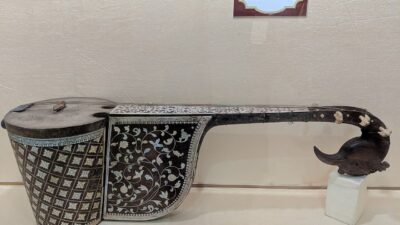
शास्त्र विंग · वाद्य-पट्टिका · Instrument Plate
स्वरबत
Swarabat
अन्य नामस्वरगत (शुद्ध उच्चारण) · सरबतले / Sarbutle · Swaragat (correct pronunciation) · Swarbat
परिचय
Overviewस्वरबत (शुद्ध उच्चारण स्वरगत) दक्षिण भारत का एक लगभग लुप्त हो चुका बास तंतु-वाद्य है — अनिवार्यतः एक 'बास रबाब'। लकड़ी के शरीर पर मढ़ी खाल, उस पर रेशम के तार, आँत के परदे और सींग का कोंचा इसकी बनावट को सरोद-रबाब परिवार से जोड़ते हैं, पर इसका सिरा तोते या मोर की आकृति में तराशा जाता है। कभी मैसूर, त्रावणकोर, तंजावुर और पुदुकोट्टई के दरबारों में कच्चेरी और हरिकथा मंडलियों का बास-आधार रहा यह वाद्य आज केवल संग्रहालयों में सुरक्षित है।
अंग्रेज़ी में पढ़ें · Read in English
The swarabat (correctly swaragat) is a nearly extinct bass string instrument of South India — essentially a 'bass rabab'. Skin stretched over a wooden body, silk strings above it, gut frets and a horn plectrum tie its construction to the sarod-rabab family, but its head is carved in the shape of a parrot or peacock. Once the bass foundation of Katcheri and Harikatha ensembles in the courts of Mysore, Travancore, Thanjavur and Pudukottai, today it survives only in museums.
वर्गीकरण
ClassificationNatya Shastra Category
तत (Tata - stringed instruments)
नाट्यशास्त्र के तत (तंतु) वर्ग में स्वरबत एक कोंचे (प्लेक्ट्रम) से बजाया जाने वाला तंतु वाद्य है — इसमें ध्वनि तारों को झंकृत (pluck) करके उत्पन्न होती है, धनुष के घर्षण से नहीं। यह वीणा-परिवार की एक गहरे स्वर वाली बास शाखा है।
In the Tata (stringed) category of the Natya Shastra, the swarabat is a plucked chordophone — its sound is produced by plucking the strings with a plectrum, not by bowing. It is a deep-toned bass branch of the veena/lute family.
Western Category
Plucked string instrument (fretted bass lute)
Western Family
Lute family — a bass member of the rabab/sarod group; a skin-bellied plucked chordophone comparable in register to a bass guitar
Sub Classification
बनावट
PhysicalDescription Hindi
स्वरबत एक भारी, गहरे स्वर वाला झंकृत तंतु वाद्य है जिसे 'बास रबाब' कहा जा सकता है। इसका शरीर लकड़ी से बना होता है जिस पर पशु-चर्म (खाल) मढ़ी जाती है — ठीक सरोद और रबाब की तरह — और इसी चर्म पर एक पुल (bridge) टिका होता है जिसके ऊपर से रेशम के तार गुज़रते हैं। तने पर आँत (गट) के परदे बँधे होते हैं और वाद्य का सिरा प्रायः तोते या मोर के आकार में तराशा जाता है।
Description English
The swarabat is a heavy, deep-toned plucked string instrument, best described as a 'bass rabab'. Its body is made of wood over which an animal skin is stretched — much like the sarod and rabab — and a bridge rests on this skin, over which silk strings pass. Gut frets are tied along the stem, and the instrument's head is often carved in the shape of a parrot or peacock.
Body
Rounded wooden resonator with a long fretted neck (stem), the head frequently carved as a parrot or peacock
गोलाकार लकड़ी का अनुनादक और लंबा परदेदार तना; सिरा अक्सर तोते या मोर की आकृति में तराशा हुआ
Solid wood resonator and stem, with a stretched animal-skin belly (soundboard) over the resonator
ठोस लकड़ी का अनुनादक व तना, अनुनादक पर मढ़ी हुई पशु-चर्म की बेली (ध्वनिपट)
approx 90-120 (large, held across the body/lap)
Single wooden resonating gourd/bowl covered with skin — the skin belly gives the deep, drum-like bass resonance that distinguishes the swarabat from the wholly wooden veena
Strings
Thick plucked playing strings tuned to the low bass register
Resonance on the swarabat comes chiefly from the skin belly rather than a dense set of sympathetic strings
Any additional side strings, when present, reinforce the bass drone/tonic
Plectrum
कोंचा / मिज़राब (सींग से बना)
Plectrum (koncha / mizrab)
Carved from horn
small hand-held pick
Held between the fingers and used to pluck the strings; unlike the sarangi, the swarabat is NOT bowed — it is plucked, producing sharply attacked, sustaining bass notes
Tuning Pegs
खूंटी
Khunti (pegs)
Wooden tuning pegs fixed to the neck/head that adjust the pitch of the main strings by rotation
Bridge
घोड़ी / पुल
Bridge (ghodi)
A bridge seated directly on the stretched skin belly, transmitting string vibration into the skin and wooden resonator — the source of the swarabat's characteristic deep, buzzing bass
Wood or bone, resting on the skin
Frets
सारंगी के विपरीत स्वरबत परदेदार (fretted) है — तने पर आँत (प्रायः बकरी की आँत) के परदे बँधे होते हैं, जिन पर उँगली दबाकर स्वर निकाले जाते हैं। परदे होने के कारण इसकी मीड सारंगी जितनी असीम नहीं, पर बास स्वरों में यह स्थिर और गूँजदार आधार देता है।
Unlike the fretless sarangi, the swarabat is fretted — frets made of animal gut (usually goat) are tied along the stem, and the player stops the strings against them. Because it has frets its glide (meend) is more limited than the sarangi's, but it gives a stable, resonant footing in the bass register.
ध्वनि-चरित्र
SoundTonal Character Hindi
स्वरबत की ध्वनि गहरी, भारी और गंभीर है — मानो संगीत की नींव में बैठा हुआ बास। इसका स्वर बास रबाब और बास गिटार के समान है; झंकृत तारों की चोट चर्म-बेली से टकराकर एक गूँजती, ढोल-जैसी गहराई पैदा करती है। इसका स्वर-विस्तार अपेक्षाकृत सीमित है, पर उस सीमित परास में यह अत्यंत प्रभावशाली और आधारभूत है।
Tonal Character English
The swarabat's tone is deep, heavy and grave — the bass that sits at the very foundation of the music. Its timbre resembles a bass rabab and a bass guitar; the plucked strings striking against the skin belly produce a resonant, drum-like depth. Its melodic range is relatively limited, but within that range it is powerful and foundational.
Timbre
Dark, woody-and-skin bass resonance with a percussive plucked attack (rabab/sarod family colour, pitched an octave lower)
Range
Low bass register — limited compass, prized for depth rather than treble agility
Dynamic Range
Strong, room-filling bass at full pluck; capable of soft supporting drone at lower dynamics
Techniques
सुनने का मार्गदर्शन
The Listening Guideस्वरबत की अपनी रिकॉर्डिंग लगभग नहीं मिलतीं, इसलिए इसकी आवाज़ तक इसके स्वर-सगे वाद्यों से पहुँचिए। किसी बास रबाब या सरोद के मंद्र-सप्तक आलाप को सुनिए और उसे मन में एक सप्तक और नीचे उतारिए — वहीं स्वरबत का गहरा रंग है। संग्रहालयों की लेक्चर-डेमॉन्स्ट्रेशन इसे असल में सुनने का दुर्लभ अवसर देती हैं।
अंग्रेज़ी में पढ़ें · Read in English
Commercial recordings of the swarabat are all but unavailable, so imagine its sound through its tonal relatives. First listen to the deep alap of a bass rabab or a sarod, and lower it an octave in your mind — that is where the swarabat's colour lives. Then seek out museum lecture-demonstrations (such as at the Iyal Isai Museum, Chennai), where such instruments are occasionally sounded.
परिचय
Identity- Year Of Origin
- 1750
अन्य विवरण
More DetailsTimbre
Dark, woody-and-skin bass resonance with a percussive plucked attack (rabab/sarod family colour, pitched an octave lower)
रोचक तथ्य
Margin Notesनाम की गुत्थी: स्वरबत या स्वरगत? — लोक-प्रचलन में यह 'स्वरबत' कहलाता है, पर विद्वानों के अनुसार इसका शुद्ध रूप 'स्वरगत' है। 'स्वर' यानी सप्तक का सुर; नाम के शेष अंश की व्युत्पत्ति पर एकमत नहीं है, और यही अस्पष्टता वाद्य की विस्मृति का एक प्रतीक बन गई है।
In popular usage it is called 'swarabat', but scholars hold its correct form to be 'swaragat'. 'Swara' means a note of the octave; there is no consensus on the etymology of the rest of the name, and that very obscurity has become a symbol of the instrument's fading from memory.
वीणा-वादक ही थे स्वरबत के वादक — दक्षिण भारत में सरस्वती वीणा के विद्यार्थी प्रायः स्वरबत बजाने में भी दक्ष होते थे। वीणे शेषण्णा (मैसूर दरबार के महान वीणा-वादक) जैसे नाम इसी दोहरी परंपरा के उदाहरण हैं।
In South India, students of the Saraswati veena were often also skilled on the swarabat. Names like Veene Sheshanna (the great veena player of the Mysore court) exemplify this twin tradition.
चर्म-बेली: गहराई का रहस्य — पूर्ण-लकड़ी की वीणा के विपरीत स्वरबत के अनुनादक पर पशु-चर्म मढ़ी होती है, ठीक सरोद और रबाब की तरह। इसी खाल पर टिका पुल तार की झंकार को एक ढोल-जैसी गहरी गूँज में बदल देता है — यही स्वरबत के बास-चरित्र का रहस्य है।
Unlike the all-wooden veena, the swarabat's resonator is covered with animal skin, just like the sarod and rabab. A bridge seated on this skin turns the pluck of the string into a drum-like depth — the secret of the swarabat's bass character.
राजदरबारों का बास — मैसूर, त्रावणकोर, तंजावुर और पुदुकोट्टई (थोंडमन वंश) के दरबारों में स्वरबत की गहरी संगत को विशेष सम्मान प्राप्त था। स्वयं त्रावणकोर के राजा-रचनाकार स्वाति तिरुनाल राम वर्मा इसके प्रशंसक-वादकों में गिने जाते हैं।
In the courts of Mysore, Travancore, Thanjavur and Pudukottai (the Thondaman dynasty), the swarabat's deep accompaniment was specially honoured. The Travancore king-composer Swathi Thirunal Rama Varma himself is counted among its admirers and players.
सवाल-जवाब
Questions & Answersस्वरबत क्या है?
स्वरबत (शुद्ध उच्चारण 'स्वरगत') दक्षिण भारत का एक दुर्लभ, गहरे स्वर वाला झंकृत तंतु वाद्य है, जिसे अनिवार्यतः 'बास रबाब' कहा जाता है। लकड़ी के शरीर पर मढ़ी खाल, रेशम के तार, आँत के परदे और सींग का कोंचा इसकी विशेषताएँ हैं। यह कर्नाटक शास्त्रीय संगीत में बास-संगत के लिए प्रयुक्त होता था।
स्वरबत को कैसे बजाया जाता है?
स्वरबत को सींग से बने कोंचे (प्लेक्ट्रम) से तारों को झंकृत करके बजाया जाता है — यह धनुष से नहीं बजाया जाता। तने पर बँधे आँत के परदों पर उँगली दबाकर स्वर निकाले जाते हैं। इसकी झंकार चर्म-बेली से टकराकर गहरी, ढोल-जैसी बास गूँज पैदा करती है।
स्वरबत सारंगी से कैसे अलग है?
सारंगी उत्तर भारत का धनुष (bow) से बजने वाला, बिना परदों का वाद्य है, जो मानवीय आवाज़ की नकल करता है। स्वरबत दक्षिण भारत का झंकृत (plucked), परदेदार बास वाद्य है, जो रबाब/सरोद परिवार से है। एक ऊँचे-भावनात्मक स्वर के लिए जाना जाता है, दूसरा गहरे बास-आधार के लिए।
क्या स्वरबत आज भी बजाया जाता है?
नहीं — स्वरबत आज लगभग विलुप्त है और भारत के सबसे दुर्लभ वाद्यों में गिना जाता है। इसके नमूने मुख्यतः संग्रहालयों में सुरक्षित हैं, जैसे चेन्नई का गवर्नमेंट म्यूज़ियम, चेन्नई का इयल इसै म्यूज़ियम और न्यूयॉर्क का मेट्रोपॉलिटन म्यूज़ियम ऑफ़ आर्ट।
स्वरबत के प्रसिद्ध वादक कौन थे?
प्रलेखित वादकों में पालघाट परमेश्वर भागवतर, बालुस्वामी दीक्षितर (रचनाकार मुत्तुस्वामी दीक्षितर के भाई), त्रावणकोर के राजा-रचनाकार स्वाति तिरुनाल राम वर्मा, मैसूर दरबार के वीणे शेषण्णा और कृष्ण अयंगार शामिल हैं।
नमूना-पट्टी
The Specimen Table| नाम | स्वरबत · Swarabat |
|---|---|
| अन्य नाम | स्वरगत (शुद्ध उच्चारण) · सरबतले / Sarbutle · Swaragat (correct pronunciation) · Swarbat · Swara-bat |
| उद्गम | 1750 |
| प्रकार | वाद्य · Instruments |
साझा कीजिए · Share this Plate