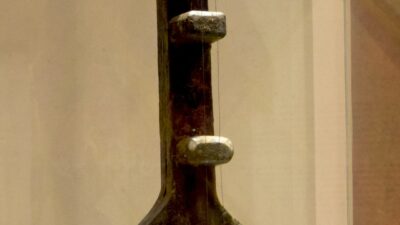
शास्त्र विंग · वाद्य-पट्टिका · Instrument Plate
नंदुनि
Nanduni
अन्य नामनंतुनि (Nanthuni) · नंद्रुनि (Nandruni) · നന്തുണി (Malayalam) · Nandruni / Nanthuni / Nanduni
परिचय
Overviewनंदुनि केरल का सादा किंतु पवित्र दो-तार वाला लोक-वाद्य है — एक ही खोखली लकड़ी से तराशी लंबी पेटी, दो धातु-तार और पतली खपच्ची की मंद टंकार। यह दरबार का नहीं, मंदिर-आँगन की रात का साज़ है; भद्रकाली/भगवती की स्तुति में गाए जाने वाले नंदुनि पट्टु, कलमेऴुत्तु पट्टु और थोट्टम पट्टु का यह अनिवार्य साथी रहा है। वीणा-परिवार का यह आदिम रूप आज संकटग्रस्त है, फिर भी कुरुप, पुल्लुवन और मन्नान परंपरा-वाहकों के हाथों इसकी आवाज़ जीवित है।
अंग्रेज़ी में पढ़ें · Read in English
The nanduni is a plain yet sacred two-stringed folk lute of Kerala — an elongated belly carved from a single hollowed block of wood, two metal strings and the soft pluck of a thin splinter. It is the instrument not of a court but of temple-courtyard nights; the indispensable companion of Nanduni pattu, Kalamezhuthu pattu and Thottam pattu sung in praise of Bhadrakali/Bhagavati. This primitive member of the veena family is endangered today, yet its voice lives on in the hands of Kurup, Pulluvan and Mannan tradition-bearers.
वर्गीकरण
ClassificationNatya Shastra Category
तत (Tata - plucked stringed / मलयालम में 'ततम्')
नंदुनि तत वर्ग का एक सरल लोक-वाद्य है — इसे उँगली या पतली लकड़ी की खपच्ची (मिज़राब जैसी) से तार छेड़कर बजाया जाता है, धनुष से नहीं। यह वीणा-परिवार का एक आदिम, दो-तार वाला रूप माना जाता है।
The nanduni belongs to the Tata (plucked stringed) category — it is sounded by plucking the strings with a finger or a thin wooden splinter (plectrum), not with a bow. It is regarded as a primitive, two-stringed member of the veena family.
Western Category
Plucked box-lute (folk chordophone)
Western Family
Lute family — a simple two-stringed box lute closer in spirit to drone-lutes such as the ektara and tanpura than to the elaborately fretted classical veena
Sub Classification
बनावट
PhysicalDescription Hindi
नंदुनि एक ही खोखली लकड़ी से तराशा हुआ सादा वाद्य है — एक लंबी पेटी (बेली) जिसके ऊपर चमड़े की झिल्ली नहीं होती। लगभग 78 सेंटीमीटर लंबे इस वाद्य में लकड़ी का ही पुल (ब्रिज), दो लकड़ी के परदे (फ्रेट) और एक लकड़ी की घोड़ी (नट) खड़े रूप में लगे होते हैं; दो धातु के तार ऊपर खूँटियों में बँधकर नीचे बेली के सिरे पर लोहे की कुंडी में कसे जाते हैं। बड़े अनुष्ठानिक रूप कहीं-कहीं चार फ़ुट तक लंबे भी मिलते हैं।
Description English
The nanduni is a plain instrument carved from a single hollowed block of wood — an elongated wooden belly with no stretched skin/parchment. Around 78 cm long, it carries a wooden bridge, two wooden frets and a wooden nut set upright; two metal strings are tied to pegs at the top and anchored to an iron hook-bar at the lower end of the belly. Larger ritual specimens as long as about four feet are also documented.
Body
Long, slender boat/stick-shaped hollow belly
लंबी, पतली नाव या डंडी जैसी खोखली पेटी
Single hollowed block of local wood (traditionally Kumizhu, Koovalam / bael, or Chittamruthu)
स्थानीय लकड़ी का एक ही खोखला टुकड़ा (परंपरागत रूप से कुमिळु, कूवलम्/बेल, या चित्तमृतु)
78 (larger ritual variants up to ~120)
Open hollowed wooden belly acting as the resonator; no skin membrane, unlike a drum-based lute
Strings
Two playing/drone strings running the length of the belly
The nanduni has NO sympathetic strings — this folk lute keeps to two plucked strings only, which distinguishes it from richer court instruments like the sarangi
Plectrum
खपच्ची (पतली लकड़ी की छड़)
Thin wooden splinter / stick
A thin sliver of wood or bamboo
The strings are plucked/struck with a thin wooden splinter (or the fingertip), producing a soft, repetitive plucked pattern under the sung ritual verse
Tuning Pegs
खूँटी
Pegs (pegbox)
Wooden pegs seated in a pegbox at the upper end, which tension and tune the two strings
Bridge
पुल / घोड़ी
Bridge (wooden)
An upright wooden bridge that lifts the strings and transmits their vibration into the hollow belly
Wood
Frets
नंदुनि में लकड़ी के केवल दो परदे (फ्रेट) होते हैं — इतने ही से लोक-भजन की सीमित स्वर-सीमा साध ली जाती है। कहा जाता है कि वाद्य के ऊपरी भाग को सप्तस्वरों के प्रतीक रूप में सात हिस्सों में बाँटकर अंकित किया जाता है।
The nanduni has only two wooden frets — enough to sound the limited melodic range of ritual song. The upper part of the instrument is traditionally said to be divided into seven marked sections, symbolising the seven notes (saptaswara).
ध्वनि-चरित्र
SoundTonal Character Hindi
नंदुनि की ध्वनि मंद, गूँजती और ध्यानमग्न है — किसी भारी शास्त्रीय वाद्य की चमक नहीं, बल्कि एक सादा, सम्मोहक झंकार जो रात-भर चलने वाले अनुष्ठान-गान के नीचे स्थिर आधार बुनती है। दो तारों की निरंतर टंकार गायक के स्वर को थामे रखती है।
Tonal Character English
The nanduni's sound is soft, humming and meditative — not the brilliance of a heavy classical instrument but a plain, hypnotic drone that weaves a steady base beneath night-long ritual singing. The continuous pluck of its two strings holds the singer's pitch steady.
Timbre
Dry, wooden, gently buzzing plucked tone; intimate and low-volume
Range
Narrow — essentially a tonic-and-drone plus the few pitches available across two frets; melody lives in the voice, not the instrument
Dynamic Range
Soft and even — designed for close, devotional performance rather than projection over an ensemble
Techniques
सुनने का मार्गदर्शन
The Listening Guideनंदुनि सुनते समय वाद्य से चमत्कार की अपेक्षा मत कीजिए — इसकी सुंदरता संयम में है। सुनिए कैसे दो तारों की एकसार टंकार गायक की आवाज़ को थामे रखती है, और शब्द ही धुन बन जाते हैं। पहले केरल संस्कृति विभाग का लघु 'नंदुनि वादन' सुनिए, फिर किसी पूर्ण नंदुनि पट्टु में डूबिए, जहाँ स्वर, कथा और भक्ति एक हो जाते हैं।
अंग्रेज़ी में पढ़ें · Read in English
When listening to the nanduni, do not expect virtuoso fireworks — its beauty is in restraint. Hear how the even pluck of two strings holds the singer's voice, and how the words themselves become the melody. Start with the Kerala culture department's short 'recital of nanthuni' to recognise the instrument's bare sound, then sink into a full nanduni pattu, where pitch, story and devotion fuse into one.
अन्य विवरण
More DetailsTimbre
Dry, wooden, gently buzzing plucked tone; intimate and low-volume
रोचक तथ्य
Margin Notesनाम का अर्थ — कुछ स्रोतों के अनुसार 'नंदुनि' नाम संस्कृत 'नाददध्वनि'/'नामध्वनि' — अर्थात् 'ध्वनि' — से व्युत्पन्न है, जो इस वाद्य की मूल पहचान (ध्वनि उत्पन्न करने वाला) को दर्शाता है।
According to some sources the name 'nanduni' derives from the Sanskrit 'Nadadhwani'/'Namdhwani' — meaning 'sound' — reflecting the instrument's essential identity as a maker of sound.
एक ही लकड़ी, बिना चमड़े के — नंदुनि की पूरी देह एक ही खोखली लकड़ी से तराशी जाती है और इसमें ढोल जैसी चमड़े की झिल्ली नहीं होती — पुल, दो परदे और घोड़ी तक लकड़ी के ही होते हैं, जो इसे एक शुद्ध काष्ठ-वाद्य बनाता है।
The entire body of the nanduni is carved from a single hollowed block of wood and has no drum-like skin membrane — even the bridge, the two frets and the nut are of wood, making it a pure wooden instrument.
अनुष्ठान का साज़, कलाकार का नहीं — नंदुनि की परंपरा एकल-कलाकार की महिमा पर नहीं, बल्कि समुदाय पर टिकी है — कुरुप, पुल्लुवन, कणियान और मन्नान परिवार इसे पीढ़ी-दर-पीढ़ी अनुष्ठान-गान के लिए संभालते आए हैं। इसीलिए इसके 'स्टार वादक' नहीं, बल्कि परंपरा-वाहक होते हैं।
The nanduni tradition rests not on the glory of a solo star but on community — Kurup, Pulluvan, Kaniyan and Mannan families have carried it for ritual singing across generations. It therefore has not 'star players' but tradition-bearers.
संग्रहालय में सुरक्षित — पालक्काड के ज़िला विरासत संग्रहालय में नंदुनि का एक नमूना प्रदर्शित है — जो इस संकटग्रस्त लोक-वाद्य के संरक्षण की ओर बढ़ते कदमों का प्रतीक है।
A specimen of the nanduni is displayed at the District Heritage Museum in Palakkad — a sign of the growing efforts to preserve this endangered folk instrument.
सवाल-जवाब
Questions & Answersनंदुनि क्या है?
नंदुनि (नंतुनि) केरल का एक दो-तार वाला लकड़ी का लोक-वाद्य है, जिसे उँगली या पतली खपच्ची से छेड़कर बजाया जाता है। यह मुख्यतः भद्रकाली/भगवती की स्तुति में गाए जाने वाले नंदुनि पट्टु जैसे अनुष्ठान-गीतों का आधार-स्वर साथी है।
नंदुनि में कितने तार होते हैं?
नंदुनि में केवल दो तार होते हैं। परंपरागत रूप से ये वनस्पति-रेशे ('पिञ्जावल्ली'/'ईरचुल्ली') से बनते थे, पर आज अधिकांश वादक धातु के तार इस्तेमाल करते हैं। इसमें कोई तरब (अनुनाद) तार नहीं होते।
नंदुनि किस संगीत में बजाई जाती है?
नंदुनि केरल के लोक-अनुष्ठान संगीत में बजाई जाती है — नंदुनि पट्टु, कलमेऴुत्तु पट्टु, अय्यप्पन पट्टु और वेट्टयक्कोरुमकन पट्टु जैसे देवी-आराधना गीतों में। यह हिंदी फ़िल्म-संगीत का वाद्य नहीं है।
नंदुनि किस समुदाय द्वारा बजाई जाती है?
नंदुनि मुख्यतः कुरुप समुदाय बजाता है, जिसे परंपरा में देवर्षि नारद का वंशज माना जाता है। पुल्लुवन, कणियान और मध्य केरल का मन्नान समुदाय भी इसे अपने अनुष्ठान-गान में प्रयोग करते हैं।
क्या नंदुनि आज भी बजाई जाती है?
हाँ, पर यह एक संकटग्रस्त लोक-वाद्य है जिसे बजाने वाले पारंपरिक परिवार बहुत कम बचे हैं। पालक्काड के ज़िला विरासत संग्रहालय में इसका नमूना है, और स्मिथसोनियन फ़ोकवेज़ तथा केरल संस्कृति विभाग ने इसका अभिलेखन किया है।
नमूना-पट्टी
The Specimen Table| नाम | नंदुनि · Nanduni |
|---|---|
| अन्य नाम | नंतुनि (Nanthuni) · नंद्रुनि (Nandruni) · നന്തുണി (Malayalam) · Nandruni / Nanthuni / Nanduni |
| प्रकार | वाद्य · Instruments |
साझा कीजिए · Share this Plate