शास्त्र विंग · वाद्य-पट्टिका · Instrument Plate
मांदर
Mandar
अन्य नाममाँदर · मान्दर · मादल / माँदल (Madal / Mandal) · मंडल (Mandal)
परिचय
Overviewमांदर छोटा नागपुर पठार का मिट्टी-खोल वाला द्वि-मुखी लोक-ढोल है — मुंडा, हो, उरांव, संताल और सदान समाज का साझा हृदय-वाद्य। गले में लटकाकर, नाचते हुए, दोनों हाथों से बजने वाला यह वाद्य कर्मा, सरहुल, झूमर, डोमकच और फागुआ की हर सामूहिक थिरकन को लय देता है; अपनी सहचरी ढाँसा से ऊँचे सुर की इसकी थाप में झारखंड की सांस्कृतिक अस्मिता धड़कती है।
अंग्रेज़ी में पढ़ें · Read in English
The mandar is the clay-shelled, two-headed folk drum of the Chota Nagpur plateau — the shared heart-drum of the Munda, Ho, Oraon, Santhal and Sadan peoples. Slung from the neck and played with both hands while dancing, it gives rhythm to every communal sway of Karma, Sarhul, jhumar, Domkach and Faguā; pitched higher than its companion the dhamsa, its beat throbs with the cultural identity of Jharkhand.
वर्गीकरण
ClassificationNatya Shastra Category
अवनद्ध (Avanaddha — चर्म-मढ़े ताल वाद्य / membranophones)
नाट्यशास्त्र के चार वाद्य-वर्गों में मांदर 'अवनद्ध' वर्ग का वाद्य है — अर्थात् जिसके मुख चमड़े से मढ़े (ढके) होते हैं और आघात (थाप) से ध्वनि उत्पन्न होती है। यह एक द्वि-मुखी (दो पुड़ी वाला) पीपे/मटके के आकार का ताल वाद्य है।
Among the four instrument classes of the Natya Shastra, the mandar belongs to 'Avanaddha' — instruments whose mouths are covered (laced) with stretched hide and which sound by percussion (thap/strike). It is a two-headed, barrel- or pot-shaped rhythm instrument.
Western Category
Membranophone (two-headed hand drum)
Western Family
Barrel / pot drum family — clay-bodied folk relative of the dholak and mridangam, played horizontally with both hands
Sub Classification
बनावट
PhysicalDescription Hindi
मांदर एक द्वि-मुखी बैरल-नुमा ताल वाद्य है जिसका खोल (शरीर) प्रायः पकी हुई मिट्टी का — और कहीं-कहीं लकड़ी का — बना होता है। बीच में हल्का उभार (पेट) होता है और दोनों सिरे खुले रहते हैं जिन पर अलग-अलग व्यास की चमड़े की पुड़ियाँ मढ़ी जाती हैं। बायाँ मुख बड़ा (गहरी, बास ध्वनि) और दायाँ मुख छोटा (ऊँची, तीखी ध्वनि) होता है। वादक इसे गले या कमर में पट्टे से लटकाकर, नाचते-नाचते दोनों हाथों की हथेली और उँगलियों से बजाता है।
Description English
The mandar is a two-headed barrel-shaped drum whose shell (body) is usually of baked clay — and in some regions of wood. It bulges gently at the centre and is open at both ends, over which leather heads of differing diameters are laced. The left (larger) face gives a deep bass tone and the right (smaller) face a higher, sharp tone. Slung from the neck or waist on a strap, it is played with both palms and fingers, often while the drummer dances.
Body
Barrel / elongated pot with a central bulge, tapering slightly to two open mouths
बीच में उभरा हुआ पीपा/मटका जैसा, दोनों ओर खुले मुख
Baked clay (Nagpuria / Jashpuria mandar of the Sadan region) — some variants of hollowed wood
पकी हुई मिट्टी (नागपुरिया/जशपुरिया मांदर) — कुछ रूप खोखली लकड़ी के भी
~50-70
Single enclosed clay/wood cavity between the two heads; the earthen shell gives the mandar its characteristic warm, earthy resonance
Heads
2
दो पुड़ियाँ — बायाँ (बड़ा) मुख बास/गंभीर स्वर के लिए और दायाँ (छोटा) मुख ऊँचे, तीखे स्वर के लिए। दोनों बकरी/भैंस के चमड़े की बनी होती हैं और गोल लकड़ी/चमड़े के छल्ले (गजरा) पर मढ़ी जाती हैं।
Two heads — the left (larger) face for bass/deep tone and the right (smaller) face for the higher, cutting tone. Both are of goat or buffalo hide stretched over a hoop and laced to the shell.
Animal hide (goat / buffalo skin)
स्वर मिलाने के लिए वादक प्रायः छोटी पुड़ी पर गीले आटे/मिट्टी की लेई (लेप) लगाकर तनाव और स्वर समायोजित करता है; पट्टे कसकर भी स्वर ऊँचा किया जाता है।
To tune, players commonly apply a paste of wet flour or clay to the head to adjust tension and pitch; the lacing can also be tightened to raise the tone.
Lacing
बद्धी / तस्मा (चमड़े की डोरी)
Leather thongs / lacing (baddhi)
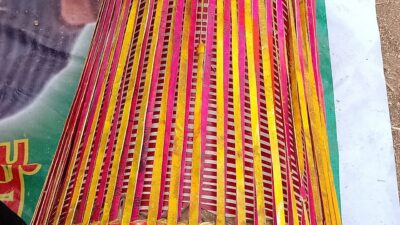
दोनों पुड़ियों को शरीर पर कसे रखने के लिए चमड़े की लंबी डोरियाँ 'V' या जालीदार पैटर्न में पूरे खोल पर लपेटी जाती हैं; इन्हें खींचकर वाद्य का तनाव और स्वर बदला जाता है।
Long leather thongs lace both heads to the shell in a V or lattice pattern running the length of the body; pulling them adjusts the drum's tension and pitch.
Strap
गमछा / पट्टा
Cloth or rope strap
मांदर को गले या कमर में कपड़े/रस्सी के पट्टे से लटकाया जाता है ताकि वादक खड़े होकर, चलते या नाचते हुए दोनों हाथों से बजा सके।
The mandar is slung from the neck or waist by a cloth or rope strap so the player can drum with both hands while standing, walking or dancing.
Playing Position
वादन-मुद्रा
Playing posture
वाद्य क्षैतिज (आड़ा) लटका रहता है; बायाँ हाथ बड़े मुख की गहरी थाप और दायाँ हाथ छोटे मुख की तीखी थाप देता है। मांदरिया अक्सर स्वयं नर्तक-दल का अगुआ होता है।
The drum hangs horizontally; the left hand strikes the larger head for deep beats and the right hand the smaller head for sharp accents. The mandariya (mandar player) often leads the dance troupe.
Sticks
मांदर बिना डंडे के, केवल हथेली और उँगलियों से बजाया जाता है (इसकी सहचरी ढाँसा नगाड़ा-वाद्य डंडों से बजता है)।
The mandar is played bare-handed with palms and fingers, without sticks (its companion dhamsa kettledrum, by contrast, is struck with sticks).
ध्वनि-चरित्र
SoundTonal Character Hindi
मांदर की ध्वनि मिट्टी-सी गर्म, गोल और नाचती हुई है — बड़े मुख का गहरा 'धा/गे' और छोटे मुख का चटख 'ना/तिन' मिलकर एक लोकधुन-सी लय बुनते हैं। यह अपनी सहचरी ढाँसा से ऊँचे सुर की होती है, इसलिए धुन/बोल मांदर संभालता है और ढाँसा गहरी बुनियादी थाप देती है।
Tonal Character English
The mandar's tone is earthy, warm and dancing — the deep 'dha/ge' of the large head and the crisp 'na/tin' of the small head weave a rolling folk pulse. It is higher-pitched than its partner the dhamsa, so the mandar carries the melodic rhythm and bols while the dhamsa lays the deep foundation beat.
Timbre
Warm, woody-earthy resonance from the clay shell; bright, cutting attack on the treble head
Range
Two contrasting registers — a bass boom (large head) and a sharp mid-high crack (small head)
Dynamic Range
From soft, intricate finger-work for slow jhumar to loud, driving open thaps for processional Karma and Domkach dancing
Techniques
सुनने का मार्गदर्शन
The Listening Guideमांदर सुनते समय दो परतें पकड़िए — बड़े मुख की गहरी 'धा' और छोटे मुख की चटख 'ना'। किसी कर्मा या झूमर रिकॉर्डिंग से शुरू कीजिए और देखिए कैसे मांदर की ऊँची, फुर्तीली लय बड़ी ढाँसा की गहरी थाप के ऊपर बुनी जाती है। धीमे से तेज़ होती लयकारी को महसूस कीजिए — यही वह क्षण है जब नाच-घेरा जीवंत हो उठता है।
अंग्रेज़ी में पढ़ें · Read in English
When you listen to the mandar, catch its two layers — the deep 'dha' of the large head and the crisp 'na' of the small head. Start with a Karma or jhumar recording and notice how the mandar's higher, agile rhythm is woven over the deep boom of the big dhamsa. Feel the layakari accelerate from slow to fast — that is the moment the dance circle comes alive.
अन्य विवरण
More DetailsTimbre
Warm, woody-earthy resonance from the clay shell; bright, cutting attack on the treble head
रोचक तथ्य
Margin Notesकुम्हार का गढ़ा वाद्य — मांदर उन गिने-चुने वाद्यों में है जिनका शरीर धातु या लकड़ी नहीं, बल्कि पकी हुई मिट्टी का होता है। नागपुरिया/जशपुरिया मांदर का खोल गाँव का कुम्हार गढ़ता है और चमड़ा स्थानीय बाज़ार से आता है — यानी पूरा वाद्य स्थानीय शिल्प का उत्पाद है।
The mandar is among the few instruments whose body is neither metal nor wood but baked clay. The shell of the Nagpuria/Jashpuriya mandar is shaped by the village potter and the hide comes from the local market — the whole instrument is a product of local craft.
मांदर और ढाँसा की जोड़ी — छोटा नागपुर के लोक-वाद्य-वृंद में मांदर अकेले नहीं बजती। इसकी स्थायी जोड़ीदार है ढाँसा — एक बड़ा अर्ध-गोलाकार नगाड़ा-वाद्य जो डंडों से बजता है और गहरी बास थाप देता है, जबकि मांदर हाथों से बजकर ऊँची, गतिशील लय संभालती है।
In the folk ensemble of Chota Nagpur the mandar rarely plays alone. Its constant partner is the dhamsa — a large hemispherical kettledrum struck with sticks that provides the deep bass, while the mandar, played by hand, carries the higher, agile rhythm.
एक नाम, कई परंपराएँ — 'मांदर/मादल/माँदल' नाम का सजातीय ढोल पूरे पूर्वी-मध्य भारत और नेपाल तक फैला है। झारखंड-छत्तीसगढ़-ओडिशा का यह मिट्टी-खोल वाला मांदर, मैथिल-नेपाली परंपरा के लकड़ी-खोल वाले 'मादल' का ही सांस्कृतिक भाई है।
A cognate drum called 'mandar/madal/mandal' spans all of eastern-central India and Nepal. The clay-shelled mandar of Jharkhand-Chhattisgarh-Odisha is a cultural sibling of the wood-shelled 'madal' of the Maithil-Nepali tradition.
सवाल-जवाब
Questions & Answersमांदर क्या है?
मांदर छोटा नागपुर पठार (झारखंड, छत्तीसगढ़, ओडिशा) का द्वि-मुखी लोक-ढोल है, जिसका खोल प्रायः पकी हुई मिट्टी का होता है। यह मुंडा, हो, उरांव, संताल और सदान समुदायों का प्रमुख ताल वाद्य है और कर्मा, सरहुल, झूमर तथा डोमकच जैसे नृत्यों में बजता है।
मांदर किस चीज़ से बनता है?
प्रामाणिक नागपुरिया/जशपुरिया मांदर का खोल पकी हुई मिट्टी (कहीं-कहीं लकड़ी) का बनता है, जिसके दोनों खुले सिरों पर बकरी/भैंस के चमड़े की पुड़ियाँ चमड़े की डोरियों से मढ़ी जाती हैं। बायाँ मुख बड़ा (बास) और दायाँ मुख छोटा (ऊँचा स्वर) होता है।
मांदर और ढाँसा में क्या अंतर है?
मांदर हाथों से बजने वाला ऊँचे सुर का द्वि-मुखी ढोल है जो धुन-लय संभालता है, जबकि ढाँसा डंडों से बजने वाला बड़ा अर्ध-गोलाकार नगाड़ा-वाद्य है जो गहरी बास थाप देता है। दोनों की जोड़ी छोटा नागपुर की लोक-ताल की रीढ़ है।
मांदर किन नृत्यों में बजता है?
मांदर कर्मा (करम पर्व), सरहुल, झूमर/झुमैर, डोमकच (विवाह), फागुआ (होली), मुंडारी और संताली सामूहिक नृत्यों में बजता है। मांदरिया प्रायः इसे गले में लटकाकर, नाचते हुए बजाता है और नृत्य-मंडली का नेतृत्व करता है।
नमूना-पट्टी
The Specimen Table| नाम | मांदर · Mandar |
|---|---|
| अन्य नाम | माँदर · मान्दर · मादल / माँदल (Madal / Mandal) · मंडल (Mandal) · Maandar / Mander · नागपुरिया मांदर / जशपुरिया मांदर (regional variants) |
| प्रकार | वाद्य · Instruments |
साझा कीजिए · Share this Plate