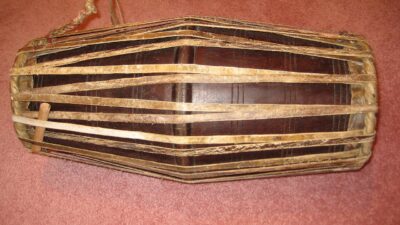
शास्त्र विंग · वाद्य-पट्टिका · Instrument Plate
मद्दले
Maddale
अन्य नाममद्दळे · मृदंग (उत्तर कन्नड़ में) · Maddale (also: Maddaḷe, Mrudanga in North Canara)
परिचय
Overviewमद्दले तटीय कर्नाटक के यक्षगान की धड़कन है — कटहल की एक ही लकड़ी को खोखला कर बनाया बैरल-ढोल, दोनों सिरों पर बकरी की खाल, चमड़े की बद्धियों से कसी हुई। दाएँ पुड़े की 'कर्णे' और बाएँ की 'बोना' इसे ऐसा विरल 'गाने वाला' ढोल बनाती हैं जिसकी सतह पर कहीं भी श्रुति गूँजती है। चंडे के गर्जन के साथ यह यक्षगान 'हिम्मेल' का प्रधान वाद्य है, और बिना नृत्य वाली विधा 'तालमद्दले' तो इसी के नाम पर है।
अंग्रेज़ी में पढ़ें · Read in English
The maddale is the heartbeat of coastal Karnataka's Yakshagana — a barrel drum hollowed from a single jackfruit block, both ends covered in goat skin and cinched with leather lacing. The 'karne' on its right head and the 'bona' on its left make it a rare 'singing' drum whose shruti rings from anywhere on the surface. With the chande it is the principal instrument of the Yakshagana 'himmela', and the danceless form 'Talamaddale' is named after it.
वर्गीकरण
ClassificationNatya Shastra Category
अवनद्ध (Avanaddha - membranophones / covered drums)
नाट्यशास्त्र के चतुर्विध वर्गीकरण में मद्दले 'अवनद्ध वाद्य' है — अर्थात चमड़े से मढ़ा हुआ ताल वाद्य, जिसकी ध्वनि झिल्ली (मुचिगे) के कंपन से उत्पन्न होती है। यह मृदंग-पखावज परिवार का दक्षिण-भारतीय, तटीय कर्नाटक का बैरल-ढोल है।
In the fourfold classification of the Natya Shastra, the maddale is an 'Avanaddha vadya' — a skin-covered percussion instrument whose sound arises from the vibration of stretched membranes (muchige). It is a barrel drum of the mridanga-pakhawaj family, native to coastal Karnataka.
Western Category
Barrel-shaped, two-headed membranophone (hand drum)
Western Family
Barrel drum family (structurally akin to the mridangam and pakhawaj, played horizontally with both hands)
Sub Classification
बनावट
PhysicalDescription Hindi
मद्दले एक दो-मुँहा बैरल आकार का ढोल है, जिसका खोल पारंपरिक रूप से कटहल (हलसु) की लकड़ी के एक ठोस टुकड़े को खोखला करके बनाया जाता है। दोनों खुले सिरों पर बकरी की खाल मढ़ी जाती है और उन्हें चमड़े के तस्मों से एक-दूसरे से कस कर बाँधा जाता है। यह तबले के दो पुड़ों जैसा स्वर और पखावज जैसी बनावट एक साथ रखता है।
Description English
The maddale is a two-faced barrel-shaped drum whose shell is traditionally carved by hollowing a single solid block of jackfruit (halasu) wood. Both open ends are covered with goat-skin membranes, laced tightly to one another with leather straps running around the barrel. It combines a tabla-like tuned tone on its heads with a pakhawaj-like one-piece body.
Body
Barrel / elongated drum (wider at the middle, tapering toward both heads)
बैरल या पीपे के आकार का — बीच में चौड़ा, दोनों सिरों की ओर पतला
Single hollowed block of jackfruit wood (also kakke, baine or hunaalu wood)
कटहल (हलसु) की लकड़ी का एक ठोस, खोखला किया हुआ टुकड़ा (कभी-कभी कक्के, बाईने या हुनालु की लकड़ी)
30-45 (traditional ~30 cm; longer 'badagutittu' variants up to a forearm's length)
Single continuous wooden chamber; wall roughly 0.5 cm thick, tuned by the tension of the criss-crossed leather lacing
Strings
The bass head (eda muchige) and the treble/right head (bala muchige); the treble head carries a black tuning circle called karne at its centre
A permanent black paste/disk at the centre of the treble head (analogous to the tabla's syahi) that produces the harmonic, ringing overtones
A tuning paste of ash and cooked rice (bona) smeared on the bass head before playing to dampen and deepen its tone
Bow
हाथ (कोई डंडा नहीं)
Hands (played bare-handed, no sticks)
Played entirely with the palms and fingers of both hands
N/A
Rested horizontally on the crossed legs / lap; the right hand plays the karne head, the left hand the bass head
Tuning Pegs
तस्मे / गट्टु (चमड़े की बद्धियाँ)
Leather lacing / gattu
Tension of the interwoven leather straps around the barrel raises or lowers the pitch of the heads; wooden or leather blocks are shifted to fine-tune
Bridge
कर्णे (केंद्रीय स्वर-बिंदु)
Karne (central tone-spot)
The karne on the treble head functions as the tonal centre, transmitting a fixed harmonic pitch to the whole membrane
Black tuning paste
Frets
मद्दले पर कोई फ्रेट नहीं होते — यह एक ताल वाद्य है; स्वर हाथों के भिन्न आघातों (गुम्पु, चापु, कपाल) और पुड़ों की खिंचावट से निकलते हैं।
The maddale has no frets — it is a percussion instrument; its distinct tones come from different hand strokes (gumpu, chapu, kapala) and the tension of the two heads.
ध्वनि-चरित्र
SoundTonal Character Hindi
मद्दले की ध्वनि गोल, गूँजती और स्पष्ट स्वर-युक्त है। इसकी सबसे विशिष्ट बात यह है कि पुड़े पर कहीं भी आघात करने से एक पूर्ण हार्मोनिक टॉनिक (श्रुति स्वर) निकलता है — यह गुण मृदंगम, पखावज या तबले में नहीं मिलता। बास पुड़ा गहरी 'गुम' देता है, तो कर्णे वाला पुड़ा तीखी, झंकारदार 'तक' — दोनों मिलकर यक्षगान के नाट्य-आवेग को धड़कन देते हैं।
Tonal Character English
The maddale's tone is round, resonant and clearly pitched. Its most distinctive property is that striking anywhere on the head yields a perfectly harmonic tonic (shruti swara) — a quality absent in the mridangam, pakhawaj or tabla. The bass head gives a deep 'gum', the karne head a sharp ringing 'tak'; together they give the pulse to Yakshagana's dramatic surge.
Timbre
Warm, woody and harmonically tuned; the tuned shruti gives it a singing quality rare among barrel drums
Range
Percussive, but pitch-centred on the singer's tonic (shruti); bass head to bright treble across roughly an octave of colour
Dynamic Range
Very wide — from a soft whispering accompaniment under sung poetry to a thunderous storm-and-battle climax on stage
Techniques
सुनने का मार्गदर्शन
The Listening Guideमद्दले का रस लेना हो तो किसी यक्षगान प्रसंग से शुरू कीजिए और भागवत के गायन के पीछे मद्दले की धड़कन पकड़िए — देखिए कैसे हर पंक्ति के अंत पर वादक 'मुक्ताय' से सम पर आ टिकता है। फिर अष्ट या त्रिवुडे ताल का एकल सुनिए, जहाँ चंडे और मद्दले आपस में बात करते हैं। बास की गहरी 'गुम' और कर्णे की तीखी 'तक' के बीच का यह संवाद ही मद्दले की आत्मा है।
अंग्रेज़ी में पढ़ें · Read in English
To hear the maddale, begin with a Yakshagana episode and listen 'behind' the bhagavata's singing — notice how the maddale lands on the sam with a 'muktaya' at the end of each line. Then hear a solo, where in Ashta or Trivude tala the player builds a dialogue between chande and maddale. Attend to how the bass 'gum' and the karne's sharp 'tak' alternate — that alternation is the maddale's language.
परिचय
Identity- Year Of Origin
- 1600
अन्य विवरण
More DetailsTimbre
Warm, woody and harmonically tuned; the tuned shruti gives it a singing quality rare among barrel drums
रोचक तथ्य
Margin Notesबडगुतिट्टु बनाम तेंकुतिट्टु — यक्षगान की दो प्रमुख शैलियाँ — उत्तर की बडगुतिट्टु और दक्षिण की तेंकुतिट्टु — में मद्दले-वादन की तकनीक, बोल और यहाँ तक कि वाद्य के आकार भी भिन्न होते हैं। यही एक वाद्य दो अलग ताल-व्याकरणों में साँस लेता है।
Yakshagana's two main styles — the northern Badagutittu and the southern Tenkutittu — differ in maddale technique, bols and even the drum's size. The same instrument thus breathes in two distinct rhythmic grammars.
बोना और कर्णे — दो अलग स्वर-रहस्य — दाएँ पुड़े पर स्थायी काली 'कर्णे' (तबले की स्याही जैसी) हार्मोनिक स्वर तय करती है, जबकि बाएँ बास पुड़े पर हर प्रदर्शन से पहले राख-और-भात की ताज़ा 'बोना' लेई लगाई जाती है जो स्वर को गहरा और दबा हुआ बनाती है।
The permanent black 'karne' on the right head (like the tabla's syahi) fixes the harmonic pitch, while a fresh paste of ash and cooked rice called 'bona' is applied to the left bass head before every performance to deepen and dampen its tone.
मृदंग का तटीय नाम — उत्तर कन्नड़ में इसी वाद्य को 'मृदंग' भी कहा जाता है — नाम प्राचीन संस्कृत 'मर्दल/मृदंग' परंपरा से जुड़ता है, यद्यपि बनावट और वादन दक्षिण-भारतीय मृदंगम से भिन्न है।
In North Canara the same instrument is also called 'Mrudanga' — the name links to the ancient Sanskrit 'mardala/mridanga' lineage, though its construction and playing differ from the South Indian mridangam.
सवाल-जवाब
Questions & Answersमद्दले क्या है?
मद्दले तटीय कर्नाटक का एक दो-मुँहा बैरल आकार का ढोल है, जो यक्षगान नाट्य की 'हिम्मेल' संगीत-मंडली का प्रधान ताल-वाद्य है। इसे कटहल की लकड़ी से बनाया जाता है और दोनों सिरों पर बकरी की खाल मढ़ी जाती है।
मद्दले और चंडे में क्या अंतर है?
यक्षगान हिम्मेल में दोनों साथ बजते हैं। चंडे तीव्र, गर्जनशील, खड़ा बजाया जाने वाला ढोल है जो वीर-रौद्र आवेग देता है; मद्दले स्वर-मिला, सूक्ष्म, हाथ से बजाया जाने वाला वाद्य है जो भागवत के गायन का अनुसरण करता है।
मद्दले की ध्वनि में क्या विशेष है?
मद्दले उन विरल ढोलों में है जो अपनी सतह पर कहीं भी आघात करने पर एक पूर्ण हार्मोनिक टॉनिक (श्रुति स्वर) देता है। दाएँ पुड़े की 'कर्णे' और बाएँ की 'बोना' लेई इसे भागवत की श्रुति में मिला देती हैं।
तालमद्दले क्या है?
तालमद्दले यक्षगान का एक बैठक-रूप है जिसमें नृत्य और वेशभूषा नहीं होती — केवल भागवत का गायन और पात्रों का शास्त्रार्थ (संवाद-वाद-विवाद) होता है। इस विधा का नाम ही 'ताल' और 'मद्दले' वाद्य पर पड़ा है।
मद्दले के प्रसिद्ध वादक कौन हैं?
'मद्दले मंत्रिक' हिरियडका गोपाल राव (1919–2020) सबसे प्रसिद्ध उस्ताद माने जाते हैं। अन्य उल्लेखनीय वादकों में गणपति भागवत, अनंत पद्मनाभ पाठक और शिक्षक मांबाडी सुब्रह्मण्य भट शामिल हैं।
नमूना-पट्टी
The Specimen Table| नाम | मद्दले · Maddale |
|---|---|
| अन्य नाम | मद्दळे · मृदंग (उत्तर कन्नड़ में) · Maddale (also: Maddaḷe, Mrudanga in North Canara) |
| उद्गम | 1600 |
| प्रकार | वाद्य · Instruments |
साझा कीजिए · Share this Plate