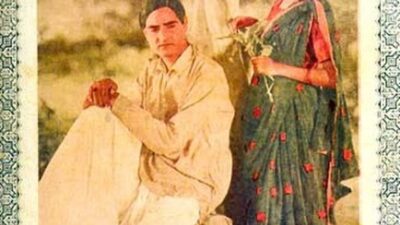
गीत विंग · गीत-पट्टिका · Song Plate
यहाँ फाड़ के खा जाता है
Yaha Phad Ke Kha Jata Hai
एक तीखा, सजीव गीत — 'यहाँ फाड़ के खा जाता है' — 1941 की फ़िल्म मासूम से।
भावतीव्र · Satirical
भाषाhindi स्वरूपUnknown
श्रेय
The Creditsसूत्र-वाक्य · The Hook
सूत्र-वाक्य
एक तीखा, सजीव गीत — 'यहाँ फाड़ के खा जाता है' — 1941 की फ़िल्म मासूम से।
In EnglishA pointed, vivid lyric — 'here it devours you whole' — from the 1941 film Masoom.
पट्टिका-लेख
The Monographपरिचय Overview
1941 की सामाजिक फ़िल्म मासूम का एक गीत, संगीत मुंशी मुबारक हुसैन। इसके शीर्षक की सजीव, लगभग चेतावनी भरी कल्पना फ़िल्म के भीतर किसी व्यंग्यात्मक या नाटकीय परिस्थितिजन्य गीत का संकेत देती है। रिकॉर्डिंग अब दुर्लभ है, और इस गीत का गायक प्रचलित सूचियों में दर्ज नहीं है।
अंग्रेज़ी में पढ़ें · Read in English
A song from the 1941 social drama Masoom, composed by Munshi Mubarak Hussain. The vivid, almost cautionary imagery of its title hints at a satirical or dramatic situational number within the film. The recording is now scarce, and the singer for this number is not documented in the standard catalogues.
काव्य The Poetry
'फाड़ के खाना' बोलचाल की हिंदी के सबसे विसरल मुहावरे को सक्रिय करता है — शिकारी और कच्चे संघर्ष की भाषा, उस दौर के प्रेम-गीतों की नरम उर्दू से एकदम भिन्न। फ़िल्म-गीत के संदर्भ में यह अतिशय हिंसा सामाजिक व्यंग्य या नाटकीय चेतावनी का काम करती है: 'यह' जो खाता है, वह एक अमूर्त सत्ता है — शहर, नियति, अन्याय, शोषक सामाजिक व्यवस्था — जिसे शिकारी की छवि से ठोस बनाया गया है। उर्दू की परिष्कृतता से परहेज़ करते हुए देशज हिंदी की यह सीधी भाषा इस गीत को जानबूझकर बोली-भाषा के स्तर पर रखती है। 1940 के हिंदी सिनेमा के सामाजिक-संदेश गीत तेज़ी से इस सीधी देशज भाषा का उपयोग करने लगे थे — उन दर्शकों तक पहुँचने के लिए जो ग़ज़ल की परिष्कृत गोलाई के बजाय बोले हुए शब्द की सपाटता पर अधिक प्रतिक्रिया करते थे।
अंग्रेज़ी में पढ़ें · Read in English
The phrase 'phad ke khana' (to tear and eat) deploys the most visceral register of colloquial Hindi — the language of predators and raw conflict, not the softened Urdu of the period's typical love songs. In a film-song context, this hyperbolic violence functions as social satire or dramatic warning: the 'it' that devours is an abstraction — city, fate, injustice, the exploitative social system — made concrete through the predator image. The directness of the vernacular Hindi, avoiding Urdu sophistication, marks this as a number deliberately placed in the spoken-language register to communicate urgency and danger without poetic distance. Social-message songs in 1940s Hindi cinema increasingly used this direct vernacular to reach audiences who responded more to the spoken word's bluntness than to the ghazal's cultivated indirection.
कहानी The Story
मासूम (1941) एक सामाजिक नाटक था जिसमें अमजद, रमोला, मज़हर ख़ान, महताब, अनीस और ख्वाजा सबीर ने अभिनय किया, संगीत मुंशी मुबारक हुसैन का था। 'यहाँ फाड़ के खा जाता है' की सजीव, लगभग आक्रामक छवि — 'यहाँ यह तुम्हें चीरकर खा जाता है' — इस गीत को फ़िल्म की संगीत-पट्टी के नाटकीय या व्यंग्यात्मक छोर पर रखती है, उसी फ़िल्म के उत्सव-गीत ('गाओ मुबारकबाद री माई') के विपरीत। गीत की छवि का लक्ष्य — वास्तव में क्या 'चीरता-खाता' है — सबसे अधिक संभवतः समाज, ग़रीबी, शोषण, या शहर है; 1940 के सामाजिक नाटक-गीतों में ऐसे अतिशय हिंसक रूपक आमतौर पर व्यक्तिगत प्रतिद्वंद्वियों के बजाय व्यवस्थागत अन्याय को लक्ष्य करते थे। रिकॉर्डिंग उपलब्ध ध्वनि-अभिलेखागारों में नहीं मिली है, और गायक दर्ज नहीं है।
अंग्रेज़ी में पढ़ें · Read in English
Masoom (1941) was a social drama featuring Amjad, Ramola, Mazhar Khan, Mahtab, Anees, and Khwaja Sabir, with music by Munshi Mubarak Hussain. The vivid, almost aggressive imagery of 'Yaha Phad Ke Kha Jata Hai' — 'here it tears you to pieces and devours you' — places this song at the dramatic or satirical end of the film's soundtrack, in contrast to the celebratory number ('Gaao Mubarak Bad Ri Mai') also catalogued for the same film. The target of the lyric's imagery — what exactly 'tears and devours' — is most likely society, poverty, exploitation, or the city; such hyperbolically violent metaphors in 1940s social drama songs typically targeted systemic injustice rather than personal adversaries. The recording is not accessible in surviving audio archives, and the singer is not documented.
वर्गीकरण
ClassificationGenre
अन्य विवरण
More Details- https://www.hindigeetmala.net/movie/masoom_1941.htm
References
रोचक तथ्य
Margin Notesमासूम (1941) में अमजद, रामोला, मज़हर ख़ान, मेहताब, अनीस और ख़्वाजा साबिर मुख्य भूमिकाओं में थे, और इसका संगीत मुंशी मुबारक हुसैन ने दिया था।
अंग्रेज़ी में पढ़ें · Read in English
Masoom (1941) starred Amjad, Ramola, Mazhar Khan, Mahtab, Anees, and Khwaja Sabir with music by Munshi Mubarak Hussain.
शीर्षक-वाक्यांश 'फाड़ के खाना' बोलचाल की हिंदी के सबसे तीव्र, हिंसक रूपकों में से एक का प्रयोग करता है, जो यह संकेत देता है कि यह प्रेम-गीत के बजाय एक व्यंग्यात्मक या सामाजिक-टिप्पणी वाला गीत है।
अंग्रेज़ी में पढ़ें · Read in English
The title phrase 'phad ke khana' (to tear and eat) uses one of colloquial Hindi's most viscerally violent metaphors, suggesting a satirical or social-commentary song rather than a love number.
इस गीत और उसी फ़िल्म के 'गाओ मुबारक बाद री माई' के बीच का विरोधाभास 1940 के दशक की उस साउंडट्रैक-प्रथा को दर्शाता है, जिसमें एक ही फ़िल्म के भीतर उत्सवधर्मी से लेकर तीव्र अंधकारमय तक — संपूर्ण नाटकीय दायरे को समाहित किया जाता था।
अंग्रेज़ी में पढ़ें · Read in English
The contrast between this song and 'Gaao Mubarak Bad Ri Mai' in the same film illustrates the 1940s soundtrack practice of covering the full dramatic range — from celebratory to intensely dark — within a single film.
नमूना-पट्टी
The Specimen Table| शीर्षक | यहाँ फाड़ के खा जाता है · Yaha Phad Ke Kha Jata Hai |
|---|---|
| फ़िल्म | मासूम · 1941 |
| वर्ष · युग | 1941 |
| संगीतकार | Munshi Mubarak Hussain |
| स्वरूप | Unknown |
| भाषा | hindi |
| भाव | तीव्र · Satirical |
| लोकप्रियता | Obscure |
| बोल-स्थिति | केवल झलक |
जुड़े हुए पन्ने
Connected Plates · The Graph Made Visibleअटलस में कोई पन्ना अकेला नहीं — इस गीत से जुड़े गीत, कलाकार, फ़िल्म, राग-ताल-विधा, सब यहाँ से खुलते हैं।
कलाकार · The Artists
फ़िल्म · The Film
साझा कीजिए · Share this Plate