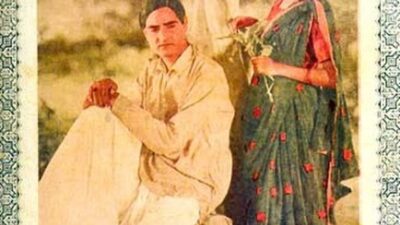
गीत विंग · गीत-पट्टिका · Song Plate
राह-ए-वफ़ा में जो आज तक हम
Rahe Wafa Me Jo Aaj Tak Hum
वफ़ा की राह पर अब तक चले — 1941 की फ़िल्म मासूम से एक ग़ज़ल-रंगत गीत।
भावउदास · दार्शनिक · Yearning
भाषाurdu स्वरूपUnknown
श्रेय
The Creditsसूत्र-वाक्य · The Hook
सूत्र-वाक्य
वफ़ा की राह पर अब तक चले — 1941 की फ़िल्म मासूम से एक ग़ज़ल-रंगत गीत।
In EnglishOn the path of fidelity walked thus far — a ghazal-tinged lyric from the 1941 film Masoom.
पट्टिका-लेख
The Monographपरिचय Overview
1941 की सामाजिक फ़िल्म मासूम का एक गीत, संगीत मुंशी मुबारक हुसैन। उर्दू शीर्षक अब तक तय की गई वफ़ा की राह ('राह-ए-वफ़ा') की बात करता है, जो इसे प्रेम और निष्ठा पर एक ग़ज़ल-रंगत चिंतन के रूप में चिह्नित करता है। रिकॉर्डिंग अब दुर्लभ है, और इस गीत का गायक प्रचलित सूचियों में दर्ज नहीं है।
अंग्रेज़ी में पढ़ें · Read in English
A song from the 1941 social drama Masoom, set to music by Munshi Mubarak Hussain. The Urdu title speaks of the path of fidelity ('rah-e-wafa') travelled until now, marking it as a ghazal-inflected meditation on love and constancy. The recording is now scarce, and the singer for this number is not documented in the standard catalogues.
काव्य The Poetry
उर्दू रोमांटिक काव्य में 'राहे वफ़ा'—वफ़ादारी की राह—एक सशक्त रूपक है। वफ़ा (निष्ठा, प्रेम में सच्चाई) और उसका विपरीत जफ़ा (ज़ुल्म, बेरुखी) क्लासिकल ग़ज़ल के दो ध्रुव हैं: प्रिय जफ़ा करता है, प्रेमी वफ़ा निभाता है—यही इस परंपरा का बुनियादी कथानक है। 'राहे वफ़ा में जो आज तक हम' इस राह पर चलने वाले का वक्तव्य है—'जो हम आज तक इस राह पर चले'—यह एक साथ आत्म-प्रमाण और शांत शिकायत है। आरज़ू लखनवी की काव्य-शैली—उन्होंने जानबूझकर सीधी उर्दू चुनी, अरबी-फ़ारसी के भारी शब्दों से परहेज़ रखा—इस बोल को फ़िल्मी दर्शकों के लिए सुलभ बनाती है बिना ग़ज़ल की गरिमा खोए। 'जो आज तक' में एक तात्कालिकता है: यह हिसाब अभी हो रहा है, किसी मोड़ पर खड़े होकर।
अंग्रेज़ी में पढ़ें · Read in English
The concept of 'rahe-wafa'—the path of fidelity—is one of the most productive organizing metaphors in Urdu romantic poetry. Wafa (faithfulness, loyalty) and its opposite jafa (cruelty, faithlessness) are the poles around which the classical ghazal organizes its emotional universe. The beloved exercises jafa—capricious cruelty, indifference—while the lover maintains wafa—loyal devotion in spite of everything. 'Rahe Wafa Me Jo Aaj Tak Hum' places the speaker on this path: 'those of us who have walked the path of fidelity up to today,' a statement of accumulated loyalty that is simultaneously a reproach and a self-certification. Arzoo Lakhnavi's poetic style—a 'straighter' Urdu that avoided ornate Arabic or Persian borrowings in favour of cleaner Urdu diction—would have made this lyric accessible to cinema audiences without sacrificing the formal dignity of the ghazal tradition. The phrase 'jo aaj tak' (who, until today) adds a temporal urgency: this accounting is happening now, at the edge of something.
कहानी The Story
मासूम (1941) के अन्य गीतों की तरह, 'राहे वफ़ा में जो आज तक हम' भी मुंशी मुबारक हुसैन का संगीत था—एस. एफ. हसनैन और सिबतैन फ़ज़ली निर्देशित, 'भारत की पहली मुस्लिम सोशल' के रूप में प्रचारित फ़िल्म का हिस्सा। फ़िल्म की नौ गीतों की पट्टी में एक तरफ़ ग़ालिब की क्लासिकल ग़ज़ल थी और दूसरी तरफ़ आरज़ू लखनवी के मौलिक बोल—पच्चीस हज़ार ग़ज़लों के कवि। 'राहे वफ़ा में जो आज तक हम' उर्दू रोमांटिक काव्य की उस प्रेम-हिसाब-करने की परंपरा में है जहाँ प्रेमी अपने वर्षों के एकतरफ़ा समर्पण का शांत लेखा-जोखा लेता है। 'मासूम' जैसी सामाजिक फ़िल्म में यह व्यक्तिगत भाव एक बड़े संदर्भ में काम करता है: समुदाय की मर्यादाओं के भीतर व्यक्तिगत ईमानदारी का प्रश्न।
अंग्रेज़ी में पढ़ें · Read in English
Like the other songs in Masoom (1941), 'Rahe Wafa Me Jo Aaj Tak Hum' was scored by Munshi Mubarak Hussain for a production directed by S.F. Hasnain and Sibtain Fazli and promoted as 'India's First Muslim Social.' The film's nine-song soundtrack divided itself between classical verse—one ghazal by Mirza Ghalib—and original lyrics by Arzoo Lakhnavi, one of the most prolific Urdu ghazal poets of the twentieth century. 'Rahe Wafa Me Jo Aaj Tak Hum'—'Those of us who have walked the path of fidelity until today'—belongs to the accounting-of-love tradition in Urdu romantic lyric: the lover who has kept faith through years of unrequited devotion addresses the beloved with a quiet reckoning. The social drama context makes this personal lyric register within a broader frame: questions of loyalty and fidelity in Masoom (1941) would have resonated with the film's thematic interest in personal integrity within community norms.
वर्गीकरण
ClassificationGenre
अन्य विवरण
More Details- https://www.hindigeetmala.net/movie/masoom_1941.htm
- https://en.wikipedia.org/wiki/Arzoo_Lakhnavi
- https://clarionindia.net/arzoo-lakhnavi-master-poet-who-wove-hindustani-poetry-with-hindi-film-songs/
References
रोचक तथ्य
Margin Notesमासूम (1941) को 'भारत का पहला मुस्लिम सोशल' के रूप में विज्ञापित किया गया था, यह एक व्यावसायिक पदनाम था जिसने इसे उस दौर में बंबई सिनेमा के भीतर मुस्लिम समुदाय की कथाओं में बढ़ती रुचि के केंद्र में स्थापित किया।
अंग्रेज़ी में पढ़ें · Read in English
Masoom (1941) was advertised as 'India's First Muslim Social,' a commercial designation that positioned it at the centre of the period's growing interest in Muslim community narratives within Bombay cinema.
आरज़ू लखनवी (1873–1951), जिन्होंने इस गीत सहित फिल्म के मूल गीत लिखे, ने सात प्रकाशित दीवानों में लगभग पच्चीस हज़ार ग़ज़लें रचीं — उर्दू साहित्यिक इतिहास के सबसे विशाल काव्य-संग्रहों में से एक।
अंग्रेज़ी में पढ़ें · Read in English
Arzoo Lakhnavi (1873–1951), who wrote the film's original lyrics including this song, authored approximately twenty-five thousand ghazals across seven published diwans—one of the most voluminous poetic outputs in Urdu literary history.
मासूम (1941) के साउंडट्रैक ने समकालीन आरज़ू लखनवी की रचनाओं को मिर्ज़ा ग़ालिब (1797–1869) की एक ग़ज़ल के साथ रखा, जिससे एक ही नौ-गीतों के कार्यक्रम में उर्दू साहित्यिक उत्पादन के लगभग सत्तर वर्षों का विस्तार समा गया।
अंग्रेज़ी में पढ़ें · Read in English
The Masoom (1941) soundtrack placed contemporary Arzoo Lakhnavi compositions alongside a Mirza Ghalib ghazal (1797–1869), spanning approximately seventy years of Urdu literary production in a single nine-song programme.
नमूना-पट्टी
The Specimen Table| शीर्षक | राह-ए-वफ़ा में जो आज तक हम · Rahe Wafa Me Jo Aaj Tak Hum |
|---|---|
| फ़िल्म | मासूम · 1941 |
| वर्ष · युग | 1941 |
| संगीतकार | Munshi Mubarak Hussain |
| स्वरूप | Unknown |
| भाषा | urdu |
| भाव | उदास · दार्शनिक · Yearning |
| लोकप्रियता | Obscure |
| बोल-स्थिति | केवल झलक |
जुड़े हुए पन्ने
Connected Plates · The Graph Made Visibleअटलस में कोई पन्ना अकेला नहीं — इस गीत से जुड़े गीत, कलाकार, फ़िल्म, राग-ताल-विधा, सब यहाँ से खुलते हैं।
कलाकार · The Artists
फ़िल्म · The Film
साझा कीजिए · Share this Plate