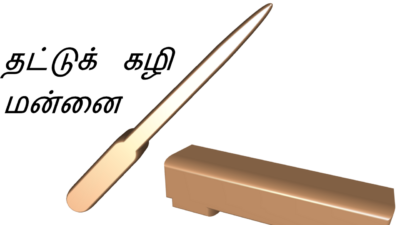
शास्त्र विंग · वाद्य-पट्टिका · Instrument Plate
तट्टुकष़ि
Thattukazhi
अन्य नामतट्टुकळि · थट्टुकष़ि · Thattukali · Thattu Kazhi
परिचय
Overviewतट्टुकष़ि — लकड़ी की एक छड़ी और एक गुटका (मन्नै/तट्टुपलक) — भरतनाट्यम का सबसे साधारण दिखने वाला किंतु सबसे मौलिक वाद्य है। नट्टुवनार इसी की 'तट्' पर पूरे नृत्य को ताल में बाँधता है; गायक, मृदंगम और नर्तक तीनों इसकी लय के अधीन चलते हैं। तंजावुर क्वार्टेट के मार्गम से लेकर आज के हर अरंगेत्रम तक, यह घन वाद्य नाट्य-लय की रीढ़ बना हुआ है।
अंग्रेज़ी में पढ़ें · Read in English
The thattukazhi — a wooden stick and a block (mannai/thattupalaka) — is the humblest-looking yet most fundamental instrument of Bharatanatyam. On its 'tat' the nattuvanar binds the whole dance into tala; singer, mridangam and dancer all move under its rhythm. From the margam of the Thanjavur Quartet to every arangetram today, this ghana idiophone remains the backbone of dance-rhythm.
वर्गीकरण
ClassificationNatya Shastra Category
घन (Ghana - solid/struck idiophones)
नाट्यशास्त्र के घन वर्ग में तट्टुकष़ि एक ठोस काष्ठ वाद्य है जो बिना तार या झिल्ली के, केवल आघात से ध्वनि उत्पन्न करता है। लकड़ी की छड़ी (तट्टुकष़ि) को लकड़ी के गुटके (मन्नै/तट्टुपलक) पर मारने से 'तट्' की तीखी ध्वनि निकलती है, जिससे ताल की स्पष्ट रेखा बनती है।
In the Ghana (solid idiophone) category of the Natya Shastra classification, the thattukazhi is a solid wooden instrument that produces sound by percussion alone — without strings or membrane. Striking the wooden stick (thattukazhi) against a wooden block (mannai / thattupalaka) yields a sharp 'tat' click that lays down a crisp rhythmic line.
Western Category
Concussion / struck idiophone (wooden clapper and beater)
Western Family
Wooden percussion clappers (comparable in function to the woodblock, claves, or a conductor's tap-box for keeping time)
Sub Classification
बनावट
PhysicalDescription Hindi
तट्टुकष़ि वस्तुतः दो अंगों वाला वाद्य है — एक ठोस लकड़ी का आयताकार गुटका जिसे मन्नै, तट्टुपलक या कट्टै कहते हैं, और एक मोटी लकड़ी की छड़ी जिसे तट्टुकष़ि (या तट्टुकुच्चि) कहते हैं। नट्टुवनार (नृत्य-संचालक) फ़र्श पर बैठकर गुटके को सामने रखता है और छड़ी से उसकी ऊपरी सतह पर आघात कर ताल की गति निर्धारित करता है।
Description English
The thattukazhi is really a two-part implement — a solid rectangular wooden block called the mannai, thattupalaka or kattai, and a thick wooden stick called the thattukazhi (or thattukuchi). The nattuvanar (dance conductor) sits on the floor with the block in front and strikes its upper surface with the stick to set and hold the tempo of the tala.
Body
मन्नै / तट्टुपलक / कट्टै (गुटका)
Mannai / Thattupalaka / Kattai (the block)
Rectangular solid block, often with a slightly raised or bevelled striking face; some blocks are hollowed underneath to add resonance
आयताकार ठोस गुटका, ऊपरी आघात-सतह कभी-कभी उभरी हुई; कुछ गुटके नीचे से खोखले होते हैं ताकि अनुनाद बढ़े
Hardwood — traditionally sheesham (Indian rosewood) or teak; modern student sets are also made of fibre/composite
कठोर लकड़ी — परंपरागत रूप से शीशम या सागवान; आधुनिक अभ्यास-सेट फ़ाइबर/कम्पोज़िट के भी बनते हैं
Block roughly 20-30 cm long, 12-18 cm wide, 5-10 cm thick (sizes vary by maker and student vs. professional)
The dense block itself is the resonator; a hollowed base or placement on a hard floor brightens and projects the click
Beater
तट्टुकष़ि / तट्टुकुच्चि (छड़ी)
Thattukazhi / Thattukuchi (the stick)
Turned hardwood (sheesham/teak) or fibre; a smooth cylindrical rod, thicker than a pencil
गढ़ी हुई कठोर लकड़ी (शीशम/सागवान) या फ़ाइबर; चिकनी बेलनाकार छड़, पेंसिल से मोटी
About 25-30 cm (commonly sold as an '11 inch' stick)
25-30
Held in the right hand and struck down onto the block; the harder, sharper strokes mark stressed beats (sam / accents) and the lighter taps mark the sub-divisions
Tuning
तट्टुकष़ि अनियततान (untuned) वाद्य है — इसका कार्य निश्चित स्वर देना नहीं, बल्कि ताल की स्पष्ट, कटी हुई गति देना है। छड़ी और गुटके के आघात-बिंदु व बल से केवल ऊँची (छड़ी) और नीची (गुटके की गूँज) दो लयात्मक रंगतें निकलती हैं।
The thattukazhi is an untuned instrument — its job is not fixed pitch but a clear, clipped articulation of the tala. Varying the strike-point and force yields essentially two rhythmic timbres: a higher click from the stick and a lower thud-resonance from the block.
Frets
यह एक आघात-वाद्य है, अतः इसमें तार, फ्रेट या झिल्ली नहीं होती — पूरी अभिव्यक्ति आघात की लय, बल और अंतराल में निहित है।
As a struck idiophone it has no strings, frets or membrane — all expression lies in the timing, force and spacing of the strokes.
Portability
छोटा, हल्का और अत्यंत सहनीय — हर नृत्य-कक्षा और अरंगेत्रम में सहज ले जाया जा सकता है। यही सरलता इसे भरतनाट्यम शिक्षण का सर्वव्यापी उपकरण बनाती है।
Small, light and extremely durable — carried effortlessly into every dance class and arangetram. This simplicity is exactly why it is the universal teaching tool of Bharatanatyam.
ध्वनि-चरित्र
SoundTonal Character Hindi
तट्टुकष़ि की ध्वनि सूखी, तीखी और कटी हुई है — 'तट्', 'तट्' की स्पष्ट लकड़ी-सी टकराहट जो सम्पूर्ण कक्ष में गूँज जाती है। इसमें माधुर्य नहीं, अनुशासन है; यह ध्वनि नर्तक के पैरों और घुँघरुओं को अचूक ताल-रेखा देती है।
Tonal Character English
The thattukazhi's tone is dry, sharp and clipped — a clear wooden 'tat, tat' that cuts through a hall. It offers no melody, only discipline; the sound gives the dancer's feet and ankle-bells (salangai/ghungroo) an unerring line of tala.
Timbre
Percussive, woody, high-attack with very short decay; block and stick together give a bright click over a low thud
Range
Untuned percussion — no melodic range; expressive range lies in dynamics (soft sub-beats to hard accents) and speed
Dynamic Range
Wide for a small instrument — from a barely audible sub-division tap to a room-filling accent that resets the whole ensemble
Techniques
सुनने का मार्गदर्शन
The Listening Guideतट्टुकष़ि को समझना हो तो किसी भरतनाट्यम कक्षा में बैठिए। पहले केवल समान 'तट्-तट्' की लय पकड़िए — यही ताल-चक्र है। फिर देखिए कि नट्टुवनार बोल (ता-ते-ता-हा) के साथ हर प्रहार को नर्तक के पैर से कैसे जोड़ता है। अंत में तीर्मानम सुनिए — तीन बार दोहराया वाक्य, जो तेज़ प्रहारों में समाप्त होकर सम पर टिक जाता है। यह लय का सबसे नग्न, सबसे शुद्ध रूप है।
अंग्रेज़ी में पढ़ें · Read in English
To 'listen' to the thattukazhi, attend to any Bharatanatyam class or arangetram. First catch only the even 'tat-tat' pulse — that is the tala cycle. Then hear how the nattuvanar ties each strike, alongside the syllables (ta-tei-ta-ha), to the dancer's feet. Finally follow a theermanam — a thrice-repeated phrase that ends in fast strokes and lands on the sam. This is rhythm in its purest, barest form.
श्रवण-कक्ष · The Listening Room
देखें-सुनें
Nattuvangam Basics | How to use Thattukali / Thattu Mannai | Beginners | Part 1 | Bharathanatyam · 2:04
Thisra Alarippu | Nattuvangam Basics | How to do on Thattu Kazhi | Bharathanatyam | Part 16 · 3:24
Nattuvangam tutorials | for Thattadavu | Basics of Nattuvangam - Nritha Saparya · 5:39
परिचय
Identity- Year Of Origin
- 1800
अन्य विवरण
More Details- Tuned
- Description English
- The thattukazhi is an untuned instrument — its job is not fixed pitch but a clear, clipped articulation of the tala. Varying the strike-point and force yields essentially two rhythmic timbres: a higher click from the stick and a lower thud-resonance from the block.
- Description
- तट्टुकष़ि अनियततान (untuned) वाद्य है — इसका कार्य निश्चित स्वर देना नहीं, बल्कि ताल की स्पष्ट, कटी हुई गति देना है। छड़ी और गुटके के आघात-बिंदु व बल से केवल ऊँची (छड़ी) और नीची (गुटके की गूँज) दो लयात्मक रंगतें निकलती हैं।
Tuning
Timbre
Percussive, woody, high-attack with very short decay; block and stick together give a bright click over a low thud
रोचक तथ्य
Margin Notesघन वाद्य — बिना तार, बिना झिल्ली — नाट्यशास्त्र के चार वाद्य-वर्गों (तत, अवनद्ध, सुषिर, घन) में तट्टुकष़ि 'घन' वर्ग का है — अर्थात् ठोस वस्तु के आघात से बजने वाला। मंजीरा, झांझ और घंटी की तरह यह भी बिना तार या झिल्ली के केवल टकराहट से ध्वनि उत्पन्न करता है।
Among the four instrument classes of the Natya Shastra (tata, avanaddha, sushira, ghana), the thattukazhi belongs to 'ghana' — solid instruments sounded by striking. Like the manjira, cymbals and bell, it produces sound purely by concussion, with no string or membrane.
तंजावुर क्वार्टेट और मार्गम — 19वीं शताब्दी में तंजावुर के चार भाइयों ने भरतनाट्यम की प्रस्तुति-क्रम (मार्गम) को व्यवस्थित किया। इसी क्रम — अलारिप्पु, जतीस्वरम, शब्दम, वर्णम, पदम, तिल्लाना — का संचालन नट्टुवनार तट्टुकष़ि से करता है, और यह परंपरा आज भी अक्षुण्ण है।
In the 19th century the four Thanjavur brothers systematised the performance sequence (margam) of Bharatanatyam. That very sequence — alarippu, jatiswaram, shabdam, varnam, padam, tillana — is conducted by the nattuvanar on the thattukazhi, a tradition unbroken to this day.
अरंगेत्रम की अनिवार्य ध्वनि — किसी भी शिष्य के प्रथम एकल मंच-प्रदर्शन (अरंगेत्रम) में गुरु स्वयं तट्टुकष़ि पर बैठकर संचालन करता है। वर्षों के प्रशिक्षण की यह पराकाष्ठा तट्टुकष़ि की 'तट्' के बिना अकल्पनीय है — यह गुरु और शिष्य के बीच का अंतिम, सार्वजनिक संवाद है।
At any student's debut solo (arangetram), the guru personally sits at the thattukazhi to conduct. This culmination of years of training is unimaginable without the thattukazhi's 'tat' — the final, public dialogue between guru and student.
आधुनिक फ़ाइबर संस्करण — परंपरागत तट्टुकष़ि शीशम या सागवान की बनती है, पर आज कक्षाओं के लिए हल्के और टिकाऊ फ़ाइबर/कम्पोज़िट सेट भी बनते हैं। '11 इंच' की छड़ी और मन्नै का यह सस्ता संस्करण विश्व भर में भरतनाट्यम के प्रसार का साथी बन गया है।
The traditional thattukazhi is made of sheesham or teak, but today lightweight, durable fibre/composite sets are also produced for classes. This inexpensive '11-inch' stick-and-mannai version has become a companion to the worldwide spread of Bharatanatyam.
सवाल-जवाब
Questions & Answersतट्टुकष़ि क्या है?
तट्टुकष़ि एक लकड़ी की छड़ी है जिसे लकड़ी के गुटके (मन्नै/तट्टुपलक) पर मारकर भरतनाट्यम और अन्य दक्षिण भारतीय नृत्यों में ताल रखा जाता है। नृत्य के इस लयात्मक संचालन को नट्टुवांगम और करने वाले को नट्टुवनार कहते हैं। यह नाट्यशास्त्र के घन (आघात) वर्ग का वाद्य है।
नट्टुवांगम और नट्टुवनार का क्या अर्थ है?
नट्टुवांगम भरतनाट्यम का लयात्मक संचालन है — बोल उच्चारित करते हुए ताल रखना। इसे करने वाला व्यक्ति नट्टुवनार कहलाता है, जो या तो तट्टुकष़ि (छड़ी-गुटका) या धातु की नट्टुवांगम-झांझ से नर्तक, गायक और मृदंगम को एक लय में बाँधता है।
तट्टुकष़ि किस चीज़ की बनी होती है?
पारंपरिक तट्टुकष़ि और मन्नै कठोर लकड़ी — शीशम या सागवान — से बनते हैं। आधुनिक अभ्यास-सेट हल्के और टिकाऊ फ़ाइबर/कम्पोज़िट के भी बनते हैं। छड़ी सामान्यतः लगभग 11 इंच लंबी होती है।
तट्टुकष़ि किस नृत्य में प्रयुक्त होता है?
यह मुख्यतः भरतनाट्यम का वाद्य है, और कुचिपुड़ी तथा भागवत मेला जैसी संबंधित शैलियों में भी प्रयुक्त होता है। केरल की कलरीपयट्टु और मोहिनीअट्टम की लय-परंपरा में भी इसी सिद्धांत की छड़ी-गुटका मिलती है।
अरंगेत्रम में तट्टुकष़ि की क्या भूमिका है?
किसी शिष्य के प्रथम एकल मंच-प्रदर्शन (अरंगेत्रम) में गुरु स्वयं तट्टुकष़ि पर बैठकर पूरे मार्गम का संचालन करता है। यह वर्षों के प्रशिक्षण की पराकाष्ठा है और गुरु-शिष्य के बीच का अंतिम, सार्वजनिक लयात्मक संवाद है।
नमूना-पट्टी
The Specimen Table| नाम | तट्टुकष़ि · Thattukazhi |
|---|---|
| अन्य नाम | तट्टुकळि · थट्टुकष़ि · Thattukali · Thattu Kazhi · Tattukazhi · தட்டுக்கழி (Tamil) |
| उद्गम | 1800 |
| प्रकार | वाद्य · Instruments |
साझा कीजिए · Share this Plate