शास्त्र विंग · वाद्य-पट्टिका · Instrument Plate
पिकोलो
Piccolo
अन्य नामपिकोलो बाँसुरी · ऑटाविनो (Ottavino) · फ्लाउटो पिकोलो (Flauto piccolo) · Piccolo (also: Piccolo flute)
परिचय
Overviewपिकोलो ऑर्केस्ट्रा का सबसे छोटा और सबसे ऊँची आवाज़ वाला वाद्य है — मुट्ठी-भर लंबी 'छोटी बाँसुरी', जो लिखे स्वर से पूरा एक सप्तक ऊपर, चमकीली और भेदक ध्वनि में बजती है। पश्चिमी शास्त्रीय संगीत और मार्च-बैंड की देन यह वाद्य हिंदी सिनेमा के ऑर्केस्ट्रेशन-युग में आया, जहाँ शंकर-जयकिशन, आर.डी. बर्मन और लक्ष्मीकांत-प्यारेलाल जैसे संगीतकारों ने इसकी उज्ज्वल चहक से गीतों के अंतरालों को उत्सवी बना दिया।
अंग्रेज़ी में पढ़ें · Read in English
The piccolo is the orchestra's smallest and highest-voiced instrument — a palm-length 'little flute' that sounds a full octave above the written note in a bright, piercing tone. A gift of Western classical and march-band music, it entered Hindi cinema during its orchestration era, where composers such as Shankar–Jaikishan, R.D. Burman and Laxmikant–Pyarelal used its brilliant chirp to make song interludes festive.
वर्गीकरण
ClassificationNatya Shastra Category
सुषिर (Sushir - wind/hollow instruments)
पिकोलो एक पश्चिमी वाद्य यंत्र है, अतः यह मूल रूप से नाट्यशास्त्र की परंपरा का अंग नहीं है। किंतु वर्गीकरण की दृष्टि से यह 'सुषिर' (फूँक से बजने वाले, खोखले) वर्ग में आता है — जैसे बाँसुरी और शहनाई — क्योंकि इसमें फूँक द्वारा वायु-स्तंभ को कंपित करके ध्वनि उत्पन्न की जाती है।
The piccolo is a Western instrument and therefore not originally part of the Natya Shastra tradition. Classificationally, however, it maps onto the 'Sushir' (blown, hollow) category — alongside the bansuri and shehnai — because sound is produced by setting an air column vibrating through breath.
Western Category
Woodwind aerophone (transverse / side-blown flute)
Western Family
Flute family — the smallest and highest-pitched member, essentially a half-size concert flute sounding an octave higher
Sub Classification
बनावट
PhysicalDescription Hindi
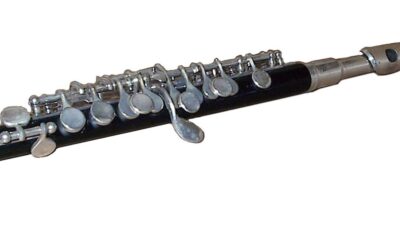
पिकोलो एक अत्यंत छोटी अनुप्रस्थ (बगल से फूँकी जाने वाली) बाँसुरी है — साधारण कॉन्सर्ट फ़्लूट की लगभग आधी लंबाई (लगभग 32 सेंटीमीटर)। इसे प्रायः दो भागों में बाँटा जाता है — शीर्ष-भाग (हेड जॉइंट) और शरीर (बॉडी) — और अधिकांश पिकोलो में कॉन्सर्ट फ़्लूट जैसा पाद-भाग (फुट जॉइंट) नहीं होता। यह लकड़ी, धातु या राल (ABS resin) से बना होता है और इसकी अँगुली-प्रणाली (fingering) लगभग बड़ी बाँसुरी जैसी ही होती है।
Description English
The piccolo is a very small transverse (side-blown) flute — roughly half the length of a standard concert flute (about 32 cm). It is usually made in two pieces — a head joint and a body — and most piccolos omit the concert flute's foot joint. It is built of wood, metal, or resin (ABS), and its fingering is nearly identical to that of the full-size flute.
Body
Slender cylindrical-to-conical tube in two joints (head + body)
पतली बेलनाकार-से-शंक्वाकार नली, दो जोड़ों में (शीर्ष + शरीर)
Grenadilla / African blackwood (professional), silver or nickel-plated metal, or ABS resin (student models such as the Yamaha YPC32)
ग्रेनेडिला (अफ़्रीकी काली लकड़ी — व्यावसायिक), चाँदी या निकल-चढ़ी धातु, अथवा ABS राल (विद्यार्थी मॉडल, जैसे यामाहा YPC32)
31-33
Open cylindrical/conical bore — sound radiates from the embouchure edge and open tone holes rather than from an enclosed chamber
Head Joint
शीर्ष-भाग (हेड जॉइंट)
Head joint
ऊपरी भाग जिसमें फूँकने का छेद (embouchure hole) होता है; वादक इसी किनारे पर बगल से हवा फूँकता है जिससे किनारे पर वायु विभाजित होकर स्वर बनता है।
The upper section bearing the embouchure (blow) hole; the player directs breath across its edge, splitting the airstream to generate tone. Head joints may be straight or, for children, curved.
Keys And Holes
चाबियाँ एवं स्वर-छिद्र
Keys and tone holes
शरीर पर धातु की चाबियाँ और पैड लगे होते हैं जो स्वर-छिद्रों को खोलते-बंद करते हैं; अधिकांश आधुनिक पिकोलो में बोहम-प्रणाली (Boehm system) की चाबी-व्यवस्था होती है, जो बड़ी बाँसुरी जैसी ही है।
The body carries metal keys and pads that open and close the tone holes; most modern piccolos use the Boehm-system keywork, identical in logic to the concert flute, so a flautist can switch to piccolo with minimal relearning.
Embouchure
मुख-छिद्र (एम्बुशर)
Embouchure hole
शीर्ष-भाग का फूँकने वाला छेद, जिस पर होंठों की सटीक स्थिति और वायु-गति से स्वर, तारत्व और तीव्रता नियंत्रित होती है। छोटे आकार के कारण पिकोलो का एम्बुशर बाँसुरी से अधिक सूक्ष्म एवं कठिन होता है।
The blow hole on the head joint; precise lip placement and air speed control pitch, timbre and dynamics. Because the instrument is so small, the piccolo embouchure is finer and more demanding than the flute's, and intonation is unforgiving.
Bore
नली (बोर)
Bore
भीतरी नली प्रायः शंक्वाकार (शीर्ष की ओर चौड़ी, नीचे संकरी) होती है, जो पिकोलो को उसका चमकीला, भेदक स्वर देती है; कुछ धातु के पिकोलो बेलनाकार बोर के भी होते हैं।
The internal bore is usually conical (wider at the head, narrowing toward the foot), which gives the piccolo its bright, penetrating tone; some metal piccolos use a cylindrical bore.
Pitch
तारत्व
Pitch / transposition
आधुनिक पिकोलो 'C' में होता है और लिखे हुए स्वर से ठीक एक सप्तक (octave) ऊँचा बजता है — अर्थात यह एक 'ट्रांसपोज़िंग' वाद्य है। पुराने बैंड-पिकोलो 'D-flat' में भी बनते थे।
The modern piccolo is pitched in C and sounds exactly one octave higher than written — making it a transposing instrument. Older band piccolos were also built in D-flat.
ध्वनि-चरित्र
SoundTonal Character Hindi
पिकोलो की ध्वनि तीखी, चमकीली और भेदक है — पूरे ऑर्केस्ट्रा के ऊपर से भी स्पष्ट सुनाई देती है। इसका ऊपरी सप्तक सीटी-सा उज्ज्वल और उत्सवी है, जबकि निचला स्वर मृदु एवं हवादार होता है। यही चमक इसे फ़िल्म-संगीत के 'सजावटी फिलर्स' और उल्लासपूर्ण अंतरे-भागों के लिए आदर्श बनाती है।
Tonal Character English
The piccolo's tone is sharp, brilliant and piercing — it cuts clearly even above a full orchestra. Its upper register is whistle-bright and festive, while its lowest notes are soft and airy. That very brightness makes it ideal for ornamental fills and joyful interlude flourishes in film music.
Timbre
Brilliant, edgy, high and clear; shrill at fortissimo, delicate and flute-like when played softly
Range
Written D5 to C8 (sounding D6 to C9) — the highest sustained pitches in the standard orchestra and concert band
Dynamic Range
Naturally very loud in the high register (hard to play softly there); more limited dynamic subtlety than the flute, so composers use it for accent and colour
Techniques
सुनने का मार्गदर्शन
The Listening Guideपिकोलो पहचानना हो तो 1950 से 1970 के दशक के भव्य फ़िल्मी गीत लगाइए और मुखड़े के बाद के अंतराल पर कान लगाइए। जब स्वर थमे और सबसे ऊपर से एक तीखी, चमकीली, सीटी-सी उछलती लकीर सुनाई दे — प्रायः वही पिकोलो है। उत्सवी और नाच-प्रधान गीतों में इसकी चंचल चहक सबसे साफ़ खुलती है; और पश्चिमी मार्च-बैंड में तो यह छाई ही रहती है।
अंग्रेज़ी में पढ़ें · Read in English
To spot the piccolo, listen to the lavish film songs of the 1950s-70s. Focus on the interludes between vocal lines — when the voice pauses and you hear the highest, brightest, whistle-like leaping tune, that is usually the piccolo. Its playful chirp is clearest in festive, dance-heavy or comic songs.
परिचय
Identity- Year Of Origin
- 1710
अन्य विवरण
More DetailsTimbre
Brilliant, edgy, high and clear; shrill at fortissimo, delicate and flute-like when played softly
रोचक तथ्य
Margin Notesआधी बाँसुरी, दुगुनी ऊँचाई — पिकोलो साधारण कॉन्सर्ट फ़्लूट की लगभग आधी लंबाई का होता है, किंतु उसी अँगुली-प्रणाली से ठीक एक सप्तक ऊँचा बजता है। इसलिए एक कुशल बाँसुरी-वादक अपेक्षाकृत कम अभ्यास से पिकोलो पर आ सकता है — यद्यपि इसका सूक्ष्म एम्बुशर और सुर मिलाना (intonation) कहीं अधिक कठिन है।
The piccolo is about half the length of a standard concert flute but, using the same fingering, sounds exactly one octave higher. A skilled flautist can therefore switch to piccolo with relatively little relearning — though its fine embouchure and intonation are far harder to master.
मार्च का प्रसिद्ध पिकोलो-एकल — जॉन फ़िलिप सूज़ा की मार्च 'स्टार्स एंड स्ट्राइप्स फ़ॉरएवर' (1896) का पिकोलो-एकल पश्चिमी संगीत का सबसे प्रसिद्ध पिकोलो अंश है — बैंड-वादकों के लिए यह मानो 'परीक्षा-पत्र' है।
The piccolo solo in John Philip Sousa's march 'The Stars and Stripes Forever' (1896) is the most famous piccolo passage in Western music — for band players it is almost a rite-of-passage test piece.
लकड़ी, धातु या प्लास्टिक — व्यावसायिक पिकोलो प्रायः ग्रेनेडिला (अफ़्रीकी काली लकड़ी) के बनते हैं, जिससे मृदु-गोल स्वर मिलता है; बैंड और परेड में धातु के पिकोलो चलते हैं; और विद्यार्थी-मॉडल (जैसे यामाहा YPC32, जो इस लेख के चित्र में है) ABS राल के बनते हैं जो मौसम-सहिष्णु और सस्ते होते हैं।
Professional piccolos are usually made of grenadilla (African blackwood) for a warmer, rounder tone; metal piccolos are favoured for bands and parades; and student models (such as the Yamaha YPC32 pictured in this article) are made of ABS resin, which is weather-resistant and affordable.
फ़िल्म-ऑर्केस्ट्रा का 'चहचहाता' रंग — हिंदी फ़िल्म-संगीत में पिकोलो प्रायः 'सोलो' नहीं बजता, बल्कि मुखड़े-अंतरे के बीच के अंतराल में उछलती, चंचल धुनें भरता है — नृत्य-गीतों, हास्य-दृश्यों और उत्सवी क्षणों में उसकी चहक सबसे स्पष्ट होती है।
In Hindi film music the piccolo rarely plays a solo; instead it fills the interludes between vocal lines with leaping, playful figures — its chirp is clearest in dance songs, comic scenes and festive moments.
सवाल-जवाब
Questions & Answersपिकोलो क्या है?
पिकोलो एक पश्चिमी वुडविंड वाद्य है — साधारण बाँसुरी (कॉन्सर्ट फ़्लूट) की लगभग आधी लंबाई की एक छोटी अनुप्रस्थ बाँसुरी, जो लिखे स्वर से एक सप्तक ऊँची, चमकीली और भेदक ध्वनि में बजती है। यह ऑर्केस्ट्रा का सबसे ऊँची आवाज़ वाला वाद्य है।
पिकोलो हिंदी फ़िल्म-संगीत में कैसे प्रयुक्त होता है?
1950-1970 के दशक के फ़िल्म-ऑर्केस्ट्रा में पिकोलो का काम मुखड़े-अंतरे के बीच उज्ज्वल, चंचल 'फिलर' और ऊँचे फ्लोरिश भरना था। शंकर-जयकिशन, आर.डी. बर्मन और लक्ष्मीकांत-प्यारेलाल जैसे संगीतकारों के उत्सवी, नृत्य-प्रधान गीतों में इसकी चहक सुनाई देती है।
पिकोलो और बाँसुरी में क्या अंतर है?
पिकोलो कॉन्सर्ट फ़्लूट (पश्चिमी बाँसुरी) की लगभग आधी लंबाई का होता है और एक सप्तक ऊँचा बजता है, यद्यपि दोनों की अँगुली-प्रणाली समान है। भारतीय 'बाँसुरी' बाँस की बनी होती है और मीड-गमक जैसी सूक्ष्म स्वर-क्रियाओं में सक्षम है, जबकि पिकोलो समान-स्वभावित पश्चिमी पैमाने का धातु/लकड़ी/राल वाद्य है।
क्या पिकोलो भारतीय शास्त्रीय संगीत का वाद्य है?
नहीं। पिकोलो विशुद्ध पश्चिमी वाद्य है। भारतीय शास्त्रीय एवं लोक-संगीत में ऊँची फूँक-ध्वनि की भूमिका बाँसुरी निभाती है। पिकोलो भारत में केवल फ़िल्म एवं मंच के पश्चिमी ऑर्केस्ट्रेशन के माध्यम से प्रयुक्त होता है।
नमूना-पट्टी
The Specimen Table| नाम | पिकोलो · Piccolo |
|---|---|
| अन्य नाम | पिकोलो बाँसुरी · ऑटाविनो (Ottavino) · फ्लाउटो पिकोलो (Flauto piccolo) · Piccolo (also: Piccolo flute) |
| उद्गम | 1710 |
| प्रकार | वाद्य · Instruments |
साझा कीजिए · Share this Plate