शास्त्र विंग · वाद्य-पट्टिका · Instrument Plate
कोम्बु
Kombu
अन्य नामकोम्पु · कोम्बु पट्टु (Kombu Pattu) · கொம்பு (Tamil) · കൊമ്പ് (Malayalam)
परिचय
Overviewकोम्बु दक्षिण भारत — केरल और तमिलनाडु — का विशाल 'C' या 'S' आकार का पीतल-श्रृंग है, जो पंचवाद्यम, पांडि मेलम और पांचारि मेलम का एकमात्र वायु-वाद्य है। केवल तीन स्वर (सा, पा, ऊँचा सा) बजाकर भी यह मुख्यतः लय-वाद्य के रूप में ढोलों की चोटों को सजाता है। कोम्बु पट्टु में एक नायक और साथी वादकों की मंडली आह्वान-प्रतिध्वनि की लयबद्ध रचनाएँ प्रस्तुत करते हैं। प्राचीन युद्ध के मुरसु-साथी से लेकर त्रिशूर पूरम की शोभायात्रा तक, कोम्बु उद्घोष और उत्सव की जीवित परंपरा है।
अंग्रेज़ी में पढ़ें · Read in English
The kombu is the great 'C'- or 'S'-shaped brass horn of South India — Kerala and Tamil Nadu — the sole wind instrument of Panchavadyam, Pandi Melam and Panchari Melam. Sounding only three notes (Sa, Pa, upper Sa), it functions chiefly as a rhythm instrument, embellishing the strokes of the drums. In Kombu Pattu a leader and a chorus of players present call-and-response rhythmic compositions. From the murasu's ancient battlefield companion to the Thrissur Pooram procession, the kombu is a living tradition of proclamation and celebration.
वर्गीकरण
ClassificationNatya Shastra Category
सुषिर (Sushira - wind/hollow instruments)
कोम्बु सुषिर वर्ग का वाद्य है — अर्थात् ऐसा खोखला वाद्य जिसमें फूँक (वायु) से ध्वनि उत्पन्न होती है। यह एक 'नैसर्गिक श्रृंग' (natural horn) है जिसमें कोई छिद्र, वॉल्व या चाबी नहीं होती; ध्वनि केवल होंठों के कंपन और श्वास-नियंत्रण से बनती है।
The kombu belongs to the Sushira (wind/hollow) category of the Natya Shastra — a hollow instrument whose sound is produced by breath. It is a 'natural horn' with no finger-holes, valves or keys; pitch is generated purely through lip vibration (embouchure) and breath control.
Western Category
Natural horn (valveless lip-reed brass aerophone)
Western Family
Labrosone / horn family (a natural horn similar in acoustic principle to the alphorn or military bugle, but shaped in a distinctive Indian C or S curve)
Sub Classification
बनावट
PhysicalDescription Hindi
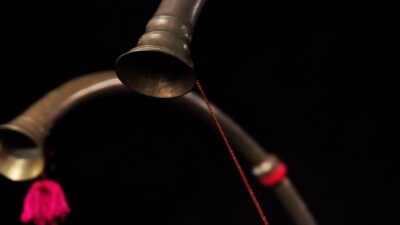
कोम्बु एक बड़ा, 'C' या 'S' आकार का घुमावदार श्रृंग है जो पीतल, ताँबे अथवा काँसे से ढाला जाता है। यह लगभग 132 सेंटीमीटर लंबा और लगभग 15 सेंटीमीटर चौड़ा होता है। इसका एक सिरा पतला (मुखनली/माउथपीस) होता है जहाँ से फूँका जाता है और दूसरा सिरा चौड़ी घंटी (bell) में खुलता है जहाँ से ध्वनि निकलती है। ले जाने में सुविधा के लिए इसे प्रायः दो या तीन जुड़ने वाले खंडों में बनाया जाता है।
Description English
The kombu is a large, 'C'- or 'S'-shaped curved horn cast from brass, copper or bronze. It is roughly 132 centimetres long and about 15 centimetres wide. One end tapers into a narrow mouthpiece into which the player blows, while the other flares into a wide bell from which the sound emerges. For portability it is often made in two or three interlocking sections.
Body
Large curved horn — either a 'C' curve or an 'S' curve
बड़ा घुमावदार श्रृंग — 'C' अथवा 'S' आकार का
Brass, copper, or bronze (cast/beaten metal)
पीतल, ताँबा या काँसा (ढली/पीटी हुई धातु)
≈132
≈15
The conical bore itself, opening into a flared bell that projects sound over long distances in open temple grounds
Sections
Holes Valves
कोम्बु में कोई छिद्र, वॉल्व या चाबी नहीं होती। यही कारण है कि यह केवल कुछ नैसर्गिक स्वर (harmonics) ही उत्पन्न कर सकता है और मुख्यतः लय-वाद्य के रूप में प्रयोग होता है।
The kombu has no finger-holes, valves or keys. For this reason it can sound only a few natural harmonics, and is used chiefly as a rhythm instrument.
Playing Posture
वादक कोम्बु को एक हाथ से थामकर, प्रायः खड़े होकर अथवा मंदिर-शोभायात्रा में चलते हुए बजाता है। इसकी घुमावदार बनावट इसे कंधे या बाँह के इर्द-गिर्द सहजता से पकड़ने योग्य बनाती है।
The player holds the kombu with one hand, usually standing or walking in a temple procession. Its curved form lets it rest comfortably around the shoulder or arm.
ध्वनि-चरित्र
SoundTonal Character Hindi
कोम्बु की ध्वनि गहरी, गूँजती और भेदक होती है — पीतल के श्रृंग की भारी, दूर तक जाने वाली टेर, जो ढोल-चेंडा की गड़गड़ाहट के ऊपर तैरती है। यह मधुर राग-वाद्य नहीं, बल्कि लय और उद्घोष का वाद्य है।
Tonal Character English
The kombu's tone is deep, resonant and penetrating — the heavy, far-carrying blare of a brass horn floating above the thunder of drums. It is not a melodic instrument but one of rhythm and announcement.
Timbre
Bold, brassy, sustained horn tone with strong carrying power in open air
Range
Only three notes — Sa (fundamental), Pa (the fifth), and the higher Sa (octave); no continuous melodic scale
Notes Hindi
कोम्बु केवल तीन स्वर उत्पन्न कर सकता है — षड्ज (सा), पंचम (पा) और तार षड्ज (ऊँचा सा)। ये तीनों नैसर्गिक स्वर (harmonics) हैं जिन्हें होंठों के कसाव और श्वास से बदला जाता है।
Notes English
The kombu can sound only three notes — Sa (the fundamental), Pa (the fifth) and the upper Sa (octave). These are natural harmonics selected by tightening the lips and controlling the breath.
Dynamic Range
Powerful and largely fixed at a loud, festive volume suited to open temple grounds; capable of sharp attack and long sustained blasts
Techniques
सुनने का मार्गदर्शन
The Listening Guideकोम्बु को समझने के लिए पहले पंचवाद्यम या पांचारि मेलम सुनिए और ढोल-झाँझ के ऊपर तैरती पीतल की भारी टेर को पहचानिए — वही कोम्बु है। फिर 'कोम्बु पट्टु' सुनिए, जहाँ केवल कोम्बु वादक बजते हैं: नायक कोई लयबद्ध बोल गढ़ता है और मंडली उसे हूबहू दोहराती है। केवल तीन स्वरों में इतनी विविध लय — यही कोम्बु का चमत्कार है।
अंग्रेज़ी में पढ़ें · Read in English
To appreciate the kombu, first hear a Panchavadyam or Panchari Melam and pick out the brass blast floating above the drums and cymbals — that is the kombu. Then listen to 'Kombu Pattu', where only kombu players perform: notice how a leader coins a rhythmic phrase and the troupe echoes it exactly. So much rhythm from only three notes — that is the miracle of the kombu.
अन्य विवरण
More DetailsTimbre
Bold, brassy, sustained horn tone with strong carrying power in open air
रोचक तथ्य
Margin Notesछह तालों की कला — प्रसिद्ध एकल कलाकार कुमठ रामन नायर के अनुसार कोम्बु पट्टु छह तालों में प्रस्तुत की जाती है — चेम्पट (8), अटन्त (14), ध्रुवम (14), चेम्प (10), अंचतन्त (16) और त्रिपुट (7)। यह वर्गीकरण दर्शाता है कि तीन स्वरों वाला वाद्य भी कितनी गहन लय-रचना कर सकता है।
According to the renowned soloist Kumath Raman Nair, Kombu Pattu is performed in six talas — chempata (8), atanta (14), dhruvam (14), chempha (10), anchatantha (16) and thriputa (7). This shows how a three-note instrument can build deeply intricate rhythm.
नायक और मंडली — कोम्बु पट्टु में 3, 5, 7 या 9 वादकों की मंडली होती है जिसका नेतृत्व एक कोम्बु-नायक करता है। नायक ताल के भीतर मौके पर कोई लयबद्ध बोल गढ़ता है, और शेष वादक उसे दोहराते हैं — पूरी प्रस्तुति सुधार (improvisation) एवं स्मृति पर टिकी होती है।
A Kombu Pattu troupe has 3, 5, 7 or 9 players led by a kombu-leader. Within the tala the leader improvises a rhythmic phrase on the spot and the rest repeat it — the whole performance rests on improvisation and memory.
युद्ध से मंदिर तक — तिरुमुरै (छठी–ग्यारहवीं शताब्दी) जैसे प्राचीन ग्रंथों में कोम्बु का उल्लेख युद्ध-वाद्य के रूप में मिलता है, जिसे मुरसु (नगाड़े) के साथ बजाया जाता था। सदियों में यह रणभूमि से हटकर मंदिर-उत्सव की शोभा बन गया।
Ancient texts such as the Tirumurai (6th–11th century) mention the kombu as a war instrument, played with the murasu (kettledrum). Over the centuries it moved from the battlefield to become the glory of temple festivals.
दो नाम, एक श्रृंग — इस वाद्य को तमिल में 'கொம்பு' (कोम्बु) और मलयालम में 'കൊമ്പ്' (कोम्प) कहते हैं — दोनों का अर्थ 'सींग' है। इसे 'कोम्पु' भी लिखा जाता है, और इसकी प्रस्तुति-शैली 'कोम्बु पट्टु' कहलाती है।
The instrument is called 'கொம்பு' (kombu) in Tamil and 'കൊമ്പ്' (kompu) in Malayalam — both meaning 'horn'. It is also spelt 'kompu', and its performance form is called 'Kombu Pattu'.
सवाल-जवाब
Questions & Answersकोम्बु क्या है?
कोम्बु दक्षिण भारत (केरल एवं तमिलनाडु) का एक बड़ा 'C' या 'S' आकार का पीतल/ताँबे/काँसे का नैसर्गिक श्रृंग है। यह पंचवाद्यम, पांडि मेलम और पांचारि मेलम में प्रयुक्त एकमात्र वायु-वाद्य है और मुख्यतः लय-वाद्य के रूप में बजाया जाता है।
कोम्बु कितने स्वर बजा सकता है?
कोम्बु केवल तीन स्वर बजा सकता है — षड्ज (सा), पंचम (पा) और तार षड्ज (ऊँचा सा)। इसमें कोई छिद्र या वॉल्व नहीं होता, इसलिए इसे राग-वाद्य नहीं, बल्कि लय-वाद्य माना जाता है।
कोम्बु पट्टु क्या है?
कोम्बु पट्टु केवल कोम्बु वादकों (3, 5, 7 या 9) की मंडली द्वारा प्रस्तुत आह्वान-प्रतिध्वनि कला है। एक नायक ताल के भीतर मौके पर लयबद्ध बोल गढ़ता है और शेष वादक उसे दोहराते हैं। यह छह तालों में प्रस्तुत की जाती है।
पंचवाद्यम के पाँच वाद्य कौन से हैं?
पंचवाद्यम के पाँच वाद्य हैं — मद्दलम, इटक्का, तिमिला, इलत्तालम और कोम्बु। इनमें से कोम्बु ही एकमात्र वायु-वाद्य है; शेष चारों ताल-वाद्य (ढोल एवं झाँझ) हैं।
कोम्बु का प्रयोग हिंदी फ़िल्म-संगीत में होता है?
मुख्यधारा के हिंदी फ़िल्म-संगीत में कोम्बु दुर्लभ है क्योंकि यह क्षेत्रीय मंदिर-उत्सव का वाद्य है। यह प्रायः केरल की पृष्ठभूमि वाले दृश्यों, पूरम-उत्सव के चित्रण तथा दक्षिण भारतीय (विशेषतः मलयालम) सिनेमा में उत्सव का वातावरण गढ़ने के लिए सुनाई देता है।
नमूना-पट्टी
The Specimen Table| नाम | कोम्बु · Kombu |
|---|---|
| अन्य नाम | कोम्पु · कोम्बु पट्टु (Kombu Pattu) · கொம்பு (Tamil) · കൊമ്പ് (Malayalam) · Kompu |
| प्रकार | वाद्य · Instruments |
साझा कीजिए · Share this Plate