शास्त्र विंग · वाद्य-पट्टिका · Instrument Plate
करनाल
Karnal
अन्य नामकरना · कर्ना · कलश करनाल (लंबा प्रकार / long variety) · Karnal (also: Karna, Karnā)
परिचय
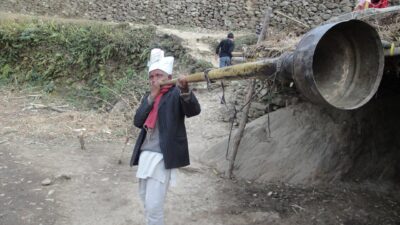
Overviewकरनाल पश्चिमी हिमालय की देव-संस्कृति का बुलंद स्वर है — एक मीटर से लंबी सीधी पीतल की तुरही, जिसका धतूरे-सा घंटी-मुख गहरे नाद को घाटियों में फैला देता है। न इसमें छेद, न कुंजी; केवल होंठों के दबाव से बजने वाली यह नैसर्गिक तुरही मधुर राग नहीं गाती, बल्कि देवता की पालकी, विवाह की बारात और मेले के आगमन की घोषणा करती है। कुल्लू दशहरे में सैकड़ों करनाल-रणसिंगा का सम्मिलित नाद इसका सर्वोच्च वैभव है।
अंग्रेज़ी में पढ़ें · Read in English
The karnal is the resounding voice of the western Himalaya's deity culture — a straight brass trumpet over a metre long whose datura-shaped bell casts a deep note across the valleys. With no holes and no valves, this natural trumpet — sounded by lip pressure alone — sings no sweet raga but announces the arrival of the deity's palanquin, the wedding procession and the fair. Its supreme grandeur is the combined blare of hundreds of karnals and ransinghas at Kullu Dussehra.
वर्गीकरण
ClassificationNatya Shastra Category
सुषिर (Sushira - wind instruments)
नाट्यशास्त्र की सुषिर (वायु) श्रेणी में करनाल एक फूँक-वाद्य है — खोखली धातु-नली में होंठों के कंपन से हवा प्रवाहित कर ध्वनि उत्पन्न होती है। इसमें न कोई छेद होता है, न कोई कुंजी; स्वर केवल होंठों के दबाव (होंठ-रीड) से बदलता है, इसलिए यह एक 'नैसर्गिक तुरही' है।
In the Sushira (wind/aerophone) category of Natya Shastra, the karnal is a blown instrument — sound is produced by the vibration of the player's lips setting the air column of a hollow metal tube in motion. It has no finger holes and no valves; pitch changes only through lip pressure (lip-reed), making it a 'natural trumpet'.
Western Category
Natural trumpet (valveless brass aerophone / labrosone)
Western Family
Lip-reed aerophone family — kin to the fanfare trumpet, Tibetan dungchen, Central Asian karnay and the alphorn in acoustic principle
Sub Classification
बनावट
PhysicalDescription Hindi
करनाल एक लंबी, सीधी धातु की तुरही है — प्रायः एक मीटर से भी अधिक लंबी — जो एक पतले नली-मुख से चौड़े, फैले हुए घंटी-मुख (bell) तक धीरे-धीरे खुलती जाती है। इसका घंटी-मुख अक्सर धतूरे के फूल जैसा फैला होता है। परिवहन में आसानी के लिए इसे प्रायः दो अलग होने वाले पीतल के खंडों में बनाया जाता है जो बजाते समय जोड़ लिए जाते हैं।
Description English
The karnal is a long, straight metal trumpet — usually over a metre in length — that widens gradually from a narrow blowing end to a broad, flared bell. Its bell often spreads open like the flower of the datura (thorn-apple). For ease of transport it is frequently made in two separable brass sections that are joined together for playing.
Body
Long straight cylindrical-to-conical tube ending in a wide flared bell
लंबी सीधी बेलनाकार-से-शंक्वाकार नली जो अंत में चौड़ी फैली घंटी में खुलती है
Brass (traditional); sometimes copper, and silver for ceremonial temple instruments
पीतल (पारंपरिक); कहीं-कहीं तांबा, और मंदिर के अनुष्ठानिक वाद्यों में चांदी (चांदी के करनाल)
100-150 (Nepali examples ~121 cm; Himachali temple pieces often longer)
The full length of the metal tube acts as the resonating air column; the flared bell projects and amplifies the tone across valleys
Strings
Not applicable — the karnal is a wind instrument (aerophone) and has no strings.
लागू नहीं — करनाल एक सुषिर (वायु) वाद्य है, इसमें कोई तार नहीं होता।
Bore And Bell
नली का भीतरी व्यास मुख से घंटी की ओर बढ़ता जाता है; यही शंक्वाकार विस्तार करनाल की गहरी, गूँजती ध्वनि का आधार है।
The internal bore widens from the mouthpiece toward the bell; this conical expansion gives the karnal its deep, resonant, far-carrying tone.
फैला हुआ घंटी-मुख, प्रायः धतूरे के फूल या कलश जैसा, जिस पर मंदिर-वाद्यों में उभरी हुई नक्काशी होती है।
The flared bell, often shaped like a datura flower or a kalash (ceremonial pot), is frequently embossed with decorative patterns on temple instruments.
Mouthpiece
मुख / फूँक-मुख
Mouthpiece
Integral brass cup at the narrow end
नली के पतले सिरे पर एक कप-नुमा मुख होता है जिस पर होंठ टिकाकर 'भिनभिनाहट' (buzz) से हवा कंपित की जाती है — यही लिप-रीड सिद्धांत है।
A cup-shaped opening at the narrow end against which the player presses the lips and buzzes to set the air column vibrating — the lip-reed (labrosone) principle.
Construction
प्रायः दो (कभी-कभी तीन) पीतल के खंड जो एक-दूसरे में फँसकर जुड़ते हैं, जिससे वाद्य को खोलकर आसानी से ले जाया जा सके।
Usually two (sometimes three) telescoping brass sections that fit together, allowing the instrument to be dismantled and carried easily.
खंडों को हाथ से जोड़ा-खोला जाता है; कारीगर पीतल की चादर को मोड़-वेल्ड कर नली और घंटी गढ़ते हैं।
Sections are hand-fitted; craftsmen shape the tube and bell by rolling and seaming brass sheet.
Frets
करनाल में न फ्रेट, न कुंजी (valves), न कोई छेद होता है। यह पूर्णतः नैसर्गिक तुरही है — स्वर केवल होंठों के दबाव और फूँक की तीव्रता से बदलते हैं, इसलिए यह हार्मोनिक श्रृंखला के कुछ ही स्वर बजा पाता है।
The karnal has no frets, no valves and no finger holes. It is a pure natural trumpet — pitch changes only through lip pressure and breath intensity, so it can sound only a few notes of the harmonic series.
ध्वनि-चरित्र
SoundTonal Character Hindi
करनाल की ध्वनि गहरी, बुलंद और भेदने वाली होती है — एक राजसी, गूँजता नाद जो पहाड़ी घाटियों में दूर तक फैल जाता है। यह मधुर-मेलोडिक वाद्य नहीं, बल्कि उद्घोषक वाद्य है: देवता के आगमन, विवाह की बारात या युद्ध-आह्वान की घोषणा करता है।
Tonal Character English
The karnal's tone is deep, powerful and penetrating — a majestic, resonant blare that carries far across mountain valleys. It is not a sweet melodic instrument but a herald: announcing the arrival of a deity, a wedding procession, or a martial call.
Timbre
Brassy, sonorous, commanding; a broad open blast rather than a nuanced melody
Range
Very limited — only the fundamental and a few natural harmonics (overtones) of the tube; typically 2-4 usable pitches
Dynamic Range
Loud and projecting by design; built to be heard over drums and across open air without amplification
Techniques
सुनने का मार्गदर्शन
The Listening Guideकरनाल को अकेले 'धुन' की तरह मत सुनिए — इसे दृश्य और संदर्भ के साथ सुनिए। कुल्लू दशहरे या किसी देव-मेले का वीडियो देखिए और महसूस कीजिए कैसे करनाल का गहरा नाद ढोल-नगाड़े की ताल और रणसिंगा के उत्तर के साथ मिलकर एक सामूहिक भव्यता रचता है।
अंग्रेज़ी में पढ़ें · Read in English
Do not listen to the karnal as a solo 'tune' — hear it with its scene and context. Watch a video of Kullu Dussehra or a deity mela: notice how the karnal's deep blare joins the beat of dhol and nagara and the answering call of the ransingha to build a collective grandeur. Attend to the moment the deity's palanquin arrives and the karnal's fanfare reaches its peak.
अन्य विवरण
More Details- Sections English
- Usually two (sometimes three) telescoping brass sections that fit together, allowing the instrument to be dismantled and carried easily.
- Joinery English
- Sections are hand-fitted; craftsmen shape the tube and bell by rolling and seaming brass sheet.
- Sections
- प्रायः दो (कभी-कभी तीन) पीतल के खंड जो एक-दूसरे में फँसकर जुड़ते हैं, जिससे वाद्य को खोलकर आसानी से ले जाया जा सके।
- Joinery
- खंडों को हाथ से जोड़ा-खोला जाता है; कारीगर पीतल की चादर को मोड़-वेल्ड कर नली और घंटी गढ़ते हैं।
Construction
Timbre
Brassy, sonorous, commanding; a broad open blast rather than a nuanced melody
रोचक तथ्य
Margin Notesकरनाल और रणसिंगा — जोड़ीदार वाद्य — करनाल सीधी तुरही है जबकि रणसिंगा उसका मुड़ा हुआ (प्रायः 'S' या 'C' आकार का) भाई-वाद्य है। हिमाचली देव-यात्राओं में दोनों प्रायः जोड़ी में बजते हैं — एक का नाद दूसरे को उत्तर देता है।
The karnal is a straight trumpet while the ransingha is its curved (often 'S'- or 'C'-shaped) sibling. In Himachali deity processions the two are usually played as a pair — one's blast answering the other.
वंशानुगत कारीगरी — मंडी की थाची जैसी जगहों में कारीगर आज भी हाथ से पीतल की चादर मोड़कर करनाल गढ़ते हैं, और साथ ही देवी-देवताओं की मूर्तियाँ भी बनाते हैं। यह कौशल प्रायः पिता से पुत्र को मिलता है।
In places like Thachi in Mandi, craftsmen still hand-shape brass sheet into karnals, and also make idols of the gods and goddesses. The skill typically passes from father to son.
चांदी के करनाल — जहाँ अधिकांश करनाल पीतल के होते हैं, वहीं कुछ मंदिरों के अनुष्ठानिक करनाल चांदी के भी बनाए जाते हैं, जिनकी मधुर-चमकीली ध्वनि विशेष शुभ मानी जाती है।
While most karnals are brass, some temple ceremonial karnals are made of silver, whose bright, ringing tone is considered especially auspicious.
एक वाद्य, कई नाम, कई देश — लंबी सीधी धातु-तुरही की यह परंपरा भारत, नेपाल और आगे पूरे एशिया में फैली है — तिब्बत का दुंगचेन, मध्य एशिया का करनाय, फारस का कर्ना — सभी एक ही ध्वनि-सिद्धांत के भाई-बंधु हैं।
This tradition of the long straight metal trumpet spreads across India, Nepal and further through Asia — the Tibetan dungchen, the Central Asian karnay, the Persian karna — all kin sharing the same acoustic principle.
सवाल-जवाब
Questions & Answersकरनाल क्या है?
करनाल एक लंबी, सीधी पीतल की तुरही है जो एक मीटर से भी अधिक लंबी होती है और इसका घंटी-मुख धतूरे के फूल जैसा फैला होता है। यह हिमाचल प्रदेश, राजस्थान एवं नेपाल में देव-यात्राओं, मंदिर-अनुष्ठानों और विवाह-जुलूसों में बजाई जाने वाली एक नैसर्गिक (छेद एवं कुंजी रहित) तुरही है।
करनाल कैसे बजाई जाती है?
करनाल एक लिप-रीड (होंठ-रीड) वाद्य है — वादक कप-नुमा मुख पर होंठ टिकाकर हवा को कंपित करता है। इसमें कोई छेद या कुंजी नहीं होती, इसलिए स्वर केवल होंठों के दबाव से बदलते हैं और यह हार्मोनिक श्रृंखला के कुछ ही स्वर बजा पाती है। कुशल वादक आवर्तन-श्वास (circular breathing) से लगातार नाद देते हैं।
करनाल और रणसिंगा में क्या अंतर है?
करनाल एक लंबी सीधी धातु-तुरही है, जबकि रणसिंगा उसका मुड़ा हुआ (प्रायः S या C आकार का) भाई-वाद्य है। हिमाचली देव-यात्राओं में दोनों प्रायः जोड़ी में बजते हैं और एक-दूसरे के नाद का उत्तर देते हैं।
करनाल कहाँ और किन अवसरों पर बजाई जाती है?
करनाल मुख्यतः हिमाचल प्रदेश (कुल्लू, मंडी) की देवता-यात्राओं, कुल्लू दशहरा एवं मंडी शिवरात्रि जैसे उत्सवों, तथा पहाड़ी विवाह-बारात में बजाई जाती है। नेपाल में यह 'पंचे बाजा' का अंग है और राजस्थान में राजसी एवं वैवाहिक जुलूसों में सुनी जाती है।
क्या करनाल शास्त्रीय संगीत या बॉलीवुड में बजाई जाती है?
नहीं, करनाल शास्त्रीय राग-संगीत का वाद्य नहीं है क्योंकि यह केवल कुछ ही स्वर बजा पाती है। यह लोक-अनुष्ठानिक वाद्य है। बॉलीवुड में यह नियमित नहीं, किंतु हिमालयी उत्सव, देव-यात्रा या राजसी दृश्यों के वातावरण के लिए इसका बुलंद नाद कभी-कभी प्रयोग होता है।
नमूना-पट्टी
The Specimen Table| नाम | करनाल · Karnal |
|---|---|
| अन्य नाम | करना · कर्ना · कलश करनाल (लंबा प्रकार / long variety) · Karnal (also: Karna, Karnā) |
| प्रकार | वाद्य · Instruments |
साझा कीजिए · Share this Plate