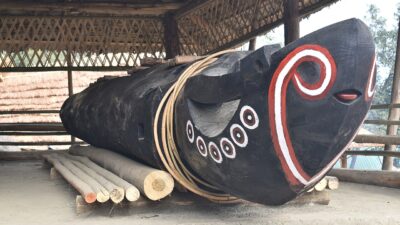
शास्त्र विंग · वाद्य-पट्टिका · Instrument Plate
काष्ठ ढोल (नागा)
Log Drum (Naga)
अन्य नामसूंगकोंग (Süngkong — आओ नागा) · खाम (Kham — कोन्याक नागा) · काष्ठ ढोल / लकड़ी का ढोल · Naga Log Drum / Slit Drum
परिचय
Overviewनागा काष्ठ ढोल — एक ही वृक्ष से तराशा हुआ विशाल खोखला लट्ठा, जिसकी ऊपरी दरार पर पड़ती लकड़ी की मुँगरियों की थाप कभी पूरी पहाड़ी घाटी तक संदेश पहुँचाती थी। 'ढोल' कहलाकर भी यह घन वाद्य (इडियोफोन) है — न तार, न चमड़ा, केवल लकड़ी की गूँज। युद्ध की चेतावनी, मृत्यु और जेन्ना की घोषणा, तथा फ़सल-उत्सव की धड़कन — नागा गाँव का समूचा जीवन इसी की थाप में दर्ज रहा; आज यह हॉर्नबिल महोत्सव में नागा अस्मिता की जीवंत आवाज़ है।
अंग्रेज़ी में पढ़ें · Read in English
The Naga log drum — a giant hollowed trunk carved from a single tree, whose wooden beaters upon the upper slit once carried messages across an entire hill valley. Though called a 'drum', it is an idiophone (Ghana) — no strings, no skin, only the resonance of wood. Warnings of war, announcements of death and genna, and the heartbeat of harvest festivals — the whole life of the Naga village was inscribed in its beat; today it is the living voice of Naga identity at the Hornbill Festival.
वर्गीकरण
ClassificationNatya Shastra Category
घन (Ghana — solid/self-sounding idiophones)
भारतीय वाद्य-वर्गीकरण की चार श्रेणियों (तत, सुषिर, अवनद्ध, घन) में नागा काष्ठ ढोल 'घन वाद्य' है — अर्थात ठोस, स्वयं-ध्वनित वाद्य जिसकी ध्वनि किसी तार या झिल्ली से नहीं, बल्कि ठोस लकड़ी के प्रहार से उत्पन्न होती है। नाम में 'ढोल' होने पर भी इसमें कोई चमड़े की झिल्ली नहीं होती, इसलिए यह अवनद्ध (मेम्ब्रेनोफोन) नहीं बल्कि घन (इडियोफोन) है।
Within the four categories of Indian instrument classification (Tata, Sushira, Avanaddha, Ghana), the Naga log drum is a 'Ghana vadya' — a solid, self-sounding instrument whose sound arises not from a string or a membrane but from striking the solid wood itself. Despite being called a 'drum', it has no skin head, so it is an idiophone (Ghana), not a membranophone (Avanaddha).
Western Category
Percussion idiophone — slit drum (log drum)
Western Family
Slit-drum family (Hornbostel-Sachs 111.231, struck idiophone); related to the African slit drum and the Pacific garamut, but uniquely Naga in scale, carving and ritual
Sub Classification
बनावट
PhysicalDescription Hindi
नागा काष्ठ ढोल एक विशाल, एकल-वृक्ष से तराशा हुआ खोखला लट्ठा है जिसकी ऊपरी सतह पर एक लंबी दरार (स्लिट) काटी जाती है। यह भारत का सबसे बड़ा एकल वाद्य माना जाता है — कुछ ढोल 10-12 मीटर तक लंबे और 3 मीटर तक परिधि के होते हैं। एक सिरे को प्रायः भैंसे/मिथुन के सींग, मानव-मुख या पक्षी की आकृति में तराशा जाता है, जो शक्ति और गाँव की प्रतिष्ठा का प्रतीक है।
Description English
The Naga log drum is a giant hollowed trunk carved from a single tree, with a long slit cut along its upper surface. It is regarded as the largest single instrument of India — some drums reach 10-12 metres in length and up to 3 metres in girth. One end is often carved into a mithun/buffalo head, a human face, or a bird figurehead, symbolising power and the prestige of the village.
Body
Elongated, boat- or canoe-like hollowed log with a lengthwise slit on top
लंबा, नाव या डोंगी जैसा खोखला लट्ठा, ऊपर लंबाई में कटी दरार
Single hardwood tree trunk (locally selected timber, chosen for tone and durability)
एकल कठोर-काष्ठ वृक्ष का तना (स्थानीय रूप से चुनी गई लकड़ी, ध्वनि और टिकाऊपन के लिए चयनित)
Length 400-1200 (approx. 4-12 metres); girth up to ~300
The entire hollowed interior of the log acts as the resonance chamber; the lengthwise slit and its 'lips' of differing thickness produce distinct pitches when struck at different points
Strings
None — the log drum is an idiophone with no strings; sound comes from striking the wooden body itself
None
None
Bow
गुर्ज / लकड़ी की मुँगरी (प्रहारक)
Wooden beaters (pestle-like mallets)
Solid wooden clubs / pestles cut from hardwood
40-90 (held by each player)
Struck vertically onto the lips and edges of the slit; the drum is not bowed. Multiple players stand along the length of the log and strike in coordinated, interlocking rhythm.
Tuning Pegs
लागू नहीं
Not applicable
No pegs — pitch is fixed at the time of carving by shaping the slit and the wall thickness at each point along the log
Bridge
लागू नहीं
Not applicable
No bridge — the sounding surfaces are the carved lips of the slit itself
Solid wood (the log body)
Frets
काष्ठ ढोल में फ्रेट या तार नहीं होते। इसकी अलग-अलग ध्वनियाँ दरार के किनारों पर अलग-अलग स्थानों और अलग-अलग मोटाई के भागों पर प्रहार करके निकाली जाती हैं — मोटा किनारा गहरी ध्वनि, पतला किनारा ऊँची ध्वनि देता है।
The log drum has no frets or strings. Its different tones are produced by striking different points along the slit lips and sections of differing wall thickness — a thicker lip gives a deep tone, a thinner lip a higher tone.
ध्वनि-चरित्र
SoundTonal Character Hindi
काष्ठ ढोल की ध्वनि गहरी, गूँजदार और भूकंपीय है — एक खोखली, लकड़ी जैसी 'टोंक-टोंक' जो पहाड़ी घाटियों में मीलों तक गूँज जाती है। धीमी, नपी-तुली थाप गंभीरता और घोषणा का भाव देती है, जबकि तेज़ अंतर्गुँथित लय उत्सव और नृत्य की धड़कन बन जाती है।
Tonal Character English
The log drum's sound is deep, booming and seismic — a hollow, woody 'tonk-tonk' that carries for miles across hill valleys. Slow, measured beats convey solemnity and announcement, while fast interlocking rhythms become the heartbeat of festival and dance.
Timbre
Dry, resonant, woody knock with a long tail of hollow reverberation; percussive rather than melodic
Range
A narrow set of fixed pitches (typically 2-4 distinct tones) determined by the carved slit lips; not a melodic/chromatic instrument
Dynamic Range
Extremely loud at the source — designed to project across valleys without amplification; from a single measured toll to a thunderous multi-player roll
Techniques
सुनने का मार्गदर्शन
The Listening Guideकाष्ठ ढोल सुनते समय धुन नहीं, धड़कन पकड़िए। पहले धीमी, गंभीर एकल थापों की गूँज महसूस कीजिए — फिर देखिए कैसे लट्ठे की लंबाई में खड़े कई वादक अचानक एक अंतर्गुँथित तेज़ लय में बँध जाते हैं और पूरा दृश्य उत्सव बन जाता है। हॉर्नबिल महोत्सव की सामूहिक प्रस्तुतियों से शुरुआत सबसे अच्छी रहती है।
अंग्रेज़ी में पढ़ें · Read in English
To appreciate the log drum, attend to the tempo of its beat rather than to melody. Hear how slow, spaced single strokes summon solemnity, and how the interlocking fast rhythm of many players suddenly turns the whole scene into celebration. Begin with the communal performances of the Hornbill Festival — there, dozens of players ranged along the log fall into a single heartbeat.
अन्य विवरण
More DetailsTimbre
Dry, resonant, woody knock with a long tail of hollow reverberation; percussive rather than melodic
रोचक तथ्य
Margin Notesमोरुंग का हृदय — काष्ठ ढोल को प्रायः 'मोरुंग' (युवागृह / सामुदायिक घर) के पास या उसके भीतर रखा जाता था। मोरुंग नागा गाँव का सामाजिक-शैक्षिक केंद्र था, और ढोल उसकी आवाज़ — गाँव की सामूहिक स्मृति और अनुशासन का प्रतीक।
The log drum was often kept near or within the 'morung' (bachelors' dormitory / community house). The morung was the social-educational hub of the Naga village, and the drum was its voice — an emblem of the village's collective memory and discipline.
बनाने की वर्जनाएँ और अनुष्ठान — नए ढोल के लिए वृक्ष का चयन, उसे काटना, खोखला करना और गाँव तक लाना — हर चरण कठोर नियमों, वर्जनाओं (टैबू) और प्रतिष्ठा-अनुष्ठानों से बँधा था। कहा जाता है कि सही ढंग से न बनाने पर यह गाँव पर अनिष्ट ला सकता था।
Selecting the tree for a new drum, felling it, hollowing it and bringing it to the village — every stage was bound by strict rules, taboos and consecration rituals. It was said that a drum made improperly could bring misfortune upon the village.
सींग और मुख की नक्काशी — ढोल के एक सिरे को प्रायः मिथुन/भैंसे के सींग, मानव-मुख या पक्षी की आकृति में तराशा जाता था। ये केवल सजावट नहीं थीं — ये शक्ति, समृद्धि और गाँव की प्रतिष्ठा के प्रतीक थे, और अक्सर शिर-यात्रा (हेडहंटिंग) युग की स्मृतियों से जुड़ी थीं।
One end of the drum was often carved into a mithun/buffalo horn, a human face or a bird figure. These were not mere decoration — they symbolised power, prosperity and village prestige, and were often tied to memories of the head-hunting age.
जनजातीय नाम-भेद — एक ही वाद्य के अलग-अलग नागा जनजातियों में अलग नाम हैं — आओ में 'सूंगकोंग', कोन्याक में 'खाम'। यह भाषायी विविधता नागालैंड की 17+ प्रमुख जनजातियों की समृद्ध सांस्कृतिक बहुलता को दर्शाती है।
The same instrument bears different names among different Naga tribes — 'Süngkong' among the Ao, 'Kham' among the Konyak. This linguistic variety reflects the rich cultural plurality of Nagaland's 17+ major tribes.
सवाल-जवाब
Questions & Answersनागा काष्ठ ढोल (लॉग ड्रम) क्या है?
नागा काष्ठ ढोल नागालैंड का एक विशाल वाद्य है, जो एकल वृक्ष से तराशकर खोखला किया जाता है और जिसकी ऊपरी सतह पर एक लंबी दरार होती है। इसे लकड़ी की मुँगरियों से बजाया जाता है। यह घन वाद्य (इडियोफोन) है, ढोल-जैसा दिखने पर भी इसमें कोई चमड़े की झिल्ली नहीं होती।
नागा काष्ठ ढोल किस काम आता था?
यह संचार, अनुष्ठान और उत्सव — तीनों के लिए प्रयुक्त होता था। अलग-अलग लय-पैटर्न शत्रु के आगमन की चेतावनी, मृत्यु या जेन्ना (अनुष्ठान-दिवस) की घोषणा, और बैठक के आह्वान जैसे कूटबद्ध संदेश देते थे; उत्सवों और नृत्यों में यह सामूहिक धड़कन बनता था।
यह किन नागा जनजातियों में पाया जाता है और इसे क्या कहते हैं?
यह मुख्यतः पूर्वी और मध्य नागा जनजातियों — आओ, कोन्याक, चांग, फोम, ख्यामनियुंगन और सांगतम — में पाया जाता है। आओ इसे 'सूंगकोंग' और कोन्याक 'खाम' कहते हैं। मोकोकचुंग ज़िले के अलीबा गाँव का ढोल विश्व के सबसे बड़े काष्ठ ढोलों में गिना जाता है।
क्या नागा काष्ठ ढोल का प्रयोग बॉलीवुड या शास्त्रीय संगीत में होता है?
नहीं — यह हिंदुस्तानी शास्त्रीय या मुख्यधारा बॉलीवुड संगीत का वाद्य नहीं है। यह एक जनजातीय, सामुदायिक वाद्य है जो मुख्यतः नागा लोक-जीवन, वृत्तचित्रों और हॉर्नबिल महोत्सव जैसे सांस्कृतिक मंचों तक सीमित है।
काष्ठ ढोल को कैसे बजाया और बनाया जाता है?
इसे लकड़ी की मुँगरियों से दरार के किनारों पर प्रहार करके बजाया जाता है; कई वादक लट्ठे की लंबाई में खड़े होकर अंतर्गुँथित लय बुनते हैं। इसे एकल कठोर-काष्ठ वृक्ष को चुनकर, काटकर, आग और नक्काशी से खोखला करके बनाया जाता है, और लट्ठे को जंगल से गाँव तक सामूहिक रूप से खींचकर लाया जाता है — यह 'लॉग-ड्रम पुलिंग' अपने आप में एक अनुष्ठान है।
नमूना-पट्टी
The Specimen Table| नाम | काष्ठ ढोल (नागा) · Log Drum (Naga) |
|---|---|
| अन्य नाम | सूंगकोंग (Süngkong — आओ नागा) · खाम (Kham — कोन्याक नागा) · काष्ठ ढोल / लकड़ी का ढोल · Naga Log Drum / Slit Drum · Naga wooden drum (single-log idiophone) |
| प्रकार | वाद्य · Instruments |
साझा कीजिए · Share this Plate