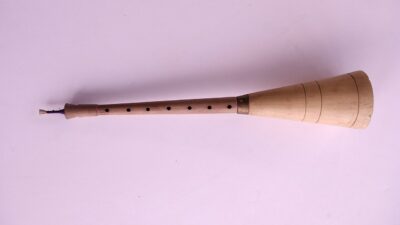
शास्त्र विंग · वाद्य-पट्टिका · Instrument Plate
तांगमुरी
Tangmuri
अन्य नामका तांगमुरी (ka tangmuri — खासी भाषा में) · तांगमुरी (सनाई) / Tangmuri (Sanai) · बुहरी / Buhri (क्षेत्रीय प्रयोग) · Tangmuri (also transliterated Tangmurí)
परिचय
Overviewतांगमuri मेघालय की खासी पहाड़ियों की दोहरी-रीड वाली लोक-ओबो है — शहनाई-नादस्वरम परिवार की पूर्वोत्तर बहन। लगभग 20 सेमी का खरादा हुआ चैंटर, सामने के सात छिद्र और अलग से जुड़ा फैला बेल; ऊपर धागे से बँधी धातु की नन्ही नली पर दोहरी रीड। इसकी ऊँची, वेधक पुकार क्सिंग ढोल के साथ मिलकर शाद सुक मिनसीम जैसे उत्सवों और नियम खासी अनुष्ठानों — दोनों को स्वर देती है।
अंग्रेज़ी में पढ़ें · Read in English
The tangmuri is the double-reed folk oboe of Meghalaya's Khasi Hills — the North-Eastern sister of the shehnai-nadaswaram family. A lathe-turned chanter of about 20 cm with seven front holes and a detachable flared bell; a double reed tied onto a tiny thread-wound metal tube on top. Its high, piercing cry, joined with the ksing drums, gives voice to both festivals such as Shad Suk Mynsiem and the rituals of Niam Khasi.
वर्गीकरण
ClassificationNatya Shastra Category
सुषिर (Sushira - wind instruments)
नाट्यशास्त्र के चार वाद्य-वर्गों में तांगमुरी 'सुषिर' (फूँक से बजने वाले, खोखले) वर्ग में आती है। यह दोहरी-रीड (double reed) वाली शंक्वाकार-नाल की सुषिर वाद्य है — जैसे शहनाई और नादस्वरम — जिसमें कलाकार की फूँक और होंठों के दबाव से वायु-स्तंभ कंपित होकर ध्वनि उत्पन्न करता है।
Within the four instrument categories of the Natya Shastra, the tangmuri belongs to the 'Sushira' (wind / hollow, blown) class. It is a double-reed, conical-bore aerophone — of the same family as the shehnai and nadaswaram — in which the player's breath and lip pressure set an air column vibrating to produce sound.
Western Category
Double-reed woodwind (oboe family)
Western Family
Conical-bore double-reed oboe (comparable in acoustics to the shawm, oboe and Indian shehnai/nadaswaram, but tribal Khasi in construction and repertoire)
Sub Classification
बनावट
PhysicalDescription Hindi
तांगमुरी लकड़ी से खरादी हुई (turned) दो-भागों वाली दोहरी-रीड वाली सुषिर वाद्य है। इसका मुख्य भाग एक शंक्वाकार-नाल वाला 'चैंटर' (चानक/नाली) है जो लगभग 20 सेंटीमीटर लंबा होता है और जिसके सामने की ओर सात सुर-छिद्र (finger-holes) बने होते हैं। इसके निचले सिरे पर एक अलग से खरादा हुआ, फैला हुआ 15 सेंटीमीटर लंबा लकड़ी का 'बेल' (शहनाई जैसा फैला मुख) पुश-फिट (धकेल कर बैठाने वाली) विधि से जोड़ा जाता है। ऊपरी सिरे पर लगभग 3 सेंटीमीटर लंबी पतली शंक्वाकार धातु की नली होती है, जिस पर दोहरी रीड बाँधी जाती है और जिसे धागे से लपेट कर चैंटर में कस दिया जाता है।
Description English
The tangmuri is a lathe-turned, two-piece, double-reed wind instrument. Its main body is a conical-bore wooden chanter about 20 cm long with seven finger-holes on the front. A separate flared, turned wooden bell about 15 cm long is joined to the lower end by a push-fit. At the top sits a thin conical-bore metal tube around 3 cm long onto which the double reed is tied; this tube is wound with thread to hold it firmly in the chanter.
Body
Two-piece straight oboe — cylindrical-to-conical chanter with a separate flared bell
दो-टुकड़ों वाली सीधी ओबो — शंक्वाकार चैंटर और अलग से फैला हुआ बेल
Turned hardwood (locally sourced wood, worked on a lathe)
खरादी हुई कठोर लकड़ी (स्थानीय लकड़ी, खराद पर तराशी हुई)
approx 35 (20 cm chanter + 15 cm bell)
Open conical bore flaring into a detachable wooden bell that projects and brightens the tone
Reed
Double reed (two blades of cane bound together)
दोहरी रीड (सरकंडे/नरकट की दो पत्तियाँ आपस में बाँधी हुई)
Thin conical-bore metal tube approximately 3 cm long onto which the reed is tied
लगभग 3 सेंटीमीटर लंबी पतली शंक्वाकार धातु की नली, जिस पर रीड बाँधी जाती है
The metal staple is wound with thread and push-fitted into the top of the chanter
धातु की नली को धागे से लपेट कर चैंटर के ऊपरी मुख में कस कर बैठाया जाता है
The player's breath sets the twin reeds beating against each other, exciting the air column — the defining sound-source of the tangmuri and its oboe kin
Finger Holes
7 (all on the front face)
7 (सभी सामने की ओर)
सामने के सात सुर-छिद्रों को उंगलियों से खोलने-बंद करने से स्वर बदलते हैं। तांगमुरी में पीछे की ओर अंगूठे का छिद्र नहीं होता, जिससे यह उत्तर भारतीय शहनाई से भिन्न है।
Opening and covering the seven front finger-holes changes the pitch. Unlike the North-Indian shehnai, the tangmuri has no rear thumb-hole, and pitch is controlled entirely from the front.
Bell
फैला हुआ मुख (बेल)
Flared bell
approx 15
Separately turned and joined to the chanter by a friction push-fit (removable)
अलग से खरादा हुआ, घर्षण-आधारित पुश-फिट से चैंटर में जुड़ा (निकाला जा सकने वाला)
Projects and amplifies the shrill, carrying tone for open-air processions and festival grounds
Frets
तांगमुरी एक सुषिर (फूँक-वाद्य) है, अतः इसमें फ्रेट नहीं होते। स्वर सात सुर-छिद्रों, फूँक की तीव्रता और होंठों के दबाव से नियंत्रित होते हैं; इसी से खासी धुनों की सूक्ष्म मींड-नुमा फिसलन संभव होती है।
As a wind instrument the tangmuri has no frets. Pitch is shaped by the seven finger-holes, breath pressure and lip control (embouchure), which together allow the subtle slides and inflections characteristic of Khasi tunes.
ध्वनि-चरित्र
SoundTonal Character Hindi
तांगमुरी की ध्वनि बहुत ऊँची, तीखी और दूर तक पहुँचने वाली होती है — शहनाई जैसी वेधक किंतु अधिक कच्ची और मुखर। खुले पहाड़ी मैदानों, जुलूसों और अनुष्ठानों में इसकी आवाज़ ढोल-नगाड़ों के ऊपर से साफ़ सुनाई देती है, इसीलिए इसे मंगल और शोक — दोनों अवसरों की 'पुकार' माना जाता है।
Tonal Character English
The tangmuri's tone is very high, piercing and far-carrying — shehnai-like in its penetration but rawer and more vocal. Over open hillside grounds, processions and rituals its cry rides clearly above the drums, which is why it serves as the summoning voice of both joyous and solemn occasions.
Timbre
Bright, reedy, nasal and shrill — a buzzing double-reed edge typical of shawm-family oboes
Range
Roughly an octave-plus of usable notes from the seven finger-holes, pitched high; exact compass varies with the maker and reed
Dynamic Range
Loud and outdoor by nature — built to project across festival grounds and cremation processions without amplification
Techniques
सुनने का मार्गदर्शन
The Listening Guideतांगमuri को उसके परिवेश में सुनिए — पहले क्सिंग ढोल की थाप, फिर उसके ऊपर तैरती ऊँची, तीखी पुकार। किसी शाद सुक मिनसीम नृत्य या नोंगबरेह के वादकों का वीडियो देखिए; तभी समझ आएगा कि यह वाद्य नर्तकों को कैसे दिशा देती है और खासी उत्सव की आत्मा कैसे रचती है।
अंग्रेज़ी में पढ़ें · Read in English
Listen to the tangmuri not alone but in its setting. First find the beat of the ksing drums, then the high, continuous cry of the tangmuri floating above it. Notice how the player keeps the tune unbroken even through breaths. Watch a video of a Shad Suk Mynsiem dance — then you will understand how this instrument steers the dancers' feet.
अन्य विवरण
More DetailsTimbre
Bright, reedy, nasal and shrill — a buzzing double-reed edge typical of shawm-family oboes
रोचक तथ्य
Margin Notes'का तांगमुरी' — सम्मान का उपसर्ग — खासी भाषा में वाद्य को केवल 'तांगमुरी' नहीं, बल्कि 'का तांगमुरी' कहा जाता है; 'का' स्त्रीलिंग सूचक उपसर्ग है, जो इस पूजनीय वाद्य को व्याकरणिक पहचान और आदर देता है।
In Khasi the instrument is called not just 'tangmuri' but 'ka tangmuri'; 'ka' is a feminine article-prefix that grants this revered instrument grammatical identity and respect.
सनाई से नाता — तांगमुरी को स्थानीय रूप से कभी-कभी 'सनाई' भी कहा जाता है — वही शब्द जो उत्तर भारत की शहनाई (सनई) से जुड़ा है। यह भारत भर की दोहरी-रीड मंगल-वाद्य परंपरा के आपसी नाते की ओर इशारा करता है।
The tangmuri is sometimes locally called 'sanai' too — the same word linked to the North-Indian shehnai (sanai). It hints at the shared kinship of India's double-reed 'auspicious' wind tradition across regions.
फूँकते हुए भी न रुकने वाली धुन — कुशल तांगमुरी वादक जुलूस और नृत्य में धुन को बिना तोड़े घंटों बजाते हैं; साँस लेते हुए भी ध्वनि जारी रखने की युक्ति (शहनाई-नादस्वरम वादकों जैसी) इसे लंबे अनुष्ठानों के लिए उपयुक्त बनाती है।
Skilled tangmuri players sustain a tune unbroken for hours during processions and dances; the knack of keeping the sound going even while breathing (as with shehnai and nadaswaram players) suits it to long rituals.
सवाल-जवाब
Questions & Answersतांगमुरी क्या है?
तांगमुरी मेघालय के खासी (हिन्न्यूट्रेप) लोगों की एक दोहरी-रीड वाली, शंक्वाकार-नाल की लकड़ी की सुषिर (फूँक) वाद्य है — शहनाई और नादस्वरम के परिवार की। यह उत्सव-नृत्यों और नियम खासी अनुष्ठानों में बजाई जाती है।
तांगमुरी में कितने सुर-छिद्र होते हैं?
तांगमुरी में सामने की ओर सात सुर-छिद्र होते हैं। इसमें उत्तर भारतीय शहनाई की तरह पीछे अंगूठे का छिद्र नहीं होता।
तांगमुरी किस चीज़ से बनी होती है?
यह खरादी हुई लकड़ी से बनी दो-भागों वाली वाद्य है: लगभग 20 सेमी का चैंटर और लगभग 15 सेमी का फैला बेल, जो पुश-फिट से जुड़ते हैं। ऊपर लगभग 3 सेमी की धातु की नली पर दोहरी रीड धागे से बँधी होती है।
तांगमुरी कब और कहाँ बजाई जाती है?
यह मेघालय की खासी पहाड़ियों में उत्सव-नृत्यों (जैसे शाद सुक मिनसीम) और नियम खासी के अनुष्ठानों — जिनमें अंत्येष्टि भी शामिल है — में बजाई जाती है। यह प्रायः क्सिंग ढोल के साथ बजती है।
तांगमुरी की ध्वनि कैसी होती है?
तांगमुरी की ध्वनि बहुत ऊँची और तीखी होती है — शहनाई जैसी वेधक, पर अधिक कच्ची और मुखर — जो खुले पहाड़ी मैदानों और जुलूसों में ढोल के ऊपर से दूर तक सुनाई देती है।
नमूना-पट्टी
The Specimen Table| नाम | तांगमुरी · Tangmuri |
|---|---|
| अन्य नाम | का तांगमुरी (ka tangmuri — खासी भाषा में) · तांगमुरी (सनाई) / Tangmuri (Sanai) · बुहरी / Buhri (क्षेत्रीय प्रयोग) · Tangmuri (also transliterated Tangmurí) |
| प्रकार | वाद्य · Instruments |
साझा कीजिए · Share this Plate