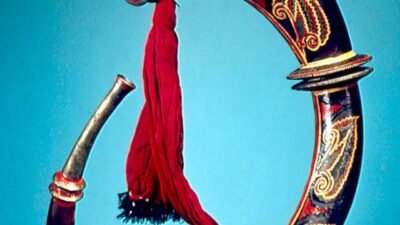
शास्त्र विंग · वाद्य-पट्टिका · Instrument Plate
शृंग
Sringa
अन्य नामशृंगी · सिंगा / सिंगी (Singa / Singi) · रणसिंगा / रणसृंग (Ransingha / Ranasringa — war horn) · तुतारी (Tutari — Maharashtra)
परिचय
Overviewशृंग भारत के सबसे प्राचीन फूँक-वाद्यों में से एक है — मूलतः पशु के सींग से, बाद में पीतल-ताँबे से गढ़ा गया 'प्राकृतिक हॉर्न', जिसमें न तार होते हैं न छिद्र। इसका 'S' आकार शृंग/नरसिंगा/तुतारी कहलाता है और 'C' आकार केरल का कोम्बु। रणभूमि की रणसिंगा-ललकार से लेकर मंदिर-मेलम की कोम्बु-गर्जना तक, इसकी भेदक टेर ने भारत के संग्राम, अनुष्ठान और उत्सव — तीनों को स्वर दिया है।
अंग्रेज़ी में पढ़ें · Read in English
The sringa is one of India's most ancient wind instruments — a 'natural horn' made originally from an animal horn and later from brass and copper, with neither strings nor holes. Its 'S' shape is called sringa/narsingha/tutari, and its 'C' shape is Kerala's kombu. From the ransingha war-cry of the battlefield to the kombu thunder of temple melam, its piercing blast has given voice to India's battles, its rituals and its festivals alike.
वर्गीकरण
ClassificationNatya Shastra Category
सुषिर (Sushira - wind / hollow instruments)
नाट्यशास्त्र की चार वाद्य-श्रेणियों — तत, अवनद्ध, घन और सुषिर — में शृंग 'सुषिर' (फूँक से बजने वाले) वर्ग का वाद्य है। यह होंठों के कंपन (एम्बशर) से ध्वनि उत्पन्न करता है, इसमें न कोई छिद्र होता है न कोई वाल्व।
Among the four instrument classes of the Natya Shastra — Tata (strings), Avanaddha (drums), Ghana (idiophones) and Sushira (wind) — the sringa belongs to Sushira, the wind class. It sounds by the vibration of the player's lips (embouchure); it has neither finger-holes nor valves.
Western Category
Natural horn — lip-vibrated aerophone (labrosone)
Western Family
Brass / horn family (valveless natural horn, comparable to the bugle, natural trumpet and alphorn in acoustic principle)
Sub Classification
बनावट
PhysicalDescription Hindi
शृंग एक प्राचीन 'प्राकृतिक हॉर्न' है — बिना छिद्र और बिना वाल्व का फूँक-वाद्य। मूलतः यह भैंस या साँड़ के सींग से बनता था (इसीलिए नाम 'शृंग' यानी सींग), बाद में पीतल या ताँबे की चादर को मोड़कर गढ़ा जाने लगा। इसके दो प्रमुख रूप हैं — 'S' आकार का लंबा घुमावदार हॉर्न (शृंग/नरसिंगा/रणसिंगा/तुतारी) और 'C' आकार का अर्धचंद्राकार हॉर्न (कोम्बु)। एक सिरा पतला होता है जहाँ होंठ रखकर फूँका जाता है और दूसरा सिरा फैला हुआ (घंटा/बेल) होता है जो ध्वनि को दूर तक फेंकता है।
Description English
The sringa is an ancient 'natural horn' — a wind instrument with no finger-holes and no valves. It was originally fashioned from a buffalo or bull horn (hence the name 'śṛṅga', meaning 'horn'), and later hammered from sheets of brass or copper. It exists in two principal forms — a long, curved 'S'-shaped horn (sringa / narsingha / ransingha / tutari) and a crescent 'C'-shaped horn (kombu). One end narrows to a mouth where the lips buzz; the other end flares into a bell that projects the sound across great distances.
Body
Long serpentine 'S' curve (Sringa / Narsingha / Ransingha / Tutari) or a broad 'C' crescent (Kombu)
लंबा नागाकार 'S' मोड़ (शृंग/नरसिंगा/रणसिंगा/तुतारी) अथवा चौड़ा अर्धचंद्राकार 'C' (कोम्बु)
Originally animal horn (buffalo / ox); today most commonly hammered brass or copper sheet, often assembled from two or more telescoping sections
मूलतः पशु-सींग (भैंस/बैल); आजकल प्रायः पीतल या ताँबे की पीटी हुई चादर, जिसे दो या अधिक जुड़ने वाले खंडों में बनाया जाता है
60-150 (Kombu ~1-1.5 m; Ransingha/Narsingha often assembled in curved sections)
The conical/flared bore of the horn itself is the resonator; the flared bell radiates and amplifies the lip-buzz acoustically, with no separate soundbox
Strings
शृंग एक सुषिर (फूँक) वाद्य है — इसमें कोई तार नहीं होता। यह खंड केवल संरचनात्मक एकरूपता हेतु रखा गया है; इसके स्थान पर वायु-स्तंभ (bore) और मुखांश ही ध्वनि-स्रोत हैं।
The sringa is a Sushira (wind) instrument — it has no strings. This section is retained only for schema consistency; in place of strings, the air column (bore) and the mouth-end are the sound source.
Mouthpiece
मुखांश / फूँक-मुख
Mouth-end / embouchure hole
पतले सिरे पर एक छोटा कप-नुमा या सादा मुख होता है जहाँ वादक अपने होंठ कसकर 'भिनभिनाते' (buzz) हुए हवा फूँकता है। यही होंठ-कंपन मूल ध्वनि उत्पन्न करता है।
At the narrow end is a small cupped or plain mouth against which the player presses the lips and buzzes air. This lip-vibration is the primary sound source, exactly as on a bugle or natural trumpet.
Bell
घंटा / फैलाव-मुख
Bell / flared end
दूसरा सिरा चौड़ा फैला हुआ होता है जो ध्वनि को केंद्रित कर दूर तक प्रक्षेपित करता है — इसी कारण शृंग की टेर मीलों तक सुनाई देती है।
The far end flares wide, focusing and projecting the sound over long distances — which is why the sringa's blast can be heard for miles.
Frets
शृंग में न फ्रेट होते हैं, न स्वर-छिद्र, न वाल्व। इसकी संपूर्ण स्वर-सामग्री केवल वायु-स्तंभ की प्राकृतिक हार्मोनिक श्रेणी और होंठों के दबाव से नियंत्रित होती है।
The sringa has no frets, no finger-holes and no valves. Its entire pitch material is governed only by the natural harmonic series of the air column and by lip pressure (overblowing).
ध्वनि-चरित्र
SoundTonal Character Hindi
शृंग की ध्वनि प्रचंड, भेदक और आदिम है — एक लंबी, गूँजती हुई टेर जो हवा को चीरती हुई दूर तक जाती है। यह करुण भी है और वीर भी: विवाह-शोभायात्रा में यह मंगल का उद्घोष है, युद्ध-भूमि में ललकार, और अंत्येष्टि में विलाप।
Tonal Character English
The sringa's tone is powerful, piercing and primal — a long, resonant blast that cuts through the air and travels far. It is at once mournful and martial: in a wedding procession it is an auspicious proclamation, on the battlefield a war-cry, and at a funeral a wail.
Timbre
Brassy, raw, buzzing and edge-heavy; rich in upper harmonics, with a rasping bite at full force
Range
Very limited melodically — it sounds the fundamental plus a small number of natural harmonics (typically 2-4 usable pitches); it is a signalling/fanfare voice, not a raga-rendering melodic instrument
Dynamic Range
From a low sustained drone-note to an extremely loud, carrying blast; designed for open-air projection without amplification
Techniques
सुनने का मार्गदर्शन
The Listening Guideशृंग को 'संगीत' की तरह नहीं, 'उद्घोष' की तरह सुनिए। कोम्बु पट्टु में दर्जनों हॉर्न चेंडा की ताल पर एक साथ गरजते हैं — यह मधुरता नहीं, ऊर्जा है। तुतारी की एकल, लंबी, भेदक टेर घोषणा करती है। सींग की इस आदिम पुकार में भारत की उत्सव-भूमि का हृदय धड़कता है।
अंग्रेज़ी में पढ़ें · Read in English
To appreciate the sringa, listen to it not as 'melody' but as 'proclamation'. In Kerala's Kombu Pattu, notice how dozens of horns thunder together in rhythmic bursts over the chenda's beat — this is not sweetness but energy and grandeur. In Maharashtra's Tutari, hear the single, long, piercing blast that announces. In this primal call of the horn beats the heart of India's festival grounds.
परिचय
IdentityYear Of Origin
Ancient — the horn (śṛṅga) is among the oldest Indian aerophones, named in Sanskrit organological tradition; the war-horn (ranasringa) is documented through the medieval Rajput and Maratha periods
अन्य विवरण
More DetailsTimbre
Brassy, raw, buzzing and edge-heavy; rich in upper harmonics, with a rasping bite at full force
रोचक तथ्य
Margin Notesनाम में ही सींग — संस्कृत 'शृंग' (śṛṅga) का अर्थ 'सींग' या 'शिखर' है। इसी मूल से 'सिंगा', 'सिंगी', 'रणसिंगा' और 'नरसिंगा' जैसे क्षेत्रीय नाम बने — सबका अर्थ अंततः 'सींग-वाद्य' है।
The Sanskrit 'śṛṅga' means 'horn' or 'peak'. From this root come the regional names 'singa', 'singi', 'ransingha' and 'narsingha' — all ultimately meaning 'horn-instrument'.
S बनाम C — एक ही परिवार, दो आकार — शृंग परिवार दो प्रमुख आकारों में मिलता है: उत्तर व मध्य भारत का लंबा नागाकार 'S' हॉर्न (शृंग/नरसिंगा/तुतारी) और केरल का चौड़ा अर्धचंद्राकार 'C' हॉर्न (कोम्बु)। दोनों की ध्वनि-रचना एक जैसी है — होंठ-कंपन से बजने वाला प्राकृतिक हॉर्न।
The sringa family appears in two main shapes: the long serpentine 'S' horn of North and Central India (sringa/narsingha/tutari) and Kerala's broad crescent 'C' horn (kombu). Both share the same acoustic principle — a natural horn sounded by lip-buzz.
युद्ध से मंदिर तक — जहाँ रणसिंगा युद्ध का संकेत-वाद्य था, वहीं वही शृंग मंदिर के मेलम और विवाह-नौबत में मंगल का उद्घोषक बन गया। एक ही वाद्य ने संग्राम और उत्सव — दोनों को स्वर दिया।
Where the Ransingha was a signalling instrument of war, the same sringa became a herald of the auspicious in temple melam and wedding naubat. One instrument gave voice to both battle and celebration.
बिना छिद्र, बिना वाल्व — केवल होंठ — शृंग में स्वर बदलने का एकमात्र साधन होंठों का दबाव (ओवरब्लोइंग) है। इसीलिए इसकी स्वर-श्रेणी केवल कुछ प्राकृतिक हार्मोनिक तक सीमित रहती है — यह मधुर राग नहीं, शक्तिशाली उद्घोष रचता है।
On the sringa, the only means of changing pitch is lip pressure (overblowing). Its range is therefore limited to a few natural harmonics — it renders not sweet ragas but powerful proclamations.
सवाल-जवाब
Questions & Answersशृंग क्या है?
शृंग एक प्राचीन भारतीय फूँक-वाद्य (सुषिर) है — बिना छिद्र और बिना वाल्व का 'प्राकृतिक हॉर्न', जो मूलतः पशु के सींग से और बाद में पीतल/ताँबे से बनाया गया। यह होंठों के कंपन से बजता है और मंदिर-अनुष्ठान, विवाह, उत्सव व ऐतिहासिक रूप से युद्ध-संकेत में प्रयुक्त होता है।
शृंग और रणसिंगा में क्या संबंध है?
'रणसिंगा' शृंग का ही सैन्य रूप है — नाम 'रण' (युद्ध) और 'सिंगा/शृंग' (सींग) से बना है, अर्थात् 'युद्ध-हॉर्न'। राजपूत व मराठा सेनाओं में इसकी टेर सैनिकों को संकेत देती थी।
कोम्बु और शृंग एक ही हैं क्या?
कोम्बु शृंग परिवार का 'C' आकार वाला केरलीय रूप है। यह केरल के मंदिर-उत्सवों के पांडि व पंचारि मेलम एवं पंचवाद्यम का अभिन्न अंग है — मूल सिद्धांत में शृंग जैसा ही होंठ-कंपन हॉर्न।
क्या शृंग पर राग बजाया जा सकता है?
नहीं। शृंग एक प्राकृतिक हॉर्न है जिसमें कोई छिद्र या वाल्व नहीं होता; यह केवल कुछ प्राकृतिक हार्मोनिक स्वर उत्पन्न कर सकता है। इसलिए यह राग-विस्तार का नहीं, बल्कि मंगल-घोष, ताल-आधारित मेलम व संकेत का वाद्य है।
शृंग आज कहाँ जीवित है?
यह केरल में कोम्बु पट्टु (मंदिर-मेलम) के रूप में सर्वाधिक जीवंत है, महाराष्ट्र में तुतारी सांस्कृतिक-राजनीतिक प्रतीक बन चुकी है, और नेपाल व हिमालयी क्षेत्र में नरसिंगा/रणसिंगा विवाह-नौबत व अनुष्ठानों में बजता है।
नमूना-पट्टी
The Specimen Table| नाम | शृंग · Sringa |
|---|---|
| अन्य नाम | शृंगी · सिंगा / सिंगी (Singa / Singi) · रणसिंगा / रणसृंग (Ransingha / Ranasringa — war horn) · तुतारी (Tutari — Maharashtra) · कोम्बु (Kombu — Kerala, C-shaped variant) · नरसिंगा (Narsingha — Nepal / North India) |
| प्रकार | वाद्य · Instruments |
साझा कीजिए · Share this Plate