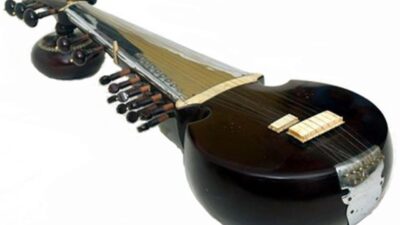
शास्त्र विंग · वाद्य-पट्टिका · Instrument Plate
मोहन वीणा
Mohan Veena
अन्य नाममोहन वीणा · मोहन बीन (Mohan Bin) · Indian Slide Guitar · Mohan Vina (also: Mohanaveena)
परिचय
Overviewमोहन वीणा एक रूपांतरित आर्चटॉप गिटार है जिसे पंडित विश्व मोहन भट्ट ने तरब और चिकारी तार जोड़कर, गोद में क्षैतिज रखकर स्लाइड से बजाने योग्य भारतीय शास्त्रीय वाद्य में ढाल दिया। इसकी सतत मींड इसे गायकी के इतने निकट ले आती है कि 1993 के एल्बम 'ए मीटिंग बाय द रिवर' (राय कूडर के साथ) ने 1994 में ग्रैमी जीता और भारतीय स्लाइड-गिटार को वैश्विक पहचान दी।
अंग्रेज़ी में पढ़ें · Read in English
The Mohan Veena is a modified archtop guitar that Pandit Vishwa Mohan Bhatt reshaped — by adding sympathetic and chikari strings and playing it flat in the lap with a slide — into an Indian classical instrument. Its continuous meend brings it so close to the singing voice that the 1993 album 'A Meeting by the River' (with Ry Cooder) won the 1994 Grammy and gave the Indian slide guitar a global identity.
वर्गीकरण
ClassificationNatya Shastra Category
तत (Tata - stringed instruments)
तत वर्ग में मोहन वीणा एक तार-वाद्य है जिसकी ध्वनि तारों को अंगुलियों (मिज़राब) से झंकृत करके तथा एक इस्पात की स्लाइड को तारों पर सरकाकर उत्पन्न होती है। यह वीणा-परिवार की आधुनिक संकर संतान है।
In the Tata (stringed) category of the Natya Shastra, the Mohan Veena is a plucked chordophone whose sound is produced by striking the strings with finger-plectra (mizrab) and gliding a steel bar (slide) along them. It is a modern hybrid descendant of the veena family.
Western Category
Plucked, lap-style slide chordophone
Western Family
Lap steel / Hawaiian slide guitar family, heavily modified into an Indian classical instrument
Sub Classification
बनावट
PhysicalDescription Hindi
मोहन वीणा एक गहराई से रूपांतरित आर्चटॉप (हवाइयन शैली) गिटार है जिसे गोद में क्षैतिज रखकर बजाया जाता है। इसमें एक खोखला लकड़ी का शरीर, चौड़ी गर्दन और लगभग 19 से 21 तार होते हैं — मुख्य वादन तार, तरब (सहानुभूति) तार और चिकारी/ड्रोन तार — जो इसे एक साधारण गिटार से भारतीय शास्त्रीय वाद्य में बदल देते हैं।
Description English
The Mohan Veena is a deeply modified archtop (Hawaiian-style) guitar played horizontally across the lap. It has a hollow wooden body, a broad neck, and roughly 19 to 21 strings — main melody strings, sympathetic (taraf) strings, and chikari/drone strings — that transform an ordinary guitar into an Indian classical instrument.
Body
Archtop guitar body (waisted, hollow), played face-up in the lap
आर्चटॉप गिटार का खोखला शरीर, गोद में ऊपर की ओर मुख करके बजाया जाने वाला
Tonewoods — spruce/cedar top with maple or Indian hardwood back and sides
टोनवुड — स्प्रूस/देवदार का ऊपरी पटल तथा मेपल या भारतीय कठोर लकड़ी की पीठ और किनारे
95-105 (length of the full instrument)
Hollow guitar body with a raised archtop that projects and sustains the slide tone
Strings
Primary melody strings played with the slide, mounted on the treble side of the neck
Fine resonating taraf strings (तरब) fixed to tuners mounted on the side of the neck, running beneath the main strings
Chikari / drone strings strung from the peghead on the bass side, strummed for rhythm (jhala) and to hold the tonal ground
Bow
स्लाइड / बार (कोई धनुष नहीं)
Slide bar (no bow)
Solid steel or glass cylinder held in the left hand
8-10
Unlike bowed instruments, the Mohan Veena has no bow; the left hand glides a steel bar along the strings to sound continuous meend, while the right hand plucks.
Tuning Pegs
खूँटी / ट्यूनर
Tuning machines
Geared guitar-style machine heads for the main and drone strings, plus a bank of side-mounted tuners for the sympathetic strings
Bridge
घुड़च (ब्रिज)
Bridge
A tiered bridge that separates the main playing strings from the lower course of sympathetic strings, transmitting vibration to the hollow body
Wood/bone
Frets
मोहन वीणा फ्रेटलेस ढंग से बजाई जाती है — यद्यपि गिटार में फ्रेट होते हैं, कलाकार तारों को दबाता नहीं बल्कि उनके ऊपर इस्पात की स्लाइड सरकाता है, जिससे निरंतर मीड और सूक्ष्म श्रुतियाँ संभव होती हैं।
The Mohan Veena is played fretlessly — although a guitar has frets, the player never presses the strings down; instead a steel slide glides above them, enabling the continuous meend and microtonal shruti essential to Hindustani raga.
ध्वनि-चरित्र
SoundTonal Character Hindi
मोहन वीणा की ध्वनि गिटार की स्पष्टता और वीणा की गहन गूँज का संगम है। स्लाइड से उपजी अनंत मीड इसे गायकी अंग के अत्यंत निकट ले आती है, और तरब तारों की झिलमिल हर स्वर को एक स्वप्निल आभा से घेर देती है।
Tonal Character English
The Mohan Veena's tone marries the clarity of a guitar with the deep resonance of a veena. The endless meend produced by the slide brings it remarkably close to the gayaki (vocal) style, while the shimmer of the sympathetic strings wraps every note in a dreamy halo.
Timbre
Warm, bell-like and singing, with a long sustain and a silvery sympathetic-string ring
Range
Roughly three octaves, from a resonant low drone register to a bright, vocal upper register
Dynamic Range
Wide — from a whispered alap to ringing jhala; usually amplified for concert projection
Techniques
सुनने का मार्गदर्शन
The Listening Guideमोहन वीणा का रस लेना हो तो किसी एकल शास्त्रीय प्रस्तुति से शुरुआत कीजिए — विश्व मोहन भट्ट का राग देस या यमन। धीमे आलाप में स्लाइड की मींड को सुनिए, फिर जोड़ में चिकारी की झनक और अंत में तबले के साथ झाले का उभार। फिर ग्रैमी-विजेता 'ए मीटिंग बाय द रिवर' सुनिए — यहाँ पूरब-पश्चिम की दो स्लाइड-गिटारें आपस में बातें करती सुनाई देंगी।
अंग्रेज़ी में पढ़ें · Read in English
To understand the Mohan Veena, begin with a solo classical recital — Bhatt's Raag Desh or Yaman. First hear the slide's meend in the slow alap, then the chikari's jingle enters in the jod, and finally the jhala peaks with the tabla. Then listen to the Grammy-winning 'A Meeting by the River' to feel the magic of the East-West dialogue.
परिचय
Identity- Year Of Origin
- 1970
अन्य विवरण
More DetailsTimbre
Warm, bell-like and singing, with a long sustain and a silvery sympathetic-string ring
रोचक तथ्य
Margin Notesएक ही रात की भेंट, जीवन भर का पुरस्कार — 'ए मीटिंग बाय द रिवर' रिकॉर्डिंग लगभग एक ही रात के स्टूडियो-सत्र में तैयार हुई थी, जहाँ विश्व मोहन भट्ट और राय कूडर पहली बार साथ बैठे। बिना पूर्वाभ्यास की इस भेंट ने 1994 का ग्रैमी जीता।
The 'A Meeting by the River' recording was made in essentially a single studio session, where Bhatt and Cooder sat together for the first time. This unrehearsed meeting won the 1994 Grammy.
नाम के पीछे 'मोहन' — मोहन वीणा का नाम विश्व मोहन भट्ट के अपने मध्य-नाम 'मोहन' पर रखा गया है। संयोगवश, पहले के राधिका मोहन मैत्र ने भी अपने मध्य-नाम 'मोहन' पर ही अपने सरोद-आधारित वाद्य को यही नाम दिया था।
The Mohan Veena is named after Vishwa Mohan Bhatt's own middle name, 'Mohan'. By coincidence, the earlier Radhika Mohan Maitra had also named his sarod-based instrument after his middle name, 'Mohan'.
गुरु-परंपरा — विश्व मोहन भट्ट सितार-सम्राट पंडित रवि शंकर के शिष्य हैं। इस प्रकार मोहन वीणा मैहर घराने की उसी गुरु-परंपरा से जुड़ी है जिसने भारतीय वाद्य-संगीत को विश्व-मंच पर पहुँचाया।
Vishwa Mohan Bhatt is a disciple of the sitar maestro Pandit Ravi Shankar. The Mohan Veena is thus linked to the same Maihar gharana guru lineage that carried Indian instrumental music to the world stage.
अगली पीढ़ी और सात्विक वीणा — विश्व मोहन भट्ट के पुत्र सलिल भट्ट ने इस परंपरा को आगे बढ़ाते हुए एक और रूपांतर 'सात्विक वीणा' विकसित किया, जिससे भारतीय स्लाइड-वीणा का परिवार और बढ़ा।
Vishwa Mohan Bhatt's son Salil Bhatt carried the tradition forward and developed a further variant, the 'Satvik Veena', expanding the family of Indian slide-veenas.
सवाल-जवाब
Questions & Answersमोहन वीणा क्या है?
मोहन वीणा एक रूपांतरित आर्चटॉप (हवाइयन) गिटार है जिसे पंडित विश्व मोहन भट्ट ने तरब और चिकारी तार जोड़कर, गोद में क्षैतिज रखकर स्लाइड से बजाने योग्य भारतीय शास्त्रीय वाद्य में ढाला। इसमें लगभग 19-21 तार होते हैं।
मोहन वीणा किसने बनाई?
आज प्रसिद्ध मोहन वीणा को पंडित विश्व मोहन भट्ट ने विकसित किया। एक पूर्ववर्ती, पृथक 'मोहन वीणा' सरोद-वादक राधिका मोहन मैत्र ने 1948 में बनाई थी, जो एक भिन्न सरोद-आधारित संकर वाद्य था।
मोहन वीणा में कितने तार होते हैं?
मोहन वीणा में लगभग 19 से 21 तार होते हैं — 3-4 मुख्य वादन तार, 4-5 चिकारी/ड्रोन तार, और लगभग 12 तरब (सहानुभूति) तार जो अपने आप झंकृत होकर वीणा-सी गूँज देते हैं।
मोहन वीणा ने ग्रैमी कब जीता?
1993 के एल्बम 'ए मीटिंग बाय द रिवर', जिसमें विश्व मोहन भट्ट ने अमेरिकी वादक राय कूडर के साथ मोहन वीणा बजाई, ने 1994 में सर्वश्रेष्ठ विश्व-संगीत एल्बम का ग्रैमी पुरस्कार जीता।
मोहन वीणा कैसे बजाई जाती है?
मोहन वीणा को गोद में क्षैतिज रखकर बजाया जाता है। बायाँ हाथ तारों के ऊपर एक इस्पात की स्लाइड सरकाता है (जिससे निरंतर मीड बनती है) और दायाँ हाथ अंगुलियों में पहनी मिज़राब से तार झंकृत करता है। इसमें फ्रेट दबाए नहीं जाते।
नमूना-पट्टी
The Specimen Table| नाम | मोहन वीणा · Mohan Veena |
|---|---|
| अन्य नाम | मोहन वीणा · मोहन बीन (Mohan Bin) · Indian Slide Guitar · Mohan Vina (also: Mohanaveena) |
| उद्गम | 1970 |
| प्रकार | वाद्य · Instruments |
साझा कीजिए · Share this Plate