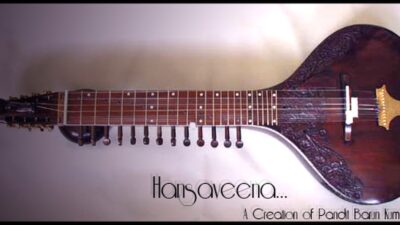
शास्त्र विंग · वाद्य-पट्टिका · Instrument Plate
हंस वीणा
Hansa Veena
अन्य नामहंसवीणा · हंस-वीणा · Hansaveena · Hansa Vina
परिचय
Overviewहंस वीणा पंडित बरुण कुमार पाल की देन है — पश्चिमी लैप-स्टील (हवाईयन) गिटार को चिकारी और तरब तार देकर, हंस की गर्दन-सी शिरा गढ़कर, हिंदुस्तानी राग के लिए ढाला गया एक फ्रेट-रहित स्लाइड वाद्य। गोद में रखे इस वाद्य पर इस्पात की छड़ सरकती है और स्वर गायकी-अंग में एक-दूसरे में घुलते चले जाते हैं; तेरह तरब तार पीछे झिलमिलाती गूँज बिछाते हैं। यह मोहन वीणा और चतुरंगी की तरह ही भारतीय स्लाइड-गिटार परिवार का एक विशिष्ट सदस्य है।
अंग्रेज़ी में पढ़ें · Read in English
The Hansa Veena is Pandit Barun Kumar Pal's creation — a fretless slide instrument that reshaped the Western lap-steel (Hawaiian) guitar for the Hindustani raga by adding chikari and tarab strings and a swan-necked headstock. Played across the lap, a steel bar glides over its strings and the notes dissolve into one another in the vocal (gaayaki) style, while thirteen sympathetic tarab strings lay a shimmering resonance behind. Like the Mohan Veena and Chaturangui, it is a distinctive member of the Indian slide-guitar family.
वर्गीकरण
ClassificationNatya Shastra Category
तत (Tata - stringed instruments)
तत वर्ग में हंस वीणा एक तंतु-वाद्य है जिसकी ध्वनि तारों को मिज़राब से छेड़ने पर उत्पन्न होती है; स्वर-परिवर्तन इस्पात की छड़ (स्लाइड बार) को तारों पर सरकाकर किया जाता है, अतः यह एक फ्रेट-रहित (fretless) घर्षण-रहित प्लक्ड कॉर्डोफोन है।
In the Tata (stringed) category, the Hansa Veena is a plucked chordophone whose tone is produced by striking the strings with plectra, while pitch is changed by gliding a steel bar (slide) along the strings. It is therefore a fretless, slide-operated plucked lute of the lap-steel type.
Western Category
Plucked slide string instrument (lap-steel / Hawaiian-guitar family, adapted to Hindustani classical)
Western Family
Lap steel / Hawaiian guitar family — reengineered with drone (chikari) and sympathetic (tarab) strings for Indian classical raga music
Sub Classification
बनावट
PhysicalDescription Hindi
हंस वीणा एक आधुनिक भारतीय स्लाइड वाद्य है जिसे पंडित बरुण कुमार पाल ने हवाईयन/लैप-स्टील गिटार को हिंदुस्तानी शास्त्रीय संगीत के अनुरूप ढालकर बनाया। इसका शरीर सितार या सरोद जैसा गूँजदार लकड़ी का होता है और इसका सबसे पहचान-योग्य लक्षण है इसकी घुमावदार, हंस की गर्दन जैसी दिखने वाली शिरा (headstock) — इसी 'हंस' से इसका नाम पड़ा। वाद्य को गोद में क्षैतिज रखकर बजाया जाता है, बायें हाथ में इस्पात की छड़ और दायें हाथ की उँगलियों पर मिज़राब पहने जाते हैं।
Description English
The Hansa Veena is a modern Indian slide instrument created by Pandit Barun Kumar Pal by adapting the Hawaiian / lap-steel guitar to Hindustani classical music. Its resonant wooden body resembles a sitar or sarod, and its most recognisable feature is the curving headstock shaped like the neck of a swan (hansa) — from which it takes its name. It is played horizontally across the lap, with a steel bar in the left hand and finger-plectra (mizrab) on the right hand.
Body
Hollow wooden resonator resembling a modified sitar/sarod body with a long fretless fingerboard and a curved swan-neck headstock
लंबे फ्रेट-रहित पटरे और घुमावदार हंस-गर्दन शिरा के साथ सितार/सरोद जैसा खोखला लकड़ी का गूँज-कक्ष
Seasoned tonewood (commonly teak/mahogany-family woods) with a resonating soundbox
पकाई हुई तानकाष्ठ (प्रायः सागवान/महोगनी वर्ग की लकड़ी) से बना गूँज-कक्ष
90-100 (played horizontally across the lap)
Hollow wooden soundbox; the swan-neck design and sympathetic-string housing amplify sustain and shimmer
Strings
Primary melody strings played with the steel bar and finger plectra
Fine tarab (sympathetic) strings that resonate on their own beneath the melody strings, giving the Hansa Veena its shimmering, sustained halo
Chikari drone/rhythm strings strummed to punctuate rhythm and sound the tonic — as on sitar and Mohan Veena
Bow
इस्पात की छड़ (स्लाइड बार) — कोई धनुष नहीं
Steel slide bar (no bow)
Solid steel/metal bar or cylinder held in the left hand
8-12 (hand-held bar)
The instrument is NOT bowed. A smooth steel bar is glided along the strings to change pitch, while the right hand plucks — the source of the Hansa Veena's continuous, vocal glides.
Tuning Pegs
खूंटी
Khunti (tuning pegs / machine heads)
Pegs along the swan-neck headstock and side of the neck adjust the melody, chikari and tarab strings
Bridge
घोड़ी (जवारी)
Bridge (Ghodi / Javari)
A flat, wide bridge (javari) that gives the buzzing, resonant sustain characteristic of Indian classical string instruments
Bone or wood with a javari-shaped surface
Frets
हंस वीणा में फ्रेट नहीं होते — कलाकार इस्पात की छड़ को तारों पर सरकाकर स्वर बदलता है, जिससे निरंतर 'मीड' (glissando) और सूक्ष्म श्रुति-भेद संभव होते हैं, ठीक मानव-कंठ की तरह।
The Hansa Veena is fretless — the player slides the steel bar along the strings to change pitch, enabling continuous 'meend' (glissando) and microtonal shading, much like the human voice.
ध्वनि-चरित्र
SoundTonal Character Hindi
हंस वीणा की ध्वनि गाती हुई, मधुर और अखंड होती है — इस्पात की छड़ हर स्वर को दूसरे से मीड में जोड़ देती है, और नीचे बजते तरब तार एक चमकती हुई गूँज की चादर बिछा देते हैं। यह लैप-स्टील गिटार की मिठास और भारतीय राग की गहराई का संगम है।
Tonal Character English
The Hansa Veena's tone is singing, sweet and seamless — the steel bar joins every note to the next in an unbroken meend, while the tarab strings lay down a shimmering carpet of resonance beneath. It marries the sweetness of the lap-steel guitar with the depth of the Indian raga.
Timbre
Warm, liquid, sustained; bright melody strings over a soft sympathetic shimmer
Range
Roughly three octaves, from a low drone Sa upward, the continuous slide allowing every microtone in between
Dynamic Range
Wide and expressive — from a meditative alap whisper to bright, rhythmic jhala
Techniques
सुनने का मार्गदर्शन
The Listening Guideहंस वीणा सुनते समय सबसे पहले यह महसूस कीजिए कि स्वर कभी टूटते नहीं — इस्पात की छड़ उन्हें एक अटूट मींड में पिरो देती है। किसी शांत क्षण में एक धीमी आलाप-प्रधान रिकॉर्डिंग से शुरुआत कीजिए और झाला तक पहुँचिए; नीचे बजते तरब तारों की झिलमिल गूँज को पहचानने की कोशिश कीजिए — वहीं इस वाद्य की आत्मा बसती है।
अंग्रेज़ी में पढ़ें · Read in English
When listening to the Hansa Veena, notice how the notes never break — the bar's meend keeps them joined like an unbroken thread. Begin in a quiet moment with a slow, alap-based recording, then move toward the jingle of the jhala. Try to catch the shimmering resonance of the tarab strings underneath — that is where this instrument's beauty lives.
परिचय
Identity- Year Of Origin
- 1973
अन्य विवरण
More DetailsTimbre
Warm, liquid, sustained; bright melody strings over a soft sympathetic shimmer
रोचक तथ्य
Margin Notesएक गिटार से जन्मा वीणा — हंस वीणा पश्चिमी हवाईयन/लैप-स्टील गिटार का हिंदुस्तानी रूपांतरण है। पंडित बरुण कुमार पाल ने लगभग 1973 तक अपने गिटार में चिकारी और तरब तार जोड़े और नई देह गढ़कर उसे 'हंस वीणा' नाम दिया — नाम में 'वीणा' इसकी भारतीय पहचान को दर्शाता है, यद्यपि इसकी बनावट गिटार-परिवार से है।
The Hansa Veena is the Hindustani reinvention of the Western Hawaiian / lap-steel guitar. By about 1973 Pandit Barun Kumar Pal had added chikari and tarab strings to his guitar and built a new body, naming it 'Hansa Veena' — the 'veena' in the name asserting its Indian identity, even though its construction descends from the guitar family.
स्लाइड-गिटार परिवार का सदस्य — हंस वीणा भारतीय स्लाइड-गिटार परिवार का एक स्वतंत्र सदस्य है, जिसमें पंडित विश्व मोहन भट्ट की 'मोहन वीणा' और पंडित देवाशीष भट्टाचार्य की 'चतुरंगी' भी आती हैं। सभी में समान सिद्धांत है — फ्रेट-रहित गिटार पर इस्पात की छड़ से राग — पर प्रत्येक की बनावट, तार-विन्यास और ध्वनि भिन्न है।
The Hansa Veena is an independent member of the Indian slide-guitar family, which also includes Pandit Vishwa Mohan Bhatt's 'Mohan Veena' and Pandit Debashish Bhattacharya's 'Chaturangui'. All share the same principle — raga on a fretless guitar with a steel bar — but each differs in body, string layout and sound.
तरब तारों की झिलमिल — हंस वीणा के 13 तरब (अनुनाद) तार किसी को बजाया नहीं जाता — वे मुख्य तारों की ध्वनि के साथ स्वतः कंपित होकर एक चमकती हुई गूँज पैदा करते हैं। यही झिलमिल इसे सामान्य गिटार से अलग कर एक शास्त्रीय भारतीय वाद्य बनाती है।
The Hansa Veena's 13 tarab (sympathetic) strings are never plucked — they vibrate on their own in resonance with the main strings, producing a shimmering halo. It is this shimmer that separates it from an ordinary guitar and makes it a classical Indian instrument.
सवाल-जवाब
Questions & Answersहंस वीणा क्या है?
हंस वीणा एक आधुनिक भारतीय स्लाइड वाद्य है जिसे पंडित बरुण कुमार पाल ने हवाईयन/लैप-स्टील गिटार को हिंदुस्तानी शास्त्रीय संगीत के अनुरूप ढालकर बनाया। इसे गोद में रखकर इस्पात की छड़ से बजाया जाता है और इसमें चिकारी तथा तरब (अनुनाद) तार होते हैं।
हंस वीणा में कितने तार होते हैं?
हंस वीणा में लगभग 21 तार होते हैं, जिनमें 13 तरब (अनुनाद) तार शामिल हैं; शेष मुख्य स्वर-तार और चिकारी तार होते हैं। तरब तार बजाए नहीं जाते, वे स्वतः गूँजकर वाद्य को झिलमिलाती ध्वनि देते हैं।
हंस वीणा और मोहन वीणा में क्या अंतर है?
दोनों भारतीय स्लाइड-गिटार परिवार के वाद्य हैं जो फ्रेट-रहित गिटार पर इस्पात की छड़ से राग बजाते हैं। हंस वीणा को पंडित बरुण कुमार पाल ने और मोहन वीणा को पंडित विश्व मोहन भट्ट ने विकसित किया; दोनों की बनावट, तार-विन्यास और नामकरण अलग हैं।
हंस वीणा किसने बनाई?
हंस वीणा को पंडित बरुण कुमार पाल ने लगभग 1970 के दशक में विकसित किया। वे एक बाल-प्रतिभा थे, ऑल इंडिया रेडियो द्वारा गिटार पर 'A' श्रेणी पाने वाले पहले कलाकार (1972-73), और उन्होंने अपने हवाईयन गिटार में चिकारी तथा तरब तार जोड़कर इस वाद्य को रचा।
हंस वीणा को कैसे बजाया जाता है?
इसे गोद में क्षैतिज रखकर बजाया जाता है। बायें हाथ में पकड़ी इस्पात की छड़ को तारों पर सरकाकर स्वर बदले जाते हैं (मीड), और दायें हाथ की उँगलियों पर पहने मिज़राब से तार छेड़े जाते हैं। इसमें फ्रेट न होने से यह मानव-कंठ की तरह हर श्रुति के बीच अखंड 'गा' सकती है।
नमूना-पट्टी
The Specimen Table| नाम | हंस वीणा · Hansa Veena |
|---|---|
| अन्य नाम | हंसवीणा · हंस-वीणा · Hansaveena · Hansa Vina · Indian Slide Guitar (Hansa Veena type) |
| उद्गम | 1973 |
| प्रकार | वाद्य · Instruments |
साझा कीजिए · Share this Plate