शास्त्र विंग · वाद्य-पट्टिका · Instrument Plate
ताऊस
Taus
अन्य नामताऊस · मयूरी वीणा (Mayuri Veena) · मयूरी (Mayuri) · ताऊस / तौस (Taoos / Tau)
परिचय
Overviewताऊस, अर्थात् 'मोर', सिख गुरमत संगीत का सबसे सुंदर तंती-गज़ साज़ है — लकड़ी से मोर के आकार में तराशा गया शरीर, गर्दन पर बँधे धातु के फ़्रेट, और तरब तारों की झिलमिलाती गूँज। परंपरा इसका आविष्कार गुरु गोबिंद सिंह जी को देती है, और यही ताऊस भारी होने के कारण छोटा होकर दिलरुबा बना। आज गुरमत संगीत अकादमियों के प्रयास से यह मोर फिर पंख खोल रहा है।
अंग्रेज़ी में पढ़ें · Read in English
The taus — 'peacock' — is the most beautiful bowed-string instrument of Sikh Gurmat Sangeet: a body carved into a peacock's shape, metal frets tied along the neck, and the shimmering hum of sympathetic strings. Tradition credits its invention to Guru Gobind Singh, and it was this very taus, being heavy, that was scaled down into the dilruba. Today, through the efforts of Gurmat Sangeet academies, the peacock is spreading its wings once more.
वर्गीकरण
ClassificationNatya Shastra Category
तत (Tata - stringed instruments)
तत वर्ग में ताऊस एक धनुष-आधारित (गज़ से बजने वाला) तार-वाद्य है, जिसमें धातु के फ़्रेट लगे होते हैं और गज़ के घर्षण से तारों में ध्वनि उत्पन्न होती है। यह वीणा-कुल का मयूर-आकार वाला रूप है।
In the Tata (stringed) category of the Natya Shastra, the taus is a bow-driven (gaz-played) fretted chordophone. Sound is produced by the friction of the bow against the strings. It is a peacock-shaped member of the veena family.
Western Category
Bowed, fretted string instrument (fretted fiddle / bowed lute)
Western Family
Fiddle / bowed-lute family — related in playing method to the viol, but with movable metal frets and sympathetic strings unique to the Indian tradition
Sub Classification
बनावट
PhysicalDescription Hindi
ताऊस एक बड़ा, भारी धनुष-वाद्य है जिसका अनुनाद-कक्ष मोर (मयूर) के शरीर के आकार में तराशा जाता है — इसीलिए इसे 'मयूरी वीणा' भी कहते हैं। लकड़ी के मोर-आकार के पेट से एक लंबी, फ़्रेटयुक्त गर्दन ऊपर उठती है, और अक्सर असली मोर-पंख गर्दन के आधार पर सजावट के रूप में लगाए जाते हैं। कलाकार इसे ज़मीन/गोद में रखकर, बाएँ हाथ से तारों पर उँगलियाँ फेरते हुए और दाएँ हाथ में गज़ पकड़कर बजाता है।
Description English
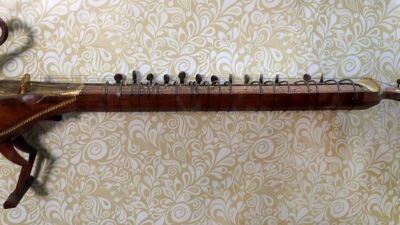
The taus is a large, heavy bowed instrument whose resonating chamber is carved in the shape of a peacock's (mayur) body — hence its other name, 'Mayuri Veena.' A long, fretted neck rises from the wooden peacock-shaped belly, and real peacock feathers are often fixed at the base of the neck as ornamentation. The player rests it on the floor or lap, fingering the strings with the left hand while drawing a bow (gaz) with the right.
Body
Zoomorphic — carved as the body of a peacock, with a curved neck-like fretboard rising from the bird's back; a carved or modelled peacock head often projects at the base
मयूर (मोर) के शरीर के आकार का — पक्षी की पीठ से फ़्रेटयुक्त गर्दन ऊपर उठती है, और आधार पर तराशा हुआ मोर का सिर निकला रहता है
Solid wood (commonly tun/toon wood, cedar, or other tonewoods), with a stretched skin or wooden soundboard over the belly
ठोस लकड़ी (प्रायः तून, देवदार आदि टोनवुड) और पेट पर खिंची हुई चमड़े की झिल्ली या लकड़ी का साउंडबोर्ड
100-130 (a large, full-length instrument, longer than a sitar)
Single large peacock-shaped wooden chamber with a skin or wood soundboard; feathers and painted plumage are decorative, not acoustic
Strings
Primary bowed melody strings running over the fretted neck
Fine tarab (sympathetic) strings running beneath the main strings that resonate on their own, giving the taus its shimmering, sustained halo
Higher chikari-style rhythm/drone strings on the side, plucked or brushed for punctuation (where present)
Bow
गज़
Gaz
Wooden stick strung with horsehair
60-75
Drawn across the main strings with the right hand while the instrument lies flat; long, singing bow-strokes sustain notes across the frets
Tuning Pegs
खूँटी
Khunti
Large wooden tuning pegs at the head for the main strings, plus rows of small side pegs for the sympathetic (tarab) strings
Bridge
घोड़ी / पुल
Ghodi / Pul
A flat, wide bridge (jawari-style) seated on the soundboard that spreads string vibration into the peacock-shaped body and gives the buzzing, resonant sustain
Wood, sometimes bone-topped
Frets
सारंगी के विपरीत, ताऊस में गर्दन पर धातु के फ़्रेट होते हैं जो सूत/तागे से बाँधे जाते हैं (सितार व दिलरुबा की तरह)। कलाकार फ़्रेट पर तार दबाकर और फिर फ़्रेट के सहारे तार को खींच/सरकाकर मींड निकालता है।
Unlike the sarangi, the taus has metal frets tied along the neck with thread (like the sitar and dilruba). The player presses the string against a fret and then produces meend (glissando) by pulling or sliding the string along the fret.
ध्वनि-चरित्र
SoundTonal Character Hindi
ताऊस की ध्वनि गहरी, गूँजती और मानवीय कंठ के निकट है — गज़ से खींचा हुआ लंबा, टिका हुआ स्वर तरब तारों की झिलमिलाहट के साथ मिलकर एक ध्यानमग्न, भक्तिमय आभा रचता है। यह दिलरुबा से अधिक बड़ी और गहरी आवाज़ देता है।
Tonal Character English
The taus produces a deep, resonant, vocal tone — the long sustained note drawn by the bow, wrapped in the shimmer of the sympathetic strings, creates a meditative, devotional aura. It is larger and deeper-voiced than its cousin the dilruba.
Timbre
Warm, sustained, gently buzzing (from the flat jawari-style bridge) with a resonant sympathetic-string halo
Range
Roughly two to three octaves centred on the middle register, following the vocal range used in shabad kirtan
Dynamic Range
Moderate to wide — from a soft, meditative alaap to a full, singing accompaniment that supports congregational singing
Techniques
सुनने का मार्गदर्शन
The Listening Guideताऊस का रस लेना हो तो किसी शांत क्षण में बैठिए और गज़ की लंबी, टिकी हुई खिंचाई पर ध्यान दीजिए — हर स्वर के पीछे उठती तरब तारों की झिलमिलाहट ही इसकी आत्मा है। किसी शबद कीर्तन की संगत से शुरू कीजिए, फिर धीमे राग-आलाप में उतरिए, और देखिए कि वादक फ़्रेट पर तार खींचकर कैसे कंठ-सी मींड निकालता है।
अंग्रेज़ी में पढ़ें · Read in English
To hear the taus, sit in a quiet moment and follow the long, sustained pull of the bow — the shimmer of the sympathetic strings that rises behind each note is the soul of the instrument. Begin with its accompaniment to a shabad kirtan, then listen to a slow raag alaap. Notice how the player pulls the string along the fret to draw a vocal meend. It is a slow, meditative, devotional experience — its flavour does not reveal itself in haste.
श्रवण-कक्ष · The Listening Room
देखें-सुनें
Taus Recital | Sandeep Singh and Avirbhav Verma at The Sacred Amritsar, 2023 · 34:42
Instrumental meditation music - Sikh string instrument Taus · 1:01:52
Taus Instrument by Sikh Music Shop | Raag Asa · 1:57
परिचय
Identity- Year Of Origin
- 1700
अन्य विवरण
More DetailsTimbre
Warm, sustained, gently buzzing (from the flat jawari-style bridge) with a resonant sympathetic-string halo
रोचक तथ्य
Margin Notesमोर का नाम, मोर का रूप — ताऊस और मयूरी — दोनों नामों का अर्थ 'मोर' है (ताऊस फ़ारसी में, मयूरी संस्कृत में)। यह उन विरल भारतीय वाद्यों में से है जिनका शरीर किसी जीव के रूप में गढ़ा जाता है।
Both of its names — taus (Persian) and mayuri (Sanskrit) — mean 'peacock.' It is one of the rare Indian instruments whose body is modelled on a living creature.
गुरु से जुड़ी परंपरा — परंपरा ताऊस के आविष्कार का श्रेय दसवें गुरु, गुरु गोबिंद सिंह जी को देती है। इसी कारण यह केवल एक वाद्य नहीं, बल्कि सिख संगीत-विरासत का प्रतीक भी माना जाता है।
Tradition credits the invention of the taus to the tenth Guru, Guru Gobind Singh. For this reason it is regarded not merely as an instrument but as an emblem of Sikh musical heritage.
पुराने चित्रों में ताऊस — 1920–1935 के लाहौर और पंजाब के फ़ोटोग्राफ़ों में ताऊस को अन्य सिख साज़ों — रबाब, सारंदा, जोड़ी, तानपूरा — के साथ प्रलेखित देखा जा सकता है, जो एक समृद्ध तंती-वादन परंपरा का प्रमाण है।
Photographs from Lahore and Punjab in the 1920s–1935 document the taus alongside other Sikh instruments — the rabab, saranda, jori and tanpura — evidence of a rich stringed-music tradition.
क्यों जन्मा दिलरुबा — ताऊस का भार और आकार उसे यात्रा के लिए अनुपयुक्त बनाता था। इसी व्यावहारिक समस्या ने दिलरुबा को जन्म दिया — एक छोटा, हल्का, आयताकार शरीर वाला रूप जिसे सैनिक और यात्री आसानी से साथ ले जा सकते थे।
The taus's weight and size made it impractical for travel. This very practical problem gave rise to the dilruba — a smaller, lighter, box-bodied version that soldiers and travellers could carry with ease.
सवाल-जवाब
Questions & Answersताऊस क्या है?
ताऊस एक मोर के आकार का, फ़्रेटयुक्त गज़-वाद्य (धनुष से बजने वाला तार-वाद्य) है, जिसे 'मयूरी वीणा' भी कहते हैं। यह सिख गुरमत संगीत में शबद कीर्तन की संगत के लिए बजाया जाता है।
ताऊस का आविष्कार किसने किया?
परंपरागत रूप से ताऊस के आविष्कार का श्रेय दसवें सिख गुरु, गुरु गोबिंद सिंह जी को दिया जाता है (कुछ वृत्तांत इसे गुरु हरगोबिंद जी से भी जोड़ते हैं)। इसका जन्म 17वीं शताब्दी के अंत में पंजाब में हुआ।
ताऊस और दिलरुबा में क्या अंतर है?
दिलरुबा ताऊस का ही छोटा, हल्का और यात्रा-योग्य रूप है। ताऊस का शरीर मोर के आकार में तराशा जाता है और वह भारी होता है, जबकि दिलरुबा का शरीर छोटा और आयताकार है, जिसे आसानी से साथ ले जाया जा सकता है। वादन-विधि दोनों की समान है।
ताऊस को 'मयूरी वीणा' क्यों कहते हैं?
'ताऊस' फ़ारसी में और 'मयूरी' संस्कृत में — दोनों का अर्थ 'मोर' है। वाद्य का शरीर सचमुच मोर के आकार में तराशा जाता है और अक्सर असली मोर-पंख भी लगाए जाते हैं, इसीलिए इसे मयूरी वीणा कहते हैं।
ताऊस फ़्रेटयुक्त है या फ़्रेटरहित?
ताऊस फ़्रेटयुक्त है — इसकी गर्दन पर सितार की तरह धातु के फ़्रेट सूत से बँधे होते हैं। यही इसे फ़्रेटरहित सारंगी से अलग करता है और दिलरुबा-इसराज परिवार से जोड़ता है।
नमूना-पट्टी
The Specimen Table| नाम | ताऊस · Taus |
|---|---|
| अन्य नाम | ताऊस · मयूरी वीणा (Mayuri Veena) · मयूरी (Mayuri) · ताऊस / तौस (Taoos / Tau) · Peacock lute |
| उद्गम | 1700 |
| प्रकार | वाद्य · Instruments |
साझा कीजिए · Share this Plate