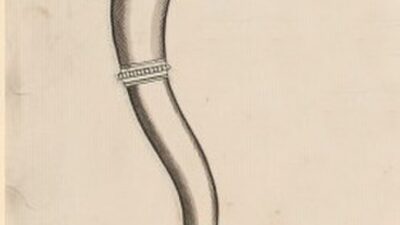
शास्त्र विंग · वाद्य-पट्टिका · Instrument Plate
नरसिंघा
Narsingha
अन्य नामनरसिंगा · नरसिंहा · नरसिंघा · नाड़सिंघा
परिचय
Overviewनरसिंघा ताँबे-पीतल का एक अर्धचंद्राकार 'C' सींग है, जो प्रायः दो जुड़ने वाले टुकड़ों में बनता है और हिमाचल, जम्मू, नेपाल तथा दक्षिणी बिहार की जनजातीय परंपराओं में गूँजता है। न छेद, न वाल्व — केवल होंठ और साँस से निकली एक भेदक पुकार, जो देवता, बारात और जुलूस के आगमन की मंगल-घोषणा करती है। यह रणसिंघा से जुड़ा फिर भी उससे भिन्न है: नरसिंघा 'C' अर्धचंद्र, रणसिंघा 'S' आकार।
अंग्रेज़ी में पढ़ें · Read in English
The narsingha is a crescent 'C'-shaped horn of copper and brass, usually built in two joinable sections, that rings out across the folk traditions of Himachal, Jammu, Nepal and southern Bihar. No holes, no valves — only a piercing call sounded by lip and breath, announcing the auspicious arrival of a deity, a wedding party or a procession. It is related to yet distinct from the ransingha: the narsingha is the 'C' crescent, the ransingha the 'S' shape.
वर्गीकरण
ClassificationNatya Shastra Category
सुषिर (Sushira - wind instruments)
नाट्यशास्त्र की चतुर्विध वाद्य-वर्गीकरण में नरसिंघा 'सुषिर' (फूँक से बजने वाले) वर्ग में आता है। इसमें ध्वनि होंठों के कंपन और फूँकी गई वायु के स्तंभ से उत्पन्न होती है — तार या चमड़े से नहीं। यह वैदिक 'शृंग' (सींग) परंपरा का धातु-निर्मित उत्तराधिकारी है।
In the fourfold Natya Shastra classification, the narsingha belongs to the 'Sushira' (blown / wind) category, where sound is produced by the vibration of the player's lips against a column of forced air — not by strings or membranes. It is the metal-bodied descendant of the Vedic 'shringa' (horn) tradition.
Western Category
Lip-vibrated aerophone (natural horn / valveless trumpet)
Western Family
Natural brass family (like the alphorn, fanfare trumpet, or shofar — a valveless horn that sounds only its natural harmonic series)
Sub Classification
बनावट
PhysicalDescription Hindi
नरसिंघा एक धातु का घुमावदार सींग-वाद्य है, जो अधिकतर ताँबे या पीतल की चादर को मोड़कर बनाया जाता है। इसकी सबसे पहचानी जाने वाली आकृति अंग्रेज़ी अक्षर 'C' जैसी अर्धचंद्राकार होती है। प्रायः यह दो अलग-अलग मुड़ी हुई नलियों से बनता है जिन्हें जोड़कर पूरा वाद्य तैयार होता है — इसी कारण इसे यात्रा के समय अलग करके ले जाया जा सकता है और जोड़ने पर 'C' या 'S' आकार दिया जा सकता है। नली एक छोर पर पतली (फूँकने का मुख) और दूसरे छोर पर चौड़ी (घंटी/मुख) होती है।
Description English
The narsingha is a curved metal horn, most often fashioned by beating and rolling sheet copper or brass. Its most recognisable form is a crescent, 'C'-shaped curve. It is frequently built from two separately curved tube-sections that join to make the complete instrument — which is why it can be dismantled for carrying and reassembled into a 'C' or an 'S' shape. The bore is narrow at the blowing end (mouthpiece) and flares to a wide bell at the far end.
Body
Curved 'C' crescent (also assembled as an 'S'); conical-to-flared tube
अर्धचंद्राकार 'C' मोड़ (या जुड़कर 'S' आकार); पतली से चौड़ी होती शंक्वाकार नली
Beaten copper or brass sheet; sometimes bronze/copper alloy, with a small metal mouthpiece
पिटी हुई ताँबे या पीतल की चादर; कभी-कभी काँसा/ताम्र-मिश्र, साथ में छोटा धातु का मुखांश
60-150 (varies widely by region and maker; often made in two joinable halves)
The flared bell projects the sound; the whole curved air-column is the resonator (no separate sound-box)
Construction
अधिकांश नरसिंघा दो घुमावदार टुकड़ों में बनाए जाते हैं जो एक जोड़ (सॉकेट) पर आपस में फँसा दिए जाते हैं। कारीगर ताँबे की पतली चादर को घुमाकर, टाँका लगाकर तथा हथौड़े से पीटकर नली को आकार देते हैं। कुछ नमूने तीन आकृतियों में बदले जा सकते हैं।
Most narsinghas are built as two curved segments that lock together at a socketed joint. Smiths roll thin copper sheet, seam-solder it and hammer the tube into shape. Some specimens can be re-configured into as many as three shapes.
फूँकने वाला सिरा एक छोटा कटोरीनुमा धातु-मुखांश होता है, जिस पर होंठ रखकर 'बज़' (कंपन) उत्पन्न किया जाता है — बाँसुरी की तरह इसमें कोई छेद या रीड नहीं होती।
The blowing end is a small cup-shaped metal mouthpiece against which the lips 'buzz'; unlike the flute it has no finger-holes and no reed.
None — pitch is controlled purely by the player's lip tension (embouchure) and breath, not by holes or valves.
Frets
नरसिंघा में न फ्रेट होते हैं, न छेद, न वाल्व। इसकी सीमित स्वर-सामग्री प्राकृतिक हार्मोनिक श्रृंखला पर टिकी होती है — वादक होंठों के दबाव और साँस से एक या दो-तीन स्वर ही निकाल पाता है।
The narsingha has no frets, no holes and no valves. Its limited note-material rests on the natural harmonic series — the player can sound only one, or at most two-to-three, pitches by varying lip pressure and breath.
ध्वनि-चरित्र
SoundTonal Character Hindi
नरसिंघा की ध्वनि तीव्र, भेदक और दूर तक गूँजने वाली होती है — पहाड़ी घाटियों में मीलों तक सुनाई देती है। यह मधुर राग-वाद्य नहीं, बल्कि एक 'पुकार' वाला वाद्य है: शुभ, गंभीर और उत्सवी। इसकी आवाज़ में देवता के आगमन, बारात के चलने या जुलूस की घोषणा की गूँज बसती है।
Tonal Character English
The narsingha's tone is piercing, penetrating and far-carrying — audible for miles across mountain valleys. It is not a melodic raga-instrument but a 'summoning' instrument: auspicious, solemn and festive. Its blast announces the arrival of a deity, the setting-off of a wedding party, or the passage of a procession.
Timbre
Brassy, raw, edgy and powerful; a single sustained blare rather than a shaped melodic line
Range
Very narrow — essentially one fundamental with one or two overblown natural harmonics; a fanfare/drone voice, not a scalar range
Dynamic Range
Loud to very loud by nature; built for outdoor, ceremonial projection without amplification
Techniques
सुनने का मार्गदर्शन
The Listening Guideनरसिंघा को किसी धुन की तरह नहीं, एक 'घटना' की तरह सुनिए। ग़ौर कीजिए कि किस तरह एक लंबी, भेदक फूँक ढोल-नगाड़े की ताल के ऊपर तैरकर वातावरण को शुभ और गंभीर बना देती है। हिमाचली देव-जुलूस या नेपाली बारात की क्षेत्रीय रिकॉर्डिंग चुनिए — वहाँ यह अकेला नहीं, समूह में, उत्सव के हृदय की तरह बजता है।
अंग्रेज़ी में पढ़ें · Read in English
To understand the narsingha, listen to it not as a melody but as an 'event'. Notice how one long, piercing blast floats over the beat of dhol and nagara and makes the atmosphere solemn and auspicious. Choose a field recording of a Himachali deity procession or a Nepali baraat — there the narsingha sounds not alone but in the ensemble, like the beating heart of the celebration.
अन्य विवरण
More Details- Assembly English
- Most narsinghas are built as two curved segments that lock together at a socketed joint. Smiths roll thin copper sheet, seam-solder it and hammer the tube into shape. Some specimens can be re-configured into as many as three shapes.
- Mouthpiece English
- The blowing end is a small cup-shaped metal mouthpiece against which the lips 'buzz'; unlike the flute it has no finger-holes and no reed.
- Finger Holes
- None — pitch is controlled purely by the player's lip tension (embouchure) and breath, not by holes or valves.
- Assembly
- अधिकांश नरसिंघा दो घुमावदार टुकड़ों में बनाए जाते हैं जो एक जोड़ (सॉकेट) पर आपस में फँसा दिए जाते हैं। कारीगर ताँबे की पतली चादर को घुमाकर, टाँका लगाकर तथा हथौड़े से पीटकर नली को आकार देते हैं। कुछ नमूने तीन आकृतियों में बदले जा सकते हैं।
- Mouthpiece
- फूँकने वाला सिरा एक छोटा कटोरीनुमा धातु-मुखांश होता है, जिस पर होंठ रखकर 'बज़' (कंपन) उत्पन्न किया जाता है — बाँसुरी की तरह इसमें कोई छेद या रीड नहीं होती।
Construction
Timbre
Brassy, raw, edgy and powerful; a single sustained blare rather than a shaped melodic line
रोचक तथ्य
Margin Notesएक वाद्य, तीन आकार — कुछ नरसिंघा नमूने इस तरह बनाए जाते हैं कि उनके जुड़ने वाले टुकड़ों को बदलकर तीन अलग-अलग आकृतियाँ — अर्धचंद्र, 'S' और लगभग सीधी — दी जा सकती हैं। यही लचीलापन इसे यात्रा और जुलूस के लिए व्यावहारिक बनाता है।
Some narsingha specimens are made so that, by re-arranging their joining sections, they can take three different shapes — crescent, 'S', and near-straight. This flexibility makes the horn practical for travel and procession.
पंचै बाजा का सदस्य — नेपाल के 'पंचै बाजा' (पाँच पारंपरिक वाद्यों के समूह) में नरसिंघा एक प्रमुख स्वर है, जो सहनाई (शहनाई), ढोलकी, ताशा/दमाहा और झ्याली (झाँझ) के साथ विवाह और मांगलिक अवसरों की धुन रचता है। इसे परंपरागत रूप से दमाई समुदाय के वादक बजाते हैं।
In Nepal's 'panche baja' (the ensemble of five traditional instruments), the narsingha is a leading voice, weaving the tune of weddings and auspicious occasions alongside the sahanai (shehnai), dholaki, tyamko/damaha and jhyali (cymbals). It is traditionally played by musicians of the Damai community.
उराँव जनजाति और सिख उदासी परंपरा — दक्षिणी बिहार-झारखंड की उराँव जनजाति इस सींग को अपने उत्सव-नृत्यों में बजाती है, जबकि सिख उदासी सम्प्रदाय के गवंतरी इसे धार्मिक जुलूसों की सार्वजनिक घोषणा के लिए फूँकते रहे हैं — एक ही वाद्य के दूर-दूर तक फैले सांस्कृतिक संदर्भ।
The Oraon tribe of southern Bihar-Jharkhand sounds this horn in their festival dances, while the Gawantaris of the Sikh Udasi sect have blown it to publicly announce religious processions — a single instrument with widely scattered cultural contexts.
करनाल का घुमावदार भाई — नरसिंघा को प्रायः 'करनाल' के साथ जोड़ा जाता है, जो हिमालयी परंपरा का एक लंबा, सीधा धातु-तुरही है। दोनों साथ बजते हैं — करनाल की गहरी सीधी आवाज़ और नरसिंघा की घुमावदार भेदक पुकार मिलकर देव-जुलूस का भव्य ध्वनि-चित्र रचते हैं।
The narsingha is often paired with the 'karnal', a long straight metal trumpet of the Himalayan tradition. The two sound together — the karnal's deep straight voice and the narsingha's curved piercing call combine to paint the grand soundscape of a deity procession.
सवाल-जवाब
Questions & Answersनरसिंघा क्या है?
नरसिंघा ताँबे या पीतल का एक घुमावदार 'C' आकार का सींग-वाद्य (तुरही) है, जो हिमाचल प्रदेश, जम्मू, नेपाल और दक्षिणी बिहार की जनजातीय परंपराओं में बजाया जाता है। इसमें कोई छेद या वाल्व नहीं होता; ध्वनि केवल होंठों के कंपन और फूँक से निकलती है।
नरसिंघा और रणसिंघा में क्या अंतर है?
दोनों एक ही धातु-सींग परिवार के हैं, पर परंपरागत रूप से नरसिंघा को 'C' अर्धचंद्राकार आकृति और रणसिंघा (रणश्रृंग) को 'S' आकृति से पहचाना जाता है। दोनों प्राकृतिक हार्मोनिक पर आधारित घोषणा-वाद्य हैं।
नरसिंघा कैसे बजाया जाता है?
वादक धातु के छोटे मुखांश पर होंठ रखकर 'बज़' (कंपन) उत्पन्न करता है, और साँस व होंठों के कसाव से एक-दो स्वर निकालता है। इसमें छेद या वाल्व न होने के कारण यह मधुर राग नहीं बजाता, बल्कि लंबी भेदक फूँक और ताल-आधारित पैटर्न बजाता है।
नरसिंघा कहाँ और किस अवसर पर बजाया जाता है?
यह हिमाचली देव-जुलूसों और मेलों, नेपाली विवाह की बारात (पंचै बाजा), झारखंड-बिहार की उराँव जनजातीय उत्सवों और सिख उदासी सम्प्रदाय के धार्मिक जुलूसों में बजाया जाता है। इसकी दूरगामी पुकार मंगल और शुभता का प्रतीक मानी जाती है।
क्या नरसिंघा फिल्मी या शास्त्रीय संगीत में प्रयुक्त होता है?
मुख्यधारा फिल्मी और हिंदुस्तानी शास्त्रीय संगीत में यह दुर्लभ है, क्योंकि इसकी स्वर-सामग्री सीमित है। पर पहाड़ी/धार्मिक-जुलूस दृश्यों की परिवेश-ध्वनि तथा क्षेत्रीय एवं लोक-प्रेरित संगीत में इसकी भेदक पुकार कभी-कभी प्रयुक्त होती है।
नमूना-पट्टी
The Specimen Table| नाम | नरसिंघा · Narsingha |
|---|---|
| अन्य नाम | नरसिंगा · नरसिंहा · नरसिंघा · नाड़सिंघा · Narsingha (also: Narsinga, Narshinga, Nar Singa) |
| प्रकार | वाद्य · Instruments |
साझा कीजिए · Share this Plate