शास्त्र विंग · वाद्य-पट्टिका · Instrument Plate
ग्लॉकेंस्पील
Glockenspiel
अन्य नामग्लॉकनश्पील · ऑर्केस्ट्रल बेल्स / Orchestral Bells · Concert Bells · Bell Lyra / बेल लायरा (मार्चिंग रूप)
परिचय
Overviewग्लॉकेंस्पील ट्यून की हुई इस्पात-पट्टियों का चमकीला घन-वाद्य है, जिसे छोटे कठोर हथौड़ों से बजाकर घंटी-सी ऊँची झंकार निकाली जाती है। मूलतः यूरोपीय आर्केस्ट्रा और मार्चिंग बैंड का वाद्य, यह हिन्दी फ़िल्म-संगीत के आर्केस्ट्रा युग में 'चमक' और 'जादू' की परत के रूप में आया — केर्सी लॉर्ड जैसे सत्र-कलाकारों के हाथों देशी धुनों पर बिखरता एक अंतरराष्ट्रीय रंग।
अंग्रेज़ी में पढ़ें · Read in English
The glockenspiel is the bright idiophone of tuned steel bars, struck with small hard mallets to yield a high, bell-like ring. Originally an instrument of the European orchestra and marching band, it entered Hindi film music in its orchestral era as a layer of 'sparkle' and 'magic' — a cosmopolitan colour scattered over indigenous melodies by session players such as Kersi Lord.
वर्गीकरण
ClassificationNatya Shastra Category
घन (Ghana - solid/struck idiophones)
नाट्यशास्त्र के चार वाद्य-वर्गों (तत, सुषिर, अवनद्ध, घन) में ग्लॉकेंस्पील 'घन' वर्ग में आता है — ऐसे ठोस वाद्य जिनकी अपनी ही धातु-देह कंपित होकर ध्वनि देती है (जैसे मंजीरा, घंटी, जलतरंग)। इसमें कोई तार या झिल्ली नहीं, बल्कि ट्यून की हुई धातु-पट्टियाँ हैं जिन्हें हथौड़ी (mallet) से आघात कर स्वर उत्पन्न होते हैं।
Among the four Natya Shastra instrument classes (tata/strings, sushira/winds, avanaddha/drums, ghana/solids), the glockenspiel belongs to 'Ghana' — solid self-sounding instruments whose own metallic body vibrates to make sound (like manjira, bells, jaltarang). It has no strings or membrane; instead, tuned metal bars are struck with mallets to produce pitches.
Western Category
Pitched (tuned) percussion — struck idiophone / metallophone
Western Family
Mallet (keyboard) percussion family — related to xylophone (wood bars), marimba, vibraphone (aluminium bars with resonators and motor) and celesta; the glockenspiel uses steel bars and sits highest and brightest in this family
Sub Classification
बनावट
PhysicalDescription Hindi
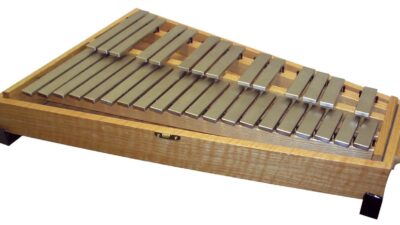
ग्लॉकेंस्पील एक ट्यून-की-हुई धातु-पट्टियों वाला ताल-वाद्य है जिसकी पट्टियाँ पियानो के सप्तक की तरह दो पंक्तियों (श्वेत-कृष्ण स्वरों की भाँति) में एक चौखटे पर जड़ी होती हैं। छोटे कठोर हथौड़ों (mallets) से आघात करने पर यह चमकीली, घंटी-सी ऊँची झंकार देता है। इसका आकार शहनाई या सारंगी जैसे मधुर-गहरे वाद्यों के विपरीत है — यह उजली, चमकती 'रौशनी' जोड़ता है।
Description English
The glockenspiel is a tuned-metal-bar percussion instrument whose bars are laid out in two rows on a frame, mirroring the white-and-black keys of a piano. Struck with small hard mallets, it produces a bright, high, bell-like shimmer. Unlike warm, deep instruments such as shehnai or sarangi, it adds glinting, sparkling 'light' to an ensemble.
Body
Rectangular case/frame holding a graduated set of bars (concert models sit on a table or trolley; the marching 'bell lyra' is mounted in an upright lyre-shaped frame)
आयताकार चौखटा/पेटी जिसमें क्रमबद्ध पट्टियाँ जड़ी होती हैं (कॉन्सर्ट रूप मेज़ पर, मार्चिंग 'बेल लायरा' खड़े लायर-आकार फ्रेम में)
Frame of wood or metal; tone bars of hardened steel (some student models use aluminium alloy)
फ्रेम लकड़ी या धातु का; स्वर-पट्टियाँ कठोर इस्पात (कुछ अभ्यास-वाद्यों में एल्युमिनियम मिश्रधातु) की
Portable table model roughly 40-60 cm wide; bars ~2.5 octaves
Usually none — the small steel bars ring on their own; unlike vibraphone/marimba, the glockenspiel generally has no tubular resonators, which keeps its tone pure, bright and penetrating
Bars
Graduated tuned steel bars arranged like a piano keyboard — the 'naturals' in front, the 'accidentals' raised behind
The glockenspiel has no sympathetic/resonating strings; each bar rings only when struck. Its 'shimmer' comes from the steel's own high overtones, not from sympathetic vibration.
Mallets
हथौड़ी / मैलेट
Mallets
Pairs of small beaters with hard heads of brass, plastic, or hard rubber; harder heads give a brighter, more metallic 'ting', softer heads a rounder tone
25-35
Held one in each hand and bounced off the bar for a clean, ringing strike; rolls (rapid alternating strokes) sustain a note since the bars are otherwise short-decaying
Tuning Pegs
स्थिर स्वर (कोई खूँटी नहीं)
Fixed tuning (no pegs)
Bars are tuned at manufacture by precisely filing their length and thickness; the player cannot retune bars during performance, so the instrument is fixed-pitch and chromatic
Bridge
सहारा-पट्टी / फेल्ट रेल
Support rails (felt/cord)
Bars rest on felt- or cord-lined rails at their nodal points so they can ring freely; pins pass through holes at the nodes to hold each bar without damping it
Felt, cord, and metal pins
Frets
यह पट्टी-वाद्य है, तार-वाद्य नहीं — इसमें फ्रेट या मीड की गुंजाइश नहीं। हर पट्टी एक निश्चित स्वर देती है, अतः यह भारतीय मीड-गमक के बजाय स्पष्ट, बिंदुवत चमकीले स्वरों के लिए उपयुक्त है।
It is a bar instrument, not a string instrument — there are no frets and no scope for meend (glissando). Each bar sounds one fixed pitch, so it excels at clean, pointillistic, sparkling notes rather than the sliding ornament central to Indian melody.
ध्वनि-चरित्र
SoundTonal Character Hindi
ग्लॉकेंस्पील की ध्वनि उजली, कुरकुरी और घंटी-सी है — जैसे संगीत पर बिखरे सितारे या बर्फ़ की झिलमिल। यह ऊँचे सप्तक में तीखी और स्पष्ट है, आर्केस्ट्रा या फ़िल्मी साज़-संगत के गहरे स्वरों के ऊपर 'चमक' और 'जादू' की परत जोड़ती है।
Tonal Character English
The glockenspiel's tone is bright, crisp and bell-like — like scattered stars or a glint of frost laid over the music. Piercing and clear in its high octaves, it adds a layer of 'sparkle' and 'magic' above the deeper voices of an orchestra or film arrangement.
Timbre
Pure, metallic, silvery with strong high overtones; short natural decay with a bright attack
Range
About 2.5 octaves; written ~G5–C8 but sounds two octaves higher (the highest-sounding of the standard mallet instruments)
Dynamic Range
From a delicate single glint to a bright, cutting sparkle that easily rides above a full ensemble because of its high, penetrating overtones
Techniques
सुनने का मार्गदर्शन
The Listening Guideग्लॉकेंस्पील को पहचानना हो तो गीत के सबसे ऊँचे सिरे पर ध्यान दीजिए — मुख्य धुन के ऊपर तैरती घंटी-सी, बर्फ़ीली टिमटिमाहट। स्वप्न-दृश्य, लोरी और 'जादुई' पलों में यह सबसे साफ़ सुनाई देती है। इसे वाइब्राफ़ोन की गूँजती मोटर-कम्पन और सेलेस्टा की मृदु कीबोर्ड-झंकार से अलग करके सुनिए — इन तीनों में ग्लॉकेंस्पील सबसे तीखी और सबसे ऊँची होती है।
अंग्रेज़ी में पढ़ें · Read in English
To spot the glockenspiel, listen to the high end of a song — a bell-like, frosty twinkle floating above the main tune. It is clearest in film songs with dream sequences, lullabies or 'magical' moments. Distinguish it from the vibraphone (slower, humming, motor-tremolo) and the celesta (keyboard-played, softer) — the glockenspiel is the sharpest and highest of the three.
परिचय
Identity- Year Of Origin
- 1700
अन्य विवरण
More DetailsTimbre
Pure, metallic, silvery with strong high overtones; short natural decay with a bright attack
रोचक तथ्य
Margin Notesघंटियों से पट्टियों तक — आरम्भिक ग्लॉकेंस्पील में सचमुच ट्यून की हुई छोटी घंटियाँ लगी होती थीं। बजाने और ढोने की सुविधा के लिए इन्हें धीरे-धीरे इस्पात की सपाट पट्टियों से बदल दिया गया, पर नाम 'घंटियों का समूह' ही बना रहा।
Early glockenspiels really did use tuned little bells. For ease of playing and transport these were gradually replaced by flat steel bars, yet the name 'a set of bells' stuck.
बेल लायरा — चलता-फिरता ग्लॉकेंस्पील — मार्चिंग बैंडों में ग्लॉकेंस्पील को एक खड़े, लायर (वीणा-नुमा) फ्रेम में लगाकर 'बेल लायरा' बना दिया जाता है, ताकि वादक चलते-चलते बजा सके।
In marching bands the glockenspiel is mounted in an upright, lyre-shaped frame to become the 'bell lyra', so the player can perform while walking.
ग्लॉकेंस्पील बनाम वाइब्राफ़ोन बनाम सेलेस्टा — तीनों 'चमकीले' लगते हैं पर अलग हैं: ग्लॉकेंस्पील इस्पात-पट्टी, सबसे ऊँची-तीखी; वाइब्राफ़ोन एल्युमिनियम-पट्टी + मोटर-कम्पन, गूँजती-मृदु; सेलेस्टा कीबोर्ड से बजने वाला, कोमल घंटी-सा। श्रोता अक्सर इन्हें एक ही मान लेते हैं।
All three sound 'bright' but differ: the glockenspiel has steel bars and is the highest and sharpest; the vibraphone has aluminium bars with a motor-driven tremolo and a warmer hum; the celesta is played from a keyboard with a soft bell tone. Listeners often confuse them.
फ़िल्मी 'जगमग' का शॉर्टकट — हिन्दी फ़िल्म-संगीत में जब किसी पल को 'जादुई', 'स्वप्निल' या 'बचपन-सा मासूम' दिखाना होता, तो संगीतकार अक्सर ग्लॉकेंस्पील (या उसकी सिंथेसाइज़्ड नकल) की टिमटिमाहट जोड़ देते — यह मानो 'जादू' का ध्वनि-चिह्न बन गई।
In Hindi film music, when a moment had to feel 'magical', 'dreamy' or 'childlike-innocent', arrangers would often add the twinkle of a glockenspiel (or its synthesized imitation) — it became almost a sonic signature for 'magic'.
सवाल-जवाब
Questions & Answersग्लॉकेंस्पील क्या है?
ग्लॉकेंस्पील एक ताल-वाद्य है जिसमें ट्यून की हुई इस्पात-पट्टियाँ पियानो-जैसी सजी होती हैं और उन्हें छोटे कठोर हथौड़ों से बजाया जाता है। यह चमकीली, घंटी-सी ऊँची झंकार देता है और मैलेट-पर्कशन परिवार का सबसे ऊँचा वाद्य है।
ग्लॉकेंस्पील और ज़ाइलोफ़ोन में क्या अंतर है?
ग्लॉकेंस्पील की पट्टियाँ इस्पात (धातु) की होती हैं, जिससे चमकीली-गूँजती घंटी-सी ध्वनि निकलती है; ज़ाइलोफ़ोन की पट्टियाँ लकड़ी की होती हैं, जिससे सूखी, खटखटाती ध्वनि आती है। ग्लॉकेंस्पील अधिक ऊँचा और झिलमिलाता है।
क्या ग्लॉकेंस्पील का उपयोग हिन्दी फ़िल्म-संगीत में हुआ है?
हाँ। बॉलीवुड के आर्केस्ट्रा युग (1950-1980) में पश्चिमी ताल-वाद्य साज़-संगत में शामिल हुए, और केर्सी लॉर्ड जैसे बहु-वाद्य सत्र-कलाकारों ने ग्लॉकेंस्पील की टिमटिमाहट को गीतों में 'चमक' और 'जादू' की परत के रूप में जोड़ा।
'ग्लॉकेंस्पील' नाम का अर्थ क्या है?
'ग्लॉकेंस्पील' जर्मन शब्द है: 'ग्लॉकन' यानी घंटियाँ और 'स्पील' यानी समूह/वादन — अर्थात 'घंटियों का सेट'। आरम्भिक वाद्य सचमुच घंटियों के होते थे, जो बाद में धातु-पट्टियों में बदल गए।
ग्लॉकेंस्पील, वाइब्राफ़ोन और सेलेस्टा को कैसे पहचानें?
ग्लॉकेंस्पील सबसे ऊँची-तीखी इस्पात-झंकार देता है; वाइब्राफ़ोन एल्युमिनियम-पट्टी और मोटर-कम्पन से गूँजता-मृदु लगता है; सेलेस्टा कीबोर्ड से बजने वाला कोमल घंटी-सा वाद्य है। तीनों 'चमकीले' हैं पर ग्लॉकेंस्पील सबसे उजला और कुरकुरा है।
नमूना-पट्टी
The Specimen Table| नाम | ग्लॉकेंस्पील · Glockenspiel |
|---|---|
| अन्य नाम | ग्लॉकनश्पील · ऑर्केस्ट्रल बेल्स / Orchestral Bells · Concert Bells · Bell Lyra / बेल लायरा (मार्चिंग रूप) · Carillon (French orchestral usage) |
| उद्गम | 1700 |
| प्रकार | वाद्य · Instruments |
साझा कीजिए · Share this Plate