शास्त्र विंग · वाद्य-पट्टिका · Instrument Plate
गागर
Gagar
अन्य नामगागर · गागरी · गेगर (कश्मीर / Geger — Kashmir) · गड़वा / गड़ा (regional)
परिचय
Overviewगागर पंजाब का वह लोक-ताल-वाद्य है जो कोई गढ़ा हुआ साज़ नहीं, बल्कि कुएँ से पानी भरने वाला पीतल-ताँबे का घड़ा है। स्त्रियाँ उँगलियों में धातु के छल्ले पहनकर इसकी दीवार और मुँह पर आघात करती हैं और गिद्धा तथा बोलियों की ताल रचती हैं। मिट्टी के 'घड़े' का यह धातु-जुड़वाँ पंजाबी विवाह, तीज और उत्सवों में स्त्री-उल्लास की खनकती आवाज़ है; कश्मीर में इसे 'गेगर' कहते हैं।
अंग्रेज़ी में पढ़ें · Read in English
The gagar is Punjab's folk rhythm instrument that is not a crafted saaz but the very brass-and-copper pitcher used to draw water from the well. Women slip metal rings onto their fingers and strike its walls and mouth to weave the rhythm of Giddha and boliyan. The metal twin of the clay 'ghara', it is the ringing voice of women's joy at Punjabi weddings, Teej and festivals; in Kashmir it is called 'geger'.
वर्गीकरण
ClassificationNatya Shastra Category
घन (Ghana — solid/idiophone instruments)
गागर घन वर्ग का वाद्य है — यह एक ठोस धातु-पात्र है जो पूरी तरह से स्वयं कंपित होकर ध्वनि उत्पन्न करता है। इसमें न कोई तार होती है, न कोई खिंचा हुआ चर्म-मुख (झिल्ली); उंगलियों में पहने धातु के छल्लों से पात्र की दीवार और मुँह पर आघात करने से ही ताल जन्म लेती है।
The gagar belongs to the Ghana (idiophone) category — it is a solid metal vessel that produces sound by vibrating as a whole. It has no strings and no stretched membrane; rhythm is born purely by striking the vessel's walls and mouth with metal rings worn on the fingers.
Western Category
Idiophone (struck vessel percussion)
Western Family
Pot / vessel percussion family (cousin of the ghatam and udu; a metal parallel to the earthen ghara)
Sub Classification
बनावट
PhysicalDescription Hindi
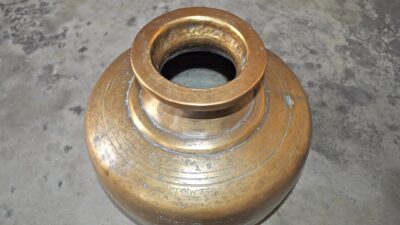
गागर वस्तुतः एक धातु का जल-पात्र (घड़ा) है — पीतल या ताँबे से गढ़ा हुआ, जिसका मुँह सँकरा और पेट गोल-फूला होता है ताकि पानी छलके नहीं। यही रोज़मर्रा का बर्तन जब घर की स्त्रियाँ उँगलियों में छल्ले पहनकर बजाने लगती हैं, तो वह गिद्धा और लोकगीतों का ताल-वाद्य बन जाता है। यह पंजाबी संस्कृति की उस परंपरा का प्रतीक है जिसमें घर के साधारण बर्तन ही संगीत के औज़ार बन जाते हैं।
Description English
The gagar is, at heart, a metal water pitcher — hammered from brass or copper, with a narrow mouth and a rounded, bulging belly so that water does not spill. When the women of the household slip metal rings onto their fingers and begin to strike it, this everyday vessel becomes the rhythm instrument of Giddha and folk song. It epitomises the Punjabi tradition of turning ordinary household utensils into musical tools.
Body
Rounded, bulbous pot with a narrow neck and flared mouth
गोल-फूला घड़ानुमा पात्र, सँकरी गर्दन और चौड़ा मुँह
Beaten brass (पीतल) or copper (ताँबा); sometimes other alloys
पीटा हुआ पीतल या ताँबा; कभी-कभी अन्य मिश्र धातु
20-50
roughly 2-5 litres of water in common household sizes; larger communal variants exist
The enclosed air column inside the pot; the narrow mouth acts as a resonating aperture that gives a bell-like ring and a deep bass 'thump' when the opening is struck
Strings
The gagar has no strings — it is an idiophone. It produces sound entirely from the vibration of its own metal body and the air inside.
गागर में कोई तार नहीं होती — यह घन (idiophone) वाद्य है और ध्वनि केवल अपने धातु-शरीर तथा भीतर की वायु के कम्पन से उत्पन्न होती है।
Playing Implement
छल्ले / मुँदरियाँ
Metal finger rings (chhalle)
Metal (brass/steel) rings worn on the fingers of both hands
बजाने वाली स्त्रियाँ अपनी उँगलियों में धातु के छल्ले पहनती हैं। छल्लों से पात्र की धातु-दीवार पर प्रहार करने से खनकती, तीखी 'टन-टन' ध्वनि निकलती है, जबकि हथेली या उँगलियों से मुँह ढकने-खोलने पर गहरी 'धम' ध्वनि बनती है।
The player wears metal rings on her fingers. Striking the metal wall with the rings produces a bright, ringing 'tan-tan'; cupping and releasing the mouth with the palm or fingers gives a deep 'thump' bass note.
Tuning
गागर की कोई निश्चित ट्यूनिंग नहीं होती; उसका स्वर पात्र के आकार, धातु की मोटाई और पानी की मात्रा पर निर्भर करता है। भीतर पानी की मात्रा बदलकर ध्वनि की गहराई थोड़ी बदली जा सकती है।
The gagar is not tuned to a fixed pitch; its tone depends on the vessel's size, the thickness of the metal, and the amount of water inside. Adjusting the water level slightly alters the depth of the sound.
Frets
गागर एक ताल-वाद्य है, अतः इसमें फ्रेट या स्वर-स्थान नहीं होते — यह राग नहीं, केवल लय देता है।
As a rhythm instrument the gagar has no frets or pitch positions — it provides not melody but rhythm.
ध्वनि-चरित्र
SoundTonal Character Hindi
गागर की ध्वनि दो रंगों की है — छल्लों की खनकती, चमकीली 'टन-टन' जो ऊँचे स्वर में हवा में तैरती है, और मुँह पर आघात से उठती गहरी, गूँजती 'धम' जो लय की ज़मीन बनाती है। मिलकर ये धातु की झंकार और घड़े की गूँज का अनोखा मेल रचती हैं।
Tonal Character English
The gagar's sound has two colours — the bright, ringing 'tan-tan' of the rings, floating high in the air, and the deep, booming 'thump' rising from a strike on the mouth, which lays the rhythmic ground. Together they weave a distinctive blend of metallic shimmer and pot-resonance.
Timbre
Metallic, ringing and resonant with a long sustain; bell-like on the walls, hollow and deep at the mouth
Range
Non-melodic (percussive); a bright high 'ting' from the rings against the wall down to a deep hollow bass from the mouth-strike
Dynamic Range
Moderate to loud — carries well over group singing and clapping in open-air Giddha gatherings
Techniques
सुनने का मार्गदर्शन
The Listening Guideगागर सुननी हो तो किसी गिद्धे की प्रस्तुति देखिए — घेरे के बीच बैठी स्त्री की उँगलियों के छल्ले जब गागर पर पड़ते हैं, तो ऊँची खनकती 'टन-टन' और गहरी 'धम' का संवाद उठता है। इसी लय पर बोली की आख़िरी पंक्ति उछलती है और दो नर्तकियाँ घेरे में कूद पड़ती हैं। घड़े और चिमटे की संगत को अलग-अलग पहचानने का अभ्यास कीजिए — तभी गागर की भूमिका स्पष्ट सुनाई देगी।
अंग्रेज़ी में पढ़ें · Read in English
The best way to appreciate the gagar is to watch and hear a Giddha performance. Notice how the rings of the woman seated in the centre weave a fast, shimmering rhythm on the gagar, and how the closing line of each boli leaps upon that beat. Follow the dialogue between the high 'tan-tan' and the deep 'thump' — this is the gagar's rhythmic language. Try to pick out its interplay with the ghara and chimta separately.
अन्य विवरण
More Details- Tunable
- Description English
- The gagar is not tuned to a fixed pitch; its tone depends on the vessel's size, the thickness of the metal, and the amount of water inside. Adjusting the water level slightly alters the depth of the sound.
- Description
- गागर की कोई निश्चित ट्यूनिंग नहीं होती; उसका स्वर पात्र के आकार, धातु की मोटाई और पानी की मात्रा पर निर्भर करता है। भीतर पानी की मात्रा बदलकर ध्वनि की गहराई थोड़ी बदली जा सकती है।
Tuning
Timbre
Metallic, ringing and resonant with a long sustain; bell-like on the walls, hollow and deep at the mouth
रोचक तथ्य
Margin Notesबर्तन से वाद्य तक — गागर पंजाबी लोक-सृजनशीलता की मिसाल है — कोई विशेष वाद्य गढ़ने के बजाय, स्त्रियों ने घर के जल-घड़े को ही ताल-वाद्य बना लिया। यही 'जुगाड़' भावना घड़ा, चिमटा, थाली और सप जैसे अन्य पंजाबी लोक-वाद्यों में भी दिखती है।
The gagar exemplifies Punjabi folk ingenuity — rather than crafting a special instrument, women turned the household water-pot itself into a rhythm instrument. The same 'jugaad' spirit appears in other Punjabi folk instruments like the ghara, chimta, thali and sapp.
स्त्रियों का वाद्य — अधिकांश भारतीय ताल-वाद्य (तबला, पखावज़, ढोल) परंपरागत रूप से पुरुष बजाते हैं, किंतु गागर मुख्यतः स्त्रियों का वाद्य है — गिद्धा के घेरे में यह स्त्री-अभिव्यक्ति और सामूहिकता का केंद्र बनता है।
Most Indian percussion (tabla, pakhawaj, dhol) is traditionally played by men, but the gagar is chiefly a women's instrument — in the Giddha circle it becomes the centre of female expression and togetherness.
मिट्टी और धातु के जुड़वाँ — गागर (धातु) और घड़ा/घरा (मिट्टी) एक ही पात्र-वाद्य परिवार के दो रूप हैं। धातु की गागर तीखी, खनकती ध्वनि देती है, जबकि मिट्टी का घड़ा गहरी, गूँजती बास — दक्षिण भारत के घटम की तरह।
The gagar (metal) and the ghara/gharha (clay) are two forms of the same vessel-percussion family. The metal gagar gives a sharp, ringing tone, while the clay ghara gives a deep, resonant bass — much like South India's ghatam.
पंजाब से कश्मीर तक — पात्र-वाद्य की यह परंपरा केवल पंजाब तक सीमित नहीं — कश्मीर में धातु-पात्र 'गेगर' और मिट्टी-पात्र 'नोट' कहलाते हैं, और 'नोट' चकरी लोक-शैली का प्रमुख ताल-वाद्य है।
This vessel-percussion tradition is not limited to Punjab — in Kashmir the metal vessel is called 'geger' and the clay one 'noot', and the 'noot' is a principal rhythm instrument of the Chakri folk style.
सवाल-जवाब
Questions & Answersगागर क्या है?
गागर पंजाब का एक धातु (पीतल/ताँबे) का जल-पात्र है जिसे उँगलियों में धातु के छल्ले पहनकर बजाया जाता है। यह मुख्यतः स्त्रियों का लोक-ताल-वाद्य है और गिद्धा नृत्य तथा बोलियों की ताल देता है।
गागर कैसे बजाई जाती है?
बजाने वाली स्त्री दोनों हाथों की उँगलियों में धातु के छल्ले पहनती है और पात्र की दीवार पर आघात करके ऊँची खनकती 'टन-टन' तथा मुँह पर आघात करके गहरी 'धम' ध्वनि निकालती है, जिससे तेज़ लयकारी बनती है।
गागर और घड़े में क्या अंतर है?
गागर धातु (पीतल/ताँबे) का पात्र है और घड़ा/घरा पकी मिट्टी का। दोनों एक ही उँगली-आघात तकनीक से बजते हैं, किंतु गागर तीखी, खनकती ध्वनि देती है जबकि घड़ा गहरी, गूँजती बास। गागर अधिकतर स्त्रियाँ और घड़ा अक्सर पुरुष बजाते हैं।
गागर का गिद्धा से क्या संबंध है?
गिद्धा पंजाब का स्त्री-घेरा-नृत्य है जिसमें स्त्रियाँ बोलियाँ (छोटी तुकबंदियाँ) गाती हैं। घेरे के बीच बैठी एक स्त्री गागर बजाकर ताल देती है, और उसी ताल पर दो नर्तकियाँ बारी-बारी उछलकर नाचती हैं। इसलिए गागर गिद्धा की केंद्रीय लय है।
क्या गागर आज भी बजाई जाती है?
गागर अब पंजाबी लोकगीतों में विरले ही सुनाई देती है, क्योंकि नल-जल और स्टील-प्लास्टिक बर्तनों ने ताँबे-पीतल के घड़े को घरों से विदा कर दिया। फिर भी यह गिद्धा-प्रतियोगिताओं, सांस्कृतिक उत्सवों और लोक-कला शिक्षा में विरासत के प्रतीक रूप में जीवित है।
नमूना-पट्टी
The Specimen Table| नाम | गागर · Gagar |
|---|---|
| अन्य नाम | गागर · गागरी · गेगर (कश्मीर / Geger — Kashmir) · गड़वा / गड़ा (regional) · Gagar (also: Gaggar, Gaagar) |
| प्रकार | वाद्य · Instruments |
साझा कीजिए · Share this Plate