शास्त्र विंग · वाद्य-पट्टिका · Instrument Plate
सिंगा
Singa
अन्य नामसिंगा · सिँগা / জিঙা (असमिया — Xinga / Singa) · मोहर सिंगा (Mahor Singa — भैंस के सींग का) · Singa (also: Xinga, Sing, Singha)
परिचय
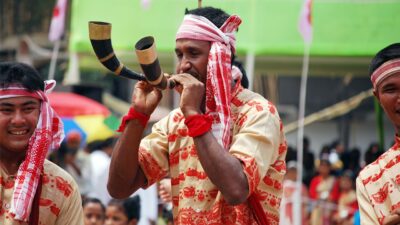
Overviewसिंगा भारत के पूर्वी आदिवासी अंचल का पुकार-वाद्य है — भैंस के मुड़े सींग या पीतल की 'S'-नली से बना एक प्राकृतिक शृंग, जो राग नहीं, बल्कि टेर, संकेत और सामूहिक आह्वान बजाता है। असम की बीहू और राभा अनुष्ठानों से लेकर झारखंड-संथाल की विवाह-बारात तक, इसकी गहरी, दूरगामी गूँज समुदाय की धड़कन बन जाती है; कभी यही टेर शिकार, पशु-चारण और शत्रु की चेतावनी का माध्यम भी थी।
अंग्रेज़ी में पढ़ें · Read in English
The singa is the summoning-instrument of eastern India's tribal heartland — a natural horn made from a curved buffalo horn or an 'S'-bent brass tube that sounds not a raga but a call, a signal, a collective summons. From Assam's Bihu and Rabha rituals to the wedding processions of the Jharkhand Santhals, its deep, far-carrying resonance becomes the pulse of the community; that same call was once also the medium of the hunt, of herding, and of warning against an approaching enemy.
वर्गीकरण
ClassificationNatya Shastra Category
सुषिर (Sushira - wind / aerophone instruments)
सिंगा नाट्यशास्त्र के 'सुषिर' (खोखले/वायु) वर्ग में आता है — जिसमें ध्वनि हवा के कंपन से उत्पन्न होती है। सिंगा एक 'प्राकृतिक शृंग' (natural horn) है जिसमें न कोई छिद्र होता है न रीड (कुछ रूपों में); ध्वनि केवल वादक के होंठों के कंपन (embouchure) से बनती है।
The singa belongs to the 'Sushira' (hollow / wind) category of the Natya Shastra, where sound is produced by vibrating air. It is a 'natural horn' — in its purest form it has neither finger-holes nor a reed; the tone is generated solely by the buzzing of the player's lips (embouchure) at the narrow end.
Western Category
Aerophone — natural horn / labrosone (lip-vibrated signal trumpet)
Western Family
Natural horn / bugle family (valveless, hole-less signalling horn, like the ancient war-horn or shofar in function)
Sub Classification
बनावट
PhysicalDescription Hindi
सिंगा एक सीधा-सा किन्तु सशक्त वायु वाद्य है, जो अक्सर भैंस के मुड़े हुए सींग से बनाया जाता है — इसीलिए इसका नाम 'सिंग' (सींग) से पड़ा। संकरे नुकीले सिरे से फूँका जाता है और चौड़े, फैले हुए मुँह से गूँजती, दूर तक जाने वाली ध्वनि निकलती है। झारखंड / संथाल क्षेत्र में यही वाद्य पीतल का बना, अंग्रेज़ी अक्षर 'S' के आकार में मुड़ा हुआ मिलता है; असम की राभा जनजाति में इसका बाँस का रूप भी प्रचलित है।
Description English
The singa is a simple yet powerful wind instrument, most often fashioned from the curved horn of a buffalo — which gives it its name from 'sing' (horn). It is blown at the narrow, pointed tip, and a resonant, far-carrying blast issues from the wide, flared mouth. In the Jharkhand / Santhal belt the same instrument appears made of brass, bent into the shape of the letter 'S'; among the Rabha tribe of Assam a bamboo form is also used.
Body
Curved / conical — a natural buffalo-horn curve, or an S-shaped bent brass tube
मुड़ा हुआ शंक्वाकार — प्राकृतिक भैंस-सींग की घुमाव, या 'S' आकार में मुड़ी पीतल की नली
Buffalo horn (Assam 'Mahor Singa'), brass (Jharkhand/Santhal), or bamboo (Rabha variant)
भैंस का सींग (असम का 'मोहर सिंगा'), पीतल (झारखंड / संथाल), या बाँस (राभा रूप)
30-90 (varies widely by material and region)
The natural hollow of the horn / conical bore itself acts as the resonating column; the flared bell projects the sound outward
Strings
None — the singa is a wind instrument with no strings
None
None — the singa itself functions almost as a single sustained drone-blast
Bow
लागू नहीं
Not applicable (no bow — it is blown)
Not applicable
0
Sound is produced by blowing, not bowing
Tuning Pegs
लागू नहीं
Not applicable
No tuning mechanism — the singa produces a small fixed set of natural harmonic pitches
Bridge
लागू नहीं
Not applicable
No bridge — sound resonates directly through the horn's bore
Not applicable
Frets
सिंगा में न फ्रेट होते हैं न छिद्र — यह अपने शुद्ध रूप में एक 'प्राकृतिक शृंग' है, जो केवल कुछ सीमित प्राकृतिक स्वर (harmonics) दे पाता है। वादक होंठों के दबाव को बदलकर ध्वनि की तीव्रता और स्वर को थोड़ा नियंत्रित करता है।
The singa has neither frets nor finger-holes — in its pure form it is a 'natural horn' capable of only a few natural harmonic pitches. The player alters lip pressure (embouchure) to control the loudness and the limited pitches available.
Construction Notes Hindi
पारंपरिक असमिया 'मोहर सिंगा' भैंस के सींग को उबालकर, अंदर से खोखला व साफ़ करके बनाया जाता है; कभी-कभी संकरे सिरे पर एक बाँस की नली (जिसे असमिया 'पेपा' में 'गर्भनोला' कहा जाता है) जोड़ी जाती है। संथाल-झारखंड का सिंगा पीतल की पतली चादर को 'S' आकार में मोड़कर व जोड़कर बनाया जाता है।
Construction Notes English
The traditional Assamese 'Mahor Singa' is made by boiling a buffalo horn, then hollowing and cleaning its interior; sometimes a bamboo insert-pipe (called 'garbhanola' in the related Assamese pepa) is fixed at the narrow end. The Santhal-Jharkhand singa is made by bending and joining thin brass sheet into the characteristic 'S' curve.
ध्वनि-चरित्र
SoundTonal Character Hindi
सिंगा की ध्वनि गहरी, गूँजती और भेदक होती है — एक लंबी, दूर तक जाने वाली टेर, जो जंगल, खेत और गाँव की सीमा पार कर जाती है। यह सुरीला वाद्य नहीं, बल्कि 'पुकार' का वाद्य है — इसकी आवाज़ में उत्सव का उल्लास और चेतावनी की गंभीरता दोनों समाई रहती हैं।
Tonal Character English
The singa's tone is deep, booming and penetrating — a long, far-travelling call that carries across forest, field and the edge of the village. It is not a melodic instrument but an instrument of 'summons' — its voice holds both festive jubilation and the gravity of a warning.
Timbre
Brassy, raw, resonant blast with a buzzing edge; rich in low harmonics
Range
Very limited — a handful of natural harmonic pitches (essentially one or two sustained blasts rather than a scale)
Dynamic Range
Loud to very loud — built for outdoor projection and long-distance signalling, not for soft indoor nuance
Techniques
सुनने का मार्गदर्शन
The Listening Guideसिंगा को सुनते समय धुन मत ढूँढिए — उसकी पुकार को महसूस कीजिए। एक लंबी फूँक हवा को चीरती हुई दूर तक जाती है; ढोल-तमक की ताल के साथ इसकी छोटी फूँकें उत्सव रच देती हैं। असम की बीहू और संथाल विवाह से शुरुआत कीजिए।
अंग्रेज़ी में पढ़ें · Read in English
When you listen to the singa, do not search for a raga or a tune — feel its call. Notice how a single long blast cuts through the air and travels far, and how its short bursts against the beat of dhol and tamak build a festival. Begin with recordings of Assam's Bihu and a Santhal wedding — that is where its true nature opens.
अन्य विवरण
More DetailsTimbre
Brassy, raw, resonant blast with a buzzing edge; rich in low harmonics
रोचक तथ्य
Margin Notesएक नाम, कई सींग — 'सिंगा' शब्द भारत भर में सींग से बने वाद्यों के लिए प्रयुक्त होता है — असमिया 'सिँगा/मोहर सिंगा', संथाल-झारखंड का पीतल का 'S'-सिंगा, और हिमालयी 'रणसिंगा' सभी एक ही शब्द-परिवार से हैं। यही 'शृंग' संस्कृत में सींग को कहते हैं।
The word 'singa' is used across India for horn-made instruments — the Assamese 'xinga/Mahor Singa', the brass 'S'-singa of the Santhal-Jharkhand belt, and the Himalayan 'ransingha' all share one word-family. 'Shringa' is the Sanskrit word for horn.
संथाल की चौकड़ी — सामान्य ज्ञान की परीक्षाओं में एक प्रसिद्ध प्रश्न है — 'तमक, सिंगा, झाँझ और बनम' किस समुदाय के वाद्य हैं? उत्तर: संथाल आदिवासी। सिंगा इस चौकड़ी का वायु-वाद्य है, जबकि तमक (नगाड़ा), झाँझ (मंजीरा) और बनम (तार-वाद्य) ताल व स्वर देते हैं।
A well-known general-knowledge question asks — 'Tamak, Singa, Jhanjh and Banam' are instruments of which community? Answer: the Santhal tribe. The singa is the wind instrument of this quartet, while the tamak (kettledrum), jhanjh (cymbals) and banam (a bowed string instrument) provide rhythm and tone.
घटती भैंसें, दुर्लभ सींग — असम में चरागाहों के सिकुड़ने और भैंसों की घटती संख्या के कारण अच्छा सींग मिलना कठिन होता जा रहा है — जिससे पारंपरिक मोहर सिंगा और पेपा बनाना दिन-प्रतिदिन दुर्लभ होता जा रहा है।
In Assam, shrinking pasture-lands and a declining buffalo population have made good horns increasingly hard to find — so making the traditional Mahor Singa and pepa grows rarer by the day.
बिना छिद्र, बिना राग — शुद्ध सिंगा में न कोई छिद्र होता है न रीड — इसलिए यह राग नहीं बजा सकता, केवल कुछ प्राकृतिक स्वर (harmonics) दे पाता है। इसकी शक्ति सुरीलेपन में नहीं, उसकी भेदक, दूरगामी पुकार में है।
The pure singa has neither finger-holes nor a reed — so it cannot play a raga, only a few natural harmonics. Its power lies not in melody but in its penetrating, far-reaching call.
सवाल-जवाब
Questions & Answersसिंगा क्या है?
सिंगा एक पारंपरिक भारतीय वायु वाद्य (सुषिर वाद्य) है, जो प्रायः भैंस के मुड़े हुए सींग या 'S'-आकार की पीतल की नली से बनाया जाता है। यह पूर्वी भारत — असम और झारखंड-संथाल क्षेत्र — का पुकार व संकेत-वाद्य है।
सिंगा कैसे बजाया जाता है?
सिंगा को उसके संकरे नुकीले सिरे से फूँका जाता है; ध्वनि दूसरे चौड़े, फैले हुए मुँह से निकलती है। इसमें कोई छिद्र या रीड नहीं होता (शुद्ध रूप में), इसलिए वादक अपने होंठों के कंपन से कुछ प्राकृतिक स्वर उत्पन्न करता है।
सिंगा किस समुदाय का वाद्य है?
सिंगा झारखंड के संथाल आदिवासियों का सबसे प्रिय वाद्य है — 'तमक, सिंगा, झाँझ और बनम' उनकी प्रसिद्ध वाद्य-मंडली है। असम में यह राभा जनजाति और बीहू परंपरा (मोहर सिंगा/पेपा) से जुड़ा है।
सिंगा का उपयोग किन अवसरों पर होता है?
सिंगा विवाह की बारात, बीहू व अन्य पर्वों, शिकार में जानवरों को हाँकने, पशु-चारण के संकेत, और दूरस्थ संचार (शत्रु की चेतावनी व ग्राम-सभा के आह्वान) में बजाया जाता है। संथाल विवाह की बारात इसकी गूँज के बिना अधूरी मानी जाती है।
क्या सिंगा पर राग बजाया जा सकता है?
नहीं। शुद्ध सिंगा में छिद्र या रीड नहीं होते, इसलिए यह केवल कुछ प्राकृतिक स्वर (harmonics) दे पाता है और राग नहीं बजा सकता। यह एक संकेत व उत्सव-वाद्य है, शास्त्रीय सुर-वाद्य नहीं।
नमूना-पट्टी
The Specimen Table| नाम | सिंगा · Singa |
|---|---|
| अन्य नाम | सिंगा · सिँগা / জিঙা (असमिया — Xinga / Singa) · मोहर सिंगा (Mahor Singa — भैंस के सींग का) · Singa (also: Xinga, Sing, Singha) · रणसिंगा / शृंग (संबंधित रूप — related cognates) |
| प्रकार | वाद्य · Instruments |
साझा कीजिए · Share this Plate