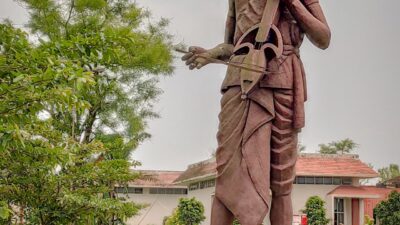
शास्त्र विंग · वाद्य-पट्टिका · Instrument Plate
सेरजा
Serja
अन्य नामसेरजा · चेरजा (असमिया लिप्यंतरण) · बेना (bena — बड़ो स्पाइक फ़िडल) · Serja (also: Serja Bina, Bena)
परिचय
Overviewसेरजा असम की बड़ो जनजाति का धनुष-सारंगी है — जंगल की गम्भारी या पवित्र सिजू लकड़ी से खोखला तराशकर, चमड़े की झिल्ली मढ़कर, बाँस की डाँड़ और मुगा-एरी रेशम के चार तारों से बना एक स्पाइक फ़िडल, जिसे सीधा खड़ा रखकर छोटे बाँस-गज़ से बजाया जाता है। बागुरुम्बा, बैसागु और डोमाशी की धुन इसी पर उठती है। यह ढके हुए 'बीन'/पुंगी से पूर्णतः भिन्न वाद्य है।
अंग्रेज़ी में पढ़ें · Read in English
The serja is the bowed fiddle of Assam's Bodo people — a spike fiddle hollowed from forest gambhari or sacred sijou wood, faced with a skin membrane, fitted with a bamboo neck and four muga-eri silk strings, and played upright with a short bamboo bow. The melodies of Bagurumba, Bwisagu and Domashi rise on it. It is an instrument wholly distinct from the covered 'been'/pungi.
वर्गीकरण
ClassificationNatya Shastra Category
तत (Tata — stringed instruments)
सेरजा तत वर्ग का एक धनुष-चालित वाद्य है — एक स्पाइक फ़िडल (कील-सारंगी) जिसमें ध्वनि गज़ (धनुष) के घर्षण से उत्पन्न होती है। यह ढके हुए 'बीन'/पुंगी से पूर्णतः भिन्न है; बीन एक सुषिर (फूँक) वाद्य है जबकि सेरजा तार-धनुष वाद्य है।
The serja belongs to the Tata (stringed) category — a bowed spike fiddle whose sound is produced by the friction of the gaz (bow) against silk strings. It is entirely distinct from the covered 'been'/pungi; the been is a wind (sushira) instrument, whereas the serja is a bowed chordophone.
Western Category
Bowed string instrument (spike fiddle)
Western Family
Fiddle / spike-fiddle family — related in construction to the sarinda, sarangi and Central/Southeast Asian membrane-covered spike fiddles; played upright rather than under the chin like the violin
Sub Classification
बनावट
PhysicalDescription Hindi
सेरजा एक हस्तनिर्मित बड़ो धनुष-वाद्य है जिसका गोलाकार अनुनाद-कक्ष एक ही लकड़ी के टुकड़े से खोखला तराशा जाता है और उस पर पशु-चर्म (बकरी की खाल) मढ़ी जाती है, जिससे इसे स्पाइक फ़िडल का चरित्र मिलता है। इसकी बाँस की डाँड़ (गर्दन) आगे की ओर मुड़ी होती है और इसमें चार तार होते हैं। इसे सारंगी की भाँति सीधा खड़ा रखकर, नीचे से ऊपर छोटे बाँस-गज़ से बजाया जाता है।
Description English
The serja is a handmade Bodo bowed instrument whose rounded resonator is hollowed from a single block of wood and covered with an animal-skin (goat) membrane, giving it the character of a spike fiddle. Its bamboo neck curves forward at the scroll and it carries four strings. Like the sarangi it is held upright against the body and bowed with a short bamboo bow, rather than tucked under the chin like a violin.
Body
Rounded, bowl-like resonator with a forward-bent scroll; overall silhouette described as resembling the human form
गोल कटोरीनुमा अनुनाद-कक्ष जिसका शीर्ष आगे झुका होता है; समग्र आकृति मानव-देह जैसी बताई जाती है
Solid wood — commonly Gambhari / gamari (Gmelina arborea) or the Bathou-sacred Sijou (Euphorbia); some makers use jackfruit or Alstonia (chatian) wood. The resonator face is covered with an animal-skin membrane.
ठोस लकड़ी — प्रायः गम्भारी/गमारी (Gmelina arborea) या बाथौ-धर्म में पवित्र सिजू (Euphorbia); कुछ कारीगर कटहल या छतियान (Alstonia) की लकड़ी लेते हैं। अनुनाद-कक्ष के मुख पर पशु-चर्म मढ़ा जाता है।
50-70 (approximate; hand-crafted, varies by maker)
Single hollowed wooden bowl with a stretched hide membrane that transmits and amplifies string vibration (membrane-resonated, unlike the sarangi's open f-hole box)
Strings
Four playing/melody strings; there are no separate banks of sympathetic strings as on the sarangi
The serja has no sympathetic (tarab) strings — its resonance comes from the skin membrane and wooden bowl, not resonating wires
One of the four strings may function as a sustaining drone against which the melody moves; there is no dedicated separate drone bank
Bow
गज़ (बाँस का धनुष)
Gaz (bamboo bow)
A short curved bamboo stick strung with horsehair or, traditionally, the fibre of the snake-plant (Sansevieria)
30-45
Drawn across the strings while the instrument stands upright; the player's fingers stop the strings directly on the fretless neck
Tuning Pegs
पुथि
Puthi
Four wooden tuning pegs (puthis) mounted in the scroll; rotated to adjust string tension and pitch
Bridge
घोड़ा (ghora)
Ghora (bridge)
A wooden bridge — locally called ghora ('horse') — that lifts the strings and transmits their vibration onto the skin membrane and wooden bowl
Wood
Frets
सेरजा फ्रेटलेस है — वादक बाँस की डाँड़ पर सीधे उँगलियाँ रखकर स्वर बनाता है, जिससे मीड जैसी सरकती, गाती हुई ध्वनि संभव होती है।
The serja is fretless — the player stops the strings directly on the bamboo neck with the fingers, enabling a sliding, vocal, meend-like glide between notes.
ध्वनि-चरित्र
SoundTonal Character Hindi
सेरजा की आवाज़ मिट्टी से जुड़ी, गूँजदार और गहरी होती है — चमड़े की झिल्ली उसे एक हल्की सी 'बज़' और उष्मा देती है। सीधे खड़े बजने के कारण इसकी ध्वनि गहरी और आत्मिक होती है, जो बड़ो लोकगीतों की सामूहिक भावना को स्वर देती है।
Tonal Character English
The serja's tone is earthy, resonant and deep — the skin membrane lends it a faint buzz and warmth. Played upright, it produces a low, soulful sound that voices the communal feeling of Bodo folk song.
Timbre
Warm, slightly buzzing, membrane-resonated fiddle tone; less nasal-bright than the sarangi, more rustic and reedy
Range
Roughly one to two octaves of folk melodic range; suited to song-accompaniment rather than wide classical elaboration
Dynamic Range
Moderate — an acoustic outdoor/celebration instrument designed to carry over dance and drums
Techniques
सुनने का मार्गदर्शन
The Listening Guideसेरजा को समझना हो तो पहले उसे अकेले सुनिए — बाँस-गज़ की सरकती मींड और चमड़े की झिल्ली की हल्की गूँज पकड़िए। फिर उसे खाम, सिफुंग और थारखा के साथ सुनिए, और देखिए कैसे यह पूरे बड़ो उत्सव की धुन थामे रहता है। बागुरुम्बा की धुन से शुरुआत सबसे अच्छी है।
अंग्रेज़ी में पढ़ें · Read in English
To understand the serja, first hear it alone — catch the sliding, singing meend of the bamboo bow and the soft buzz of the skin membrane. Then hear it within its family: how the serja holds the melody amid the thud of the kham, the breath of the sifung and the clack of the tharkha. Begin with a Bagurumba tune — that is where its flight opens up.
अन्य विवरण
More DetailsTimbre
Warm, slightly buzzing, membrane-resonated fiddle tone; less nasal-bright than the sarangi, more rustic and reedy
रोचक तथ्य
Margin Notesसेरजा का GI टैग — 31 मार्च 2024 को बड़ो सेरजा सहित बड़ो समुदाय के 13 पारंपरिक उत्पादों को भौगोलिक संकेत (GI) टैग मिला; बाद में अक्टूबर 2024 में और उत्पाद जोड़े गए, जिससे कुल संख्या 21 हो गई। यह मान्यता वाद्य के संरक्षण और बाज़ार-पहचान दोनों में सहायक है।
On 31 March 2024 the Bodo Serja, along with 13 traditional Bodo products, received a Geographical Indication (GI) tag; more were added in October 2024, taking the total to 21. The recognition helps both the preservation and the market identity of the instrument.
पवित्र सिजू और बाथौ धर्म — सेरजा बनाने में प्रयुक्त सिजू (यूफोर्बिया) बड़ो के बाथौ धर्म का केंद्रीय पवित्र पौधा है। इसलिए यह वाद्य केवल संगीत-उपकरण नहीं, बल्कि सांस्कृतिक-आध्यात्मिक वस्तु भी है।
The sijou (Euphorbia) used to build the serja is the central sacred plant of the Bodo Bathou faith. The instrument is therefore not merely a musical tool but a cultural-spiritual object.
मानव-देह जैसा वाद्य — सेरजा की बनावट मानव-आकृति जैसी बताई जाती है और इसके अंगों के नाम शरीर के अंगों पर आधारित होते हैं। इसे सीधा खड़ा रखकर बजाया जाता है — वायलिन की तरह ठोड़ी के नीचे नहीं।
The serja is described as human-form in shape, with its components named after body parts. It is held and played upright — not tucked under the chin like a violin.
खाम–सेरजा दल — बड़ो उत्सवों में सेरजा अकेले नहीं, बल्कि एक दल में बजता है: खाम (ढोल) ताल देता है, सिफुंग (बाँसुरी) और सेरजा धुन उठाते हैं, थारखा (बाँस की करताल) और जोथा (झाँझ) लय सजाते हैं — यही बागुरुम्बा और बैसागु की आवाज़ है।
At Bodo festivals the serja plays not alone but in an ensemble: the kham (drum) keeps time, the sifung (flute) and serja carry the melody, and the tharkha (bamboo clapper) and jotha (cymbals) ornament the rhythm — this is the sound of Bagurumba and Bwisagu.
सवाल-जवाब
Questions & Answersसेरजा क्या है?
सेरजा असम की बड़ो (बोरो) जनजाति का पारंपरिक धनुष-वाद्य (स्पाइक फ़िडल) है, जिसे 'बेना' भी कहते हैं। यह लकड़ी के गोल, चमड़ा-मढ़े अनुनाद-कक्ष, बाँस की डाँड़ और चार रेशमी तारों से बना होता है और सीधा खड़ा रखकर छोटे बाँस-गज़ से बजाया जाता है।
सेरजा और 'बीन' (पुंगी) में क्या अंतर है?
नाम मिलते-जुलते लगने पर भी दोनों पूरी तरह अलग हैं। बीन/पुंगी एक ढका हुआ फूँक-वाद्य (सुषिर) है जिसे सपेरे बजाते हैं, जबकि सेरजा एक तार-धनुष वाद्य (तत) है, जिसे गज़ से रगड़कर बजाया जाता है।
सेरजा किस उत्सव और नृत्य में बजता है?
सेरजा बागुरुम्बा (तितली नृत्य), बैसागु (बड़ो नववर्ष/वसंत उत्सव) और डोमाशी नृत्य, विवाह तथा बाथौ पूजा में सिफुंग, खाम, थारखा और जोथा के साथ बजता है।
सेरजा किस सामग्री से बनता है?
यह गम्भारी या पवित्र सिजू (कभी-कभी कटहल/छतियान) की लकड़ी से बनता है, इसकी डाँड़ बाँस की होती है, तार मुगा/एरी देशी रेशम के होते हैं, अनुनाद-कक्ष पर पशु-चर्म मढ़ा होता है, और गज़ की डोर घोड़े के बाल या साँप-पौधे के रेशे की होती है।
क्या सेरजा को कोई विशेष मान्यता मिली है?
हाँ। 31 मार्च 2024 को बड़ो सेरजा को भौगोलिक संकेत (GI) टैग मिला, बड़ो समुदाय के पारंपरिक उत्पादों के एक बड़े समूह के साथ, जिससे इसकी सांस्कृतिक पहचान और संरक्षण को बल मिला।
नमूना-पट्टी
The Specimen Table| नाम | सेरजा · Serja |
|---|---|
| अन्य नाम | सेरजा · चेरजा (असमिया लिप्यंतरण) · बेना (bena — बड़ो स्पाइक फ़िडल) · Serja (also: Serja Bina, Bena) |
| प्रकार | वाद्य · Instruments |
साझा कीजिए · Share this Plate