शास्त्र विंग · वाद्य-पट्टिका · Instrument Plate
पैन फ्लूट
Pan Flute
अन्य नामपैनपाइप्स · पैन बाँसुरी · नाय / नाई (रोमानियाई) · साइरिंक्स (यूनानी)
परिचय
Overviewपैन फ्लूट घटती लम्बाई की बंद-तल नलियों की एक पंक्ति है, जिसमें हर नली एक ही स्वर देती है और कलाकार सिर सरकाकर धुन बुनता है। न रीड, न छेद — केवल साँस, किनारा और गति। यूनानी देवता पैन से लेकर आंडीज़ के सीकू और रोमानिया के नाय तक फैली इस बाँसुरी की मुलायम, गूँजती आवाज़ को पश्चिमी सिनेमा ने एकांत का पर्याय बना दिया, और वहीं से यह विदेशी रंगत 1980-90 के दशक में कभी-कभार हिंदी फ़िल्म-अरेंजमेंट तक भी पहुँची।
अंग्रेज़ी में पढ़ें · Read in English
The pan flute is a row of stopped tubes of decreasing length, each giving a single note, the player weaving melody by sliding the head. No reed, no holes — only breath, edge, and motion. Spanning the Greek god Pan, the Andean siku, and the Romanian nai, this flute's soft, echoing voice was made a byword for solitude by Western cinema, and from there its exotic colour reached, occasionally, into Hindi film arrangements of the 1980s-90s.
वर्गीकरण
ClassificationNatya Shastra Category
सुषिर (Sushira - wind / hollow instruments)
नाट्यशास्त्र के वाद्य-वर्गीकरण में पैन फ्लूट 'सुषिर' (हवा से बजने वाले खोखले वाद्य) वर्ग में आती है, जैसे बाँसुरी और शहनाई। इसमें अनेक बंद-तल वाली नलियाँ पंक्तिबद्ध जुड़ी होती हैं और कलाकार नली के खुले सिरे पर हवा फूँककर स्वर उत्पन्न करता है। यह भारतीय मूल का वाद्य नहीं है, किंतु वर्गीकरण की दृष्टि से यह सुषिर परिवार का ही है।
In the Natya Shastra instrument taxonomy, the pan flute belongs to the 'Sushira' (hollow, wind-blown) category, alongside the bansuri and shehnai. It consists of several stopped (closed-bottom) tubes bound in a row; the player blows across the open top edge of each tube to sound a note. It is not an instrument of Indian origin, but by classification it belongs squarely to the Sushira wind family.
Western Category
Woodwind — edge-blown aerophone (rim-blown flute)
Western Family
Flute family; specifically a set of end-blown, stopped tubular flutes with one note per pipe and no finger holes
Hornbostel Sachs
421.112 — Sets of end-blown flutes (panpipes), tubes stopped at the lower end
Sub Classification
बनावट
PhysicalDescription Hindi
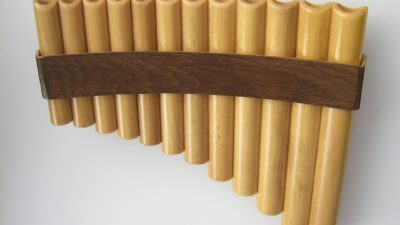
पैन फ्लूट अलग-अलग लम्बाई की अनेक नलियों (पाइपों) का एक गुच्छा है, जिन्हें घटती लम्बाई के क्रम में एक पंक्ति में बाँध दिया जाता है। हर नली का निचला सिरा बंद होता है और ऊपरी सिरा खुला — कलाकार खुले सिरे के किनारे पर हवा की धार फूँकता है। सबसे लम्बी नली सबसे नीचा (मंद्र) स्वर और सबसे छोटी नली सबसे ऊँचा (तार) स्वर देती है। इसमें कोई तार, रीड या छेद नहीं होते।
Description English
The pan flute is a bundle of several tubes (pipes) of differing lengths, bound in a row in order of decreasing length. Each pipe is stopped (closed) at the bottom and open at the top; the player directs a stream of air across the open edge. The longest pipe gives the lowest note and the shortest pipe the highest. It has no strings, no reed, and no finger holes.
Body
A raft or curved row of graduated tubes (straight in Andean styles, gently curved/arc-shaped in the Romanian nai)
क्रमबद्ध नलियों की एक सीधी बेड़ा-आकृति (आंडियन शैली) या हल्की घुमावदार चाप (रोमानियाई नाय)
Bamboo, giant cane/reed, or wood (traditional); modern concert instruments use maple, ebony, resin, or metal
बाँस, नरकट/बेंत या लकड़ी (परंपरागत); आधुनिक कॉन्सर्ट वाद्य में मेपल, आबनूस, रेज़िन या धातु
Andean siku/zampoña: 6-17; Romanian concert nai: 20-25 (up to ~30)
Individual pipes range from about 5 cm (highest) to 60 cm (lowest); assembled instrument roughly 15-40 cm across
Each stopped pipe is a closed cylindrical resonator; its length sets the fundamental pitch (a stopped pipe sounds roughly an octave lower than an open pipe of the same length)
Pipes
Typically 6-25 depending on tradition and model
Single-note tubes tuned by length; a stopper (wax, cork, or wooden plug) at the base fine-tunes each pitch
हर नली एक ही स्वर देती है और उसकी लम्बाई से स्वर तय होता है; तल पर लगा प्लग (मोम, कॉर्क या लकड़ी) सूक्ष्म ट्यूनिंग करता है।
Diatonic in most folk instruments; the Romanian nai and modern chromatic pan flutes add pipes/tilting to reach semitones
अधिकांश लोक-वाद्य शुद्ध (डायटॉनिक) स्वरों में; रोमानियाई नाय और आधुनिक क्रोमैटिक पैन फ्लूट अतिरिक्त नलियों या झुकाव से अर्धस्वर देते हैं
Mouth Edge
फूँक-किनारा
Blowing edge (labium)
नली का खुला ऊपरी किनारा, जिस पर तिरछी हवा की धार टकराकर स्वर बनाती है — ठीक वैसे ही जैसे बोतल के मुँह पर फूँकने से आवाज़ बनती है।
The open upper rim of each tube; an angled stream of breath strikes this edge to set the air column vibrating — the same principle as blowing across a bottle's mouth.
Reed
पैन फ्लूट में कोई रीड (जीभी) नहीं होती — ध्वनि केवल किनारे पर हवा की धार के विभाजन से बनती है (एज-टोन)।
The pan flute has no reed — sound arises purely from the air jet splitting at the pipe's edge (an edge-tone), like all flutes.
Frets
इसमें न फ्रेट होते हैं न स्वर-छिद्र। हर स्वर के लिए एक अलग नली है; अर्धस्वर वाद्य को झुकाकर या ठोड़ी/होंठ की स्थिति बदलकर निकाले जाते हैं।
There are neither frets nor finger holes. Each note has its own pipe; semitones are obtained by tilting the instrument or altering jaw/lip position.
ध्वनि-चरित्र
SoundTonal Character Hindi
पैन फ्लूट की आवाज़ मुलायम, हवादार और सीटी-सी गोल होती है — साँस की हल्की झिलमिलाहट के साथ। इसका स्वर एकांत, पहाड़ी और स्वप्निल भाव जगाता है; यही 'गूँजती हुई घाटी' वाली रहस्यमयी रंगत इसे फ़िल्म-संगीत में विदेशी, विशिष्ट छटा देने के काम आती है।
Tonal Character English
The pan flute's tone is soft, breathy, and rounded like a whistle, with a gentle shimmer of air in it. Its voice evokes solitude, mountains, and reverie; this misty 'echoing valley' quality is exactly what made it useful in film music as an exotic, distinctive colour.
Timbre
Pure, airy, hollow-whistle tone with a characteristic breath-noise onset; fuller and warmer in the low pipes, bright and piercing in the high pipes
Range
About 2 octaves on a folk siku; up to roughly 3 octaves on a 22-25 pipe Romanian concert nai
Dynamic Range
Moderate — expressive from a whispering pianissimo to a bright forte, though it does not project as loudly as brass or reed instruments without amplification
Techniques
सुनने का मार्गदर्शन
The Listening Guideपैन फ्लूट का रस लेना हो तो पहले कोई धीमी, एकल धुन चुनिए और हर स्वर के साथ आती साँस की झिलमिलाहट पर कान लगाइए — इसी में वाद्य की आत्मा है। फिर वाइब्रेटो को पकड़िए, जो स्वर को गाता हुआ बना देता है। अंत में किसी तेज़ आंडियन धुन में सिर के संचालन की फुर्ती को महसूस कीजिए।
अंग्रेज़ी में पढ़ें · Read in English
To understand the pan flute, first hear a slow solo melody — notice how each note carries a faint shimmer of breath, and how vibrato makes the tone 'sing'. Then feel the head movement: in fast tunes the player sweeps the lips across the pipes with lightning agility. Compare Gheorghe Zamfir's romantic style with the collective, dance-like style of Andean ensembles.
परिचय
Identity- Year Of Origin
- -2000
वर्गीकरण
ClassificationHornbostel Sachs
421.112 — Sets of end-blown flutes (panpipes), tubes stopped at the lower end
अन्य विवरण
More DetailsTimbre
Pure, airy, hollow-whistle tone with a characteristic breath-noise onset; fuller and warmer in the low pipes, bright and piercing in the high pipes
रोचक तथ्य
Margin Notesएक नली, एक स्वर — अधिकांश बाँसुरियों में छेद दबाकर स्वर बदले जाते हैं, पर पैन फ्लूट में हर स्वर की अपनी अलग बंद-तल नली होती है। इसीलिए तेज़ धुनें बजाना सिर की चपलता की परीक्षा है।
Most flutes change pitch by covering finger holes, but on the pan flute every note has its own separate stopped pipe. That is why fast tunes are a test of the head's agility.
अर्धस्वर के लिए झुकाव — शुद्ध-स्वरी लोक-पैन फ्लूट पर बीच के अर्धस्वर पाने के लिए कलाकार वाद्य को अपनी ओर झुका लेता है, जिससे नली का स्वर आधा सुर नीचे आ जाता है — रोमानियाई नाय-वादकों की खास कारीगरी।
On a diatonic folk pan flute, to reach in-between semitones the player tilts the instrument toward the face, dropping a pipe's pitch by up to a semitone — a special craft of Romanian nai players.
फ़िल्मों में एकांत की आवाज़ — पश्चिमी सिनेमा में पैन फ्लूट प्रायः एकांत, स्मृति और खुले भूदृश्य का संकेत बन जाती है; एन्नियो मॉरिकोने ने 'वन्स अपॉन अ टाइम इन अमेरिका' (1984) जैसे स्कोर में इसकी गूँजती रंगत का उपयोग किया।
In Western cinema the pan flute often becomes a signal of solitude, memory, and open landscape; Ennio Morricone drew on its echoing colour in scores such as 'Once Upon a Time in America' (1984).
बाँसुरी की चचेरी बहन — पैन फ्लूट और भारतीय बाँसुरी दोनों 'एज-टोन' सिद्धांत पर बजती हैं — हवा की धार किनारे पर टकराकर स्वर बनाती है। अंतर यह है कि बाँसुरी में एक नली और कई छेद होते हैं, जबकि पैन फ्लूट में कई नलियाँ और कोई छेद नहीं।
Both the pan flute and the Indian bansuri sound on the 'edge-tone' principle — an air stream striking an edge to make a note. The difference is that the bansuri has one tube with many holes, while the pan flute has many tubes and no holes.
सवाल-जवाब
Questions & Answersपैन फ्लूट क्या है?
पैन फ्लूट (पैनपाइप्स) घटती लम्बाई की अनेक बंद-तल नलियों का एक गुच्छा है, जिसमें हर नली एक ही स्वर देती है। इसमें न रीड होती है न छेद; कलाकार नली के खुले किनारे पर हवा फूँककर और सिर सरकाकर धुन बजाता है।
पैन फ्लूट पर अलग-अलग स्वर कैसे बजते हैं?
हर स्वर की अपनी अलग नली होती है — लम्बी नली नीचा स्वर, छोटी नली ऊँचा स्वर देती है। कलाकार सिर या वाद्य को दायें-बायें सरकाकर सही नली तक पहुँचता है, और अर्धस्वर के लिए वाद्य को झुका लेता है।
क्या पैन फ्लूट भारतीय वाद्य है?
नहीं। पैन फ्लूट भारतीय मूल का वाद्य नहीं है — इसकी जड़ें प्राचीन यूनान, दक्षिण अमेरिका (आंडीज़) और रोमानिया-पूर्वी यूरोप में हैं। हिंदी फ़िल्म-संगीत में इसे 1980-90 के दशक में कभी-कभार विदेशी, हवादार रंगत के लिए इस्तेमाल किया गया।
पैन फ्लूट का सबसे प्रसिद्ध वादक कौन है?
रोमानिया के घेओर्घे ज़ाम्फ़िर को 'पैन फ्लूट का उस्ताद' कहा जाता है। उनकी धुन 'द लोनली शेफर्ड' और फ़िल्म-स्कोर सहभागिताओं ने इस वाद्य को विश्व भर में लोकप्रिय बनाया।
पैन फ्लूट और बाँसुरी में क्या फ़र्क है?
दोनों एज-टोन (किनारे पर हवा) से बजती हैं, पर बाँसुरी में एक ही नली और कई छेद होते हैं जिनसे स्वर बदलते हैं, जबकि पैन फ्लूट में हर स्वर की अलग नली होती है और कोई छेद नहीं। इसीलिए बाँसुरी मींड में और पैन फ्लूट हवादार टिम्बर में श्रेष्ठ है।
नमूना-पट्टी
The Specimen Table| नाम | पैन फ्लूट · Pan Flute |
|---|---|
| अन्य नाम | पैनपाइप्स · पैन बाँसुरी · नाय / नाई (रोमानियाई) · साइरिंक्स (यूनानी) · सीकू / ज़म्पोन्या (आंडियन) · Panpipes |
| उद्गम | -2000 |
| प्रकार | वाद्य · Instruments |
साझा कीजिए · Share this Plate