शास्त्र विंग · वाद्य-पट्टिका · Instrument Plate
रुद्र वीणा
Rudra Veena
अन्य नामबीन · रुद्र वीणा (Rudra Vina) · Bin · Been (dhrupad veena — snake-charmer 'been/pungi' से भिन्न)
परिचय
Overviewरुद्र वीणा, यानी 'बीन', भारतीय शास्त्रीय संगीत की ध्रुपद परंपरा का शिखर-वाद्य है — दो बड़े तूँबों पर टिका एक लंबा दंड, ऊँचे धातु के पर्दे और गहरी बास ध्वनि, जिसमें कोई तरब तार नहीं होता। शिव से जुड़ी पौराणिक उत्पत्ति, मुगल दरबार की विरासत और बीनकार घरानों की जीवित कड़ी इसे एक पवित्र, राजसी आभा देती है। असद अली ख़ान और ज़िया मोहिउद्दीन डागर जैसे साधकों ने इस दुर्लभ, संकटग्रस्त कला को 21वीं सदी तक जीवित रखा।
अंग्रेज़ी में पढ़ें · Read in English
The Rudra Veena, or 'Bin', is the pinnacle instrument of dhrupad in Indian classical music — a long stem slung over two large gourds, with tall metal frets, a deep bass voice and no sympathetic strings. Its mythic origin in Shiva, its Mughal-court heritage and its living line of beenkar gharanas give it a sacred, regal aura. Masters such as Asad Ali Khan and Zia Mohiuddin Dagar kept this rare, endangered art alive into the 21st century.
वर्गीकरण
ClassificationNatya Shastra Category
तत (Tata - stringed instruments)
तत वर्ग में रुद्र वीणा एक 'दंड-वीणा' (छड़-ज़िदर / stick-zither) है — एक लंबे बेलनाकार दंड पर तार खिंचे रहते हैं और नीचे दो बड़े तूँबे (लौकी के अनुनादक) लगे होते हैं। ध्वनि तारों को मिज़राब से झंकृत करके उत्पन्न होती है। यह सारंगी जैसे धनुष-वाद्य से भिन्न 'झंकृत' (plucked) वाद्य है।
In the Tata (stringed) category, the Rudra Veena is a 'stick-zither' (danda-veena) — strings run along a long tubular stem with two large gourd resonators (tumba) fixed beneath it. Sound is produced by plucking the strings with wire plectrums (mizrab). Unlike the bowed sarangi, it is a plucked instrument.
Western Category
Plucked stick/tube zither
Western Family
Zither family (fretted stick-zither with twin gourd resonators; distinct from the lute-family sitar and from the bowed sarangi)
Sub Classification
बनावट
PhysicalDescription Hindi
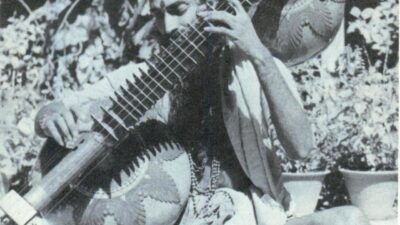
रुद्र वीणा एक भव्य, बड़ा वाद्य है जिसमें एक लंबा खोखला बेलनाकार दंड (लगभग 90–100 सेमी) होता है, जिस पर ऊँचे धातु के पर्दे मोम से जड़े रहते हैं। दंड के दोनों सिरों के नीचे दो बड़े गोल तूँबे (सूखी लौकी के अनुनादक) लगे रहते हैं, जो गहरी बास ध्वनि को गूँजाते हैं। वादक इसे तिरछा पकड़ता है — एक तूँबा बाएँ कंधे पर और दूसरा दाहिनी जाँघ/घुटने पर टिका रहता है।
Description English
The Rudra Veena is a large, majestic instrument with a long hollow tubular stem (about 90–100 cm) bearing tall metal frets fixed in place with wax. Two large round gourd resonators (dried-gourd tumbas) are attached beneath either end of the stem, amplifying its deep bass tone. The player holds it diagonally — one gourd rests on the left shoulder and the other on the right thigh/knee.
Body
Long straight tubular stem (dandi) with two large hemispherical gourds slung below
लंबा सीधा बेलनाकार दंड (डाँड़) जिसके नीचे दो बड़े अर्धगोल तूँबे
Stem traditionally of tun/teak wood or thick bamboo; resonators of dried bottle-gourd (later fibreglass/wood in modern builds)
दंड परंपरागत रूप से तून/सागवान की लकड़ी या मोटे बाँस का; तूँबे सूखी लौकी के (आधुनिक निर्माण में कभी-कभी फ़ाइबरग्लास या लकड़ी के)
Stem length approx. 90-120; each gourd approx. 35-45 cm diameter
Two separate gourd resonators (tumba) providing deep, sustained bass resonance
Strings
Primary playing strings (melody strings) running over the high frets along the stem
The classic Rudra Veena has NO sympathetic (tarab) strings — this distinguishes it from the sitar, sarod and sarangi. Its resonance comes from the twin gourds and long sustain, not sympathetic shimmer.
Side drone/rhythm strings (chikari) plucked to sound the tonic and mark laya, running along the side of the stem
Bow
मिज़राब (कोई धनुष नहीं)
Mizrab (no bow — plucked, not bowed)
Wire plectrums worn on the right-hand fingers
N/A
Strings are plucked with wire plectrums (mizrab) on the index and middle fingers; the Rudra Veena is NOT a bowed instrument
Tuning Pegs
खूँटी / कील
Khunti (tuning pegs)
Large wooden tuning pegs set into the ends of the stem to tension the main and drone strings
Bridge
जवारी (घोड़ी)
Jawari (bridge)
A broad, flat-topped bridge whose curved surface gives the strings their characteristic buzzing, sustaining 'jawari' timbre
Wood or bone/deer-horn, sometimes with a wide arched crown
Frets
रुद्र वीणा में लगभग 24 ऊँचे धातु के पर्दे होते हैं जो मोम से दंड पर जड़े रहते हैं। पर्दे बहुत ऊँचे होने से वादक तार को बगल में खींचकर विस्तृत मींड (एक ही पर्दे से कई सुर तक) निकाल सकता है — जो ध्रुपद के गहरे आलाप की आत्मा है।
The Rudra Veena has about 24 tall metal frets fixed to the stem with wax. Because the frets are very high, the player can pull a string sideways to produce wide meend (spanning several notes from a single fret) — the very soul of dhrupad's deep alap.
ध्वनि-चरित्र
SoundTonal Character Hindi
रुद्र वीणा की ध्वनि गंभीर, गहरी और ध्यानमग्न है — मानो पृथ्वी के भीतर से उठता कोई नाद। इसका बास स्वर, लंबा सस्टेन और जवारी की गूँज मिलकर एक ऐसा वातावरण रचते हैं जो आलाप और ध्रुपद की धीमी, चिंतनशील गति के लिए आदर्श है।
Tonal Character English
The Rudra Veena's tone is grave, deep and meditative — like a primordial sound rising from within the earth. Its bass voice, long sustain and buzzing jawari together create an atmosphere ideal for the slow, contemplative pace of alap and dhrupad.
Timbre
Deep, sonorous, gently buzzing (from the jawari bridge); rich in low overtones with an unusually long sustain
Range
Deep bass — roughly an octave below the sitar; spans about two-and-a-half to three octaves in skilled hands
Dynamic Range
Naturally soft and intimate; historically un-amplified, favouring close, meditative listening rather than large projection
Techniques
सुनने का मार्गदर्शन
The Listening Guideरुद्र वीणा को सुनने के लिए धैर्य और शांति चाहिए। किसी असद अली ख़ान या ज़िया मोहिउद्दीन डागर के आलाप से शुरुआत कीजिए — बिना ताल के, एक-एक सुर धीरे-धीरे खुलता है। मींड को सुनिए: कैसे एक ही तार खिंचकर कई सुरों की यात्रा करता है। जल्दी मत कीजिए; बीन का सौंदर्य गहराई और ठहराव में है।
अंग्रेज़ी में पढ़ें · Read in English
Listening to the Rudra Veena asks for patience and stillness. Begin with an alap by Asad Ali Khan or Zia Mohiuddin Dagar — without rhythm, note by note, the raga slowly opens. Follow the meend: how a single pulled string journeys across several notes. Do not hurry; the Bin's beauty lies not in speed but in depth and repose. As rhythm arrives in jod and jhala, feel the flow of energy build.
परिचय
Identity- Year Of Origin
- 1500
अन्य विवरण
More DetailsTimbre
Deep, sonorous, gently buzzing (from the jawari bridge); rich in low overtones with an unusually long sustain
रोचक तथ्य
Margin Notesवाद्यों का राजा — ध्रुपद परंपरा में रुद्र वीणा को 'वाद्यों का राजा' कहा जाता था। इसे बजाना अत्यंत प्रतिष्ठित माना जाता था और बीनकारों को दरबार में विशेष सम्मान प्राप्त था। सितार की तुलना में इसकी गूँज एक सप्तक नीची और कहीं अधिक गंभीर होती है।
In the dhrupad tradition the Rudra Veena was called the 'king of instruments'. Playing it was considered highly prestigious and beenkars enjoyed special honour at court. Its resonance is a full octave below the sitar and far graver.
नौबत ख़ान का मुगल चित्र — मुगल काल का प्रसिद्ध चित्र 'नौबत ख़ान रुद्र वीणा बजाते हुए' इस वाद्य की दरबारी प्रतिष्ठा का प्रमाण है। नौबत ख़ान तानसेन के दामाद थे और अकबर के दरबार के प्रमुख बीनकार माने जाते हैं।
The famous Mughal-era painting 'The Musician Naubat Khan playing a Rudra Vina' testifies to the instrument's courtly prestige. Naubat Khan was Tansen's son-in-law and a leading beenkar of Akbar's court.
सुरबहार — बीन का विकल्प — 19वीं सदी में बीन की कठिनता और घटती परंपरा के कारण 'सुरबहार' (बास सितार) विकसित हुआ, ताकि सितारवादक भी बीन जैसी गंभीर आलाप-शैली बजा सकें। इस तरह सुरबहार अप्रत्यक्ष रूप से रुद्र वीणा की विरासत को आगे ले गया।
In the 19th century, because of the Bin's difficulty and declining lineage, the 'surbahar' (bass sitar) was developed so that sitarists too could play a grave, veena-like alap style. In this way the surbahar indirectly carried forward the Rudra Veena's legacy.
दो घराने, दो शैलियाँ — आधुनिक रुद्र वीणा वादन मुख्यतः दो शैलियों में बँटा है — डागरबानी (ज़िया मोहिउद्दीन डागर एवं बहाउद्दीन डागर द्वारा, धीमे-ध्यानमय आलाप पर केंद्रित) और खंडारबानी (असद अली ख़ान द्वारा, गमक और शक्ति पर केंद्रित)।
Modern Rudra Veena playing is divided mainly into two styles — Dagarbani (of Zia Mohiuddin Dagar and Bahauddin Dagar, focused on slow meditative alap) and Khandarbani (of Asad Ali Khan, focused on gamak and power).
सवाल-जवाब
Questions & Answersरुद्र वीणा क्या है?
रुद्र वीणा (बीन) एक प्राचीन उत्तर भारतीय तंत्री-वाद्य है — एक लंबे बेलनाकार दंड पर ऊँचे पर्दे और नीचे दो बड़े तूँबे लगे होते हैं। यह ध्रुपद परंपरा का सर्वोच्च वाद्य है, जिसे मिज़राब से झंकृत करके एकल आलाप के लिए बजाया जाता है।
रुद्र वीणा और सपेरों की बीन में क्या अंतर है?
दोनों बिलकुल अलग वाद्य हैं। रुद्र वीणा एक तत (तंत्री) वाद्य है जिसे तारों को झंकृत करके बजाया जाता है, जबकि सपेरों की 'बीन/पुंगी' एक सुषिर (फूँक) वाद्य है। केवल नाम की समानता से भ्रम होता है।
रुद्र वीणा में कितने तार होते हैं?
पारंपरिक रुद्र वीणा में आमतौर पर 4 मुख्य वादन तार और 2-3 चिकारी (ड्रोन) तार होते हैं। अधिकांश अन्य भारतीय तंत्री-वाद्यों के विपरीत, इसमें कोई तरब (अनुनाद) तार नहीं होता।
रुद्र वीणा के सबसे प्रसिद्ध वादक कौन हैं?
आधुनिक युग के सबसे प्रसिद्ध बीनकार उस्ताद असद अली ख़ान (खंडारबानी शैली) और उस्ताद ज़िया मोहिउद्दीन डागर (डागरबानी शैली) हैं। आज बहाउद्दीन डागर और कार्स्टन विके जैसे शिष्य इस परंपरा को आगे बढ़ा रहे हैं।
रुद्र वीणा का उपयोग किस संगीत में होता है?
रुद्र वीणा मुख्यतः हिंदुस्तानी शास्त्रीय संगीत की ध्रुपद शैली में एकल वाद्य के रूप में बजाई जाती है — विशेषकर धीमे, गंभीर आलाप के लिए। यह फ़िल्मी या लोक-संगीत का वाद्य नहीं है और आज एक दुर्लभ, संकटग्रस्त कला है।
नमूना-पट्टी
The Specimen Table| नाम | रुद्र वीणा · Rudra Veena |
|---|---|
| अन्य नाम | बीन · रुद्र वीणा (Rudra Vina) · Bin · Been (dhrupad veena — snake-charmer 'been/pungi' से भिन्न) |
| उद्गम | 1500 |
| प्रकार | वाद्य · Instruments |
साझा कीजिए · Share this Plate