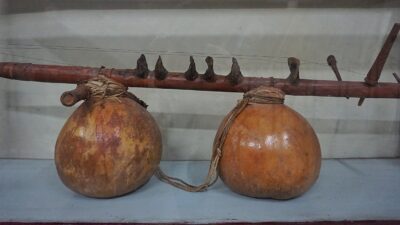
शास्त्र विंग · वाद्य-पट्टिका · Instrument Plate
जंतर
Jantar
अन्य नामजंतर · जन्तर · Jantar (Rajasthani stick zither) · जंतर वीणा
परिचय
Overviewजंतर राजस्थान का दुर्लभ दंड-वीणा वाद्य है जिसके दोनों सिरों पर बँधे दो तूंबे उसे हर दूसरे तंत्री-वाद्य से अलग करते हैं। बाँस के डांड पर मोम से जमे लगभग बारह लकड़ी के परदे, इस्पात के चार-छह तार और खुला द्रोन इसकी देह हैं; पर इसकी आत्मा है देवनारायण की फड़ के आगे खड़े गूजर भोपा की पुकार, जिसके नीचे यह रात-भर एक अटूट नाद रचता है। विद्वान इसे वीणा का आदिम रूप मानते हैं।
अंग्रेज़ी में पढ़ें · Read in English
The jantar is Rajasthan's rare stick-veena, set apart from every other stringed instrument by the two gourds lashed at its ends. About a dozen wooden frets waxed onto a bamboo rod, four to six steel strings and an open drone form its body; but its soul is the cry of the Gujar Bhopa standing before Devnarayan's phad, beneath which it weaves an unbroken sound through the night. Scholars regard it as an early form of the veena.
वर्गीकरण
ClassificationNatya Shastra Category
तत (Tata - stringed instruments)
नाट्यशास्त्र की 'तत' (तंत्री) श्रेणी में जंतर एक दंड-वीणा (स्टिक-ज़िदर) है, जो तारों को उँगली या मिज़राब से झंकृत कर ध्वनि उत्पन्न करती है। इसे प्रायः वीणा का आदिम/प्रारंभिक रूप माना जाता है।
In the Tata (stringed) category of the Natya Shastra, the jantar is a stick-zither (dand-veena) that produces sound by plucking its strings with the finger or a plectrum. It is often regarded as an early, ancestral form of the veena.
Western Category
Plucked chordophone — fretted stick zither
Western Family
Tube/stick zither family (a fretted plucked lute-zither with twin gourd resonators, structurally akin to the rudra veena and the West African/South Asian gourd-stick zithers)
Sub Classification
बनावट
PhysicalDescription Hindi
जंतर एक दंड-वीणा है जिसमें एक लंबे खोखले बाँस या लकड़ी के दंड (जिसे 'डांड' या 'नाल' कहते हैं) के दोनों सिरों पर दो बड़े तूंबे (लौकी/सूखी तुम्बी के अनुनादक) जुड़े होते हैं। दंड के मध्य भाग पर उभरे हुए लकड़ी के परदे (फ्रेट) मोम से जमाए जाते हैं, जिन पर उँगलियाँ दबाकर स्वर निकाले जाते हैं। रूप में यह वीणा से बहुत मिलता-जुलता है।
Description English
The jantar is a stick-zither built on a long hollow bamboo or wooden rod (called the 'daand' or 'nal') to which two large gourd resonators (tumba) are fixed at the two ends. Raised wooden frets, set into the middle of the rod with wax, are pressed by the fingers to sound the notes. In form it closely resembles a veena.
Body
Long straight tubular rod (daand/nal) with a large gourd resonator lashed at each end
लंबा सीधा नलाकार दंड (डांड/नाल) जिसके दोनों छोर पर एक-एक बड़ा तूंबा बँधा होता है
Hollow bamboo or wood for the rod; dried bottle-gourd (lauki/tumba) for the two resonators; strung with steel wire and horsehair fittings
दंड के लिए खोखला बाँस या लकड़ी; अनुनादकों के लिए सूखी लौकी (तूंबा); तार इस्पात (स्टील) के तथा कुछ जोड़ घोड़े के बाल (होर्सहेयर) के
90-110 (approximate length of the rod)
Two gourd (tumba) resonators — one at each end of the rod — which amplify and project the plucked tone; unlike most veenas which carry a single main resonator
Strings
Metal (steel) playing/drone strings running the length of the daand, tuned via wooden pegs
The jantar traditionally has no separate bank of sympathetic (tarab) strings; its resonance comes from the twin gourds and the open drone strings rather than sympathetic wires
One or two of the metal strings are kept as open drones, sounded between sung phrases to sustain the tonic during epic recitation
Bow
—
Not bowed — plucked
The Devnarayan jantar is a plucked instrument: sounded with the fingers or a small plectrum/mizraab, not a bow. (Some regional survey notes describe bowed variants, but the Bhopa's Devnarayan jantar is plucked.)
—
Plucked with the index finger or a wire/horn plectrum while the frets are stopped with the other hand
Tuning Pegs
खूँटी
Khunti
Wooden tuning pegs set into the rod that tension and tune each metal string by direct rotation
Bridge
घुड़च / पुल
Ghudach / Pul
A main bridge (and often a small auxiliary bridge) that carries the strings and transmits their vibration into the gourd resonators
Wood, sometimes with bone or horn insert
Frets
जंतर सपरदा (फ्रेटयुक्त) वाद्य है — दंड के मध्य पर लगभग बारह उभरे हुए लकड़ी के परदे मोम से जमाए जाते हैं। कलाकार इन परदों पर उँगली दबाकर स्थिर स्वर निकालता है। परदों की संख्या क्षेत्र और बनावट के अनुसार बदल सकती है।
The jantar is a fretted instrument — roughly twelve raised wooden frets are fixed onto the middle of the rod with wax. The player stops the string against these frets to produce fixed pitches. The number of frets can vary by region and maker.
ध्वनि-चरित्र
SoundTonal Character Hindi
जंतर की ध्वनि खुली, गूँजती और थोड़ी रूखी-लोक रंग की होती है — दो तूंबों की अनुगूँज उसे एक भरा-पूरा, ज़मीनी नाद देती है। यह मधुर-कोमल संगत का वाद्य नहीं, बल्कि गाथा-गायन का साथी है: तेज़ झंकार, खुला द्रोन और लय का सहारा। भोपा के ऊँचे, पुकारते स्वर के नीचे यह निरंतर बजता एक आधार-मंच रचता है।
Tonal Character English
The jantar's tone is open, resonant and slightly rustic — the twin gourds give it a full, earthy voice. It is not an instrument of soft melodic filigree but a companion to epic singing: bright plucked attack, an open drone, and rhythmic support. Under the Bhopa's high, declamatory voice it lays down a continuous sounding platform.
Timbre
Bright, buzzing, gourd-amplified resonance with a strong sustaining drone
Range
Modest — a folk melodic compass of about one to one-and-a-half octaves around the tonic, sufficient for the modal tunes of the epic
Dynamic Range
Moderate to loud — built to carry a night-long open-air recitation before a village audience without amplification
Techniques
सुनने का मार्गदर्शन
The Listening Guideजंतर को उसकी कथा के साथ सुनिए। किसी देवनारायण फड़-वाचन को खोजिए, जहाँ भोपा खड़े होकर गाता है और नीचे जंतर लगातार बजता है। हर पंक्ति के बाद जंतर कैसे धुन दोहराता है और खुला द्रोन कैसे रात-भर सा टिकाए रखता है — इसी में इस वाद्य का रस है।
अंग्रेज़ी में पढ़ें · Read in English
The right way to hear the jantar is to hear it with its story. Find a performance of a Devnarayan phad recitation, where the Bhopa sings standing and the jantar rings continuously beneath his voice. Notice how, after each sung line, the jantar 'answers' by echoing the tune, and how the open drone holds the tonic through the whole night. It is an instrument not of solo virtuosity but of narrative rasa.
अन्य विवरण
More DetailsTimbre
Bright, buzzing, gourd-amplified resonance with a strong sustaining drone
रोचक तथ्य
Margin Notesदो तूंबों वाली अनोखी वीणा — जंतर की सबसे विशिष्ट पहचान उसके दो तूंबे हैं, जो दंड के दोनों छोर पर बँधे रहते हैं और ध्वनि को दोगुना गूँजाते हैं। रुद्र वीणा में भी दो तूंबे होते हैं, इसीलिए जंतर को उसका लोक-रिश्तेदार माना जाता है।
The jantar's most distinctive feature is its two gourds, lashed to the ends of the rod, which double its resonance. The rudra veena too carries two gourds, which is why the jantar is regarded as its folk relative.
फड़, भोपा और जंतर की त्रयी — राजस्थान की फड़-परंपरा एक अनूठी 'चलती-फिरती मंदिर' कला है — लंबे कपड़े पर देवता की सम्पूर्ण गाथा चित्रित होती है, भोपा उसके आगे खड़ा होकर गाता है, और जंतर उस गायन का साथ देता है। तीनों मिलकर ही अनुष्ठान पूरा होता है।
Rajasthan's phad tradition is a unique 'portable temple' art — a deity's entire legend is painted on a long cloth, the Bhopa sings standing before it, and the jantar accompanies the singing. Only the three together complete the ritual.
बागड़ावत — गूजरों की महागाथा — देवनारायण की फड़ के साथ जो बागड़ावत गाथा गाई जाती है, वह हज़ारों पंक्तियों की एक विशाल वीर-कथा है। इतनी लंबी कथा को कंठस्थ रखकर रात-भर गाना और साथ में जंतर बजाना — यह गूजर भोपा की स्मृति और साधना दोनों की परीक्षा है।
The Bagadawat cycle sung with Devnarayan's phad is a vast heroic saga of thousands of lines. To hold so long a tale in memory and sing it through the night while playing the jantar tests both the Gujar Bhopa's memory and his devotion.
संग्रहालय में सुरक्षित इतिहास — उदयपुर के भारतीय लोक कला मंडल में जंतर का एक ऐतिहासिक नमूना संरक्षित है, जिसका विवरण इसे लकड़ी, इस्पात और घोड़े के बाल से बना, दो तूंबों वाला तथा भोपाओं/गूजरों द्वारा बागड़ावत-गायन में प्रयुक्त बताता है।
A historical specimen of the jantar is preserved at the Bharatiya Lok Kala Mandal in Udaipur; its record describes it as made of wood, steel and horsehair, carrying two tumbas, and used by Bhopas/Gujars to sing the Bagadawats.
सवाल-जवाब
Questions & Answersजंतर क्या है?
जंतर राजस्थान का एक तंत्री (तत) लोक वाद्य है — एक दंड-वीणा जिसके दोनों सिरों पर दो तूंबे (लौकी के अनुनादक) लगे होते हैं। इसमें इस्पात के 4-6 तार तथा लगभग बारह लकड़ी के परदे होते हैं, और इसे उँगली या मिज़राब से बजाया जाता है। इसे वीणा का प्रारंभिक रूप माना जाता है।
जंतर किस समुदाय द्वारा और किस अवसर पर बजाया जाता है?
जंतर मुख्यतः गूजर समुदाय के भोपा (पुरोहित-गायक) बजाते हैं, जब वे देवनारायण जी की फड़ (चित्रपट) के आगे खड़े होकर बागड़ावत गाथा का रात-भर वाचन करते हैं। देवनारायण-वाचन का जंतर पवित्र माना जाता है।
जंतर में कितने तूंबे और तार होते हैं?
जंतर में दो तूंबे होते हैं — दंड के दोनों सिरों पर एक-एक — जो इसे अधिकांश वीणाओं से अलग करते हैं। इसमें सामान्यतः इस्पात के 4-6 तार होते हैं, जो लकड़ी की खूँटियों से मिलाए जाते हैं।
जंतर और रावणहत्था में क्या अंतर है?
दोनों राजस्थान की फड़-परंपरा के वाद्य हैं, पर जंतर एक झंकृत (प्लक्ड) दंड-वीणा है जो देवनारायण की फड़ के साथ बजती है, जबकि रावणहत्था एक धनुष-वाद्य (बोड) है जो पाबूजी की फड़ के वाचन में बजाया जाता है।
क्या जंतर आज भी बजाया जाता है?
हाँ, किंतु यह एक संकटग्रस्त लोक वाद्य है। इसे मुख्यतः वंशानुगत गूजर भोपा परिवार जीवित रखे हुए हैं। संग्रहालयों, लोक-संगीत संस्थानों और वृत्तचित्रकारों के दस्तावेज़ीकरण से इसमें नई रुचि जगी है।
नमूना-पट्टी
The Specimen Table| नाम | जंतर · Jantar |
|---|---|
| अन्य नाम | जंतर · जन्तर · Jantar (Rajasthani stick zither) · जंतर वीणा · Jantra |
| प्रकार | वाद्य · Instruments |
साझा कीजिए · Share this Plate